Australia Pharmaceutical Packaging Market Summary
The australia pharmaceutical packaging market was estimated at USD 133 Million in 2025 and is projected to reach USD 156 Million by 2032, growing at a CAGR of 2.7% from 2026 to 2032.
Australia Pharmaceutical Packaging Market Year-wise Growth Rate and Key Drivers
This graph highlights how the Australia Pharmaceutical Packaging Market has steadily grown over the past five years, supported by major growth factors.
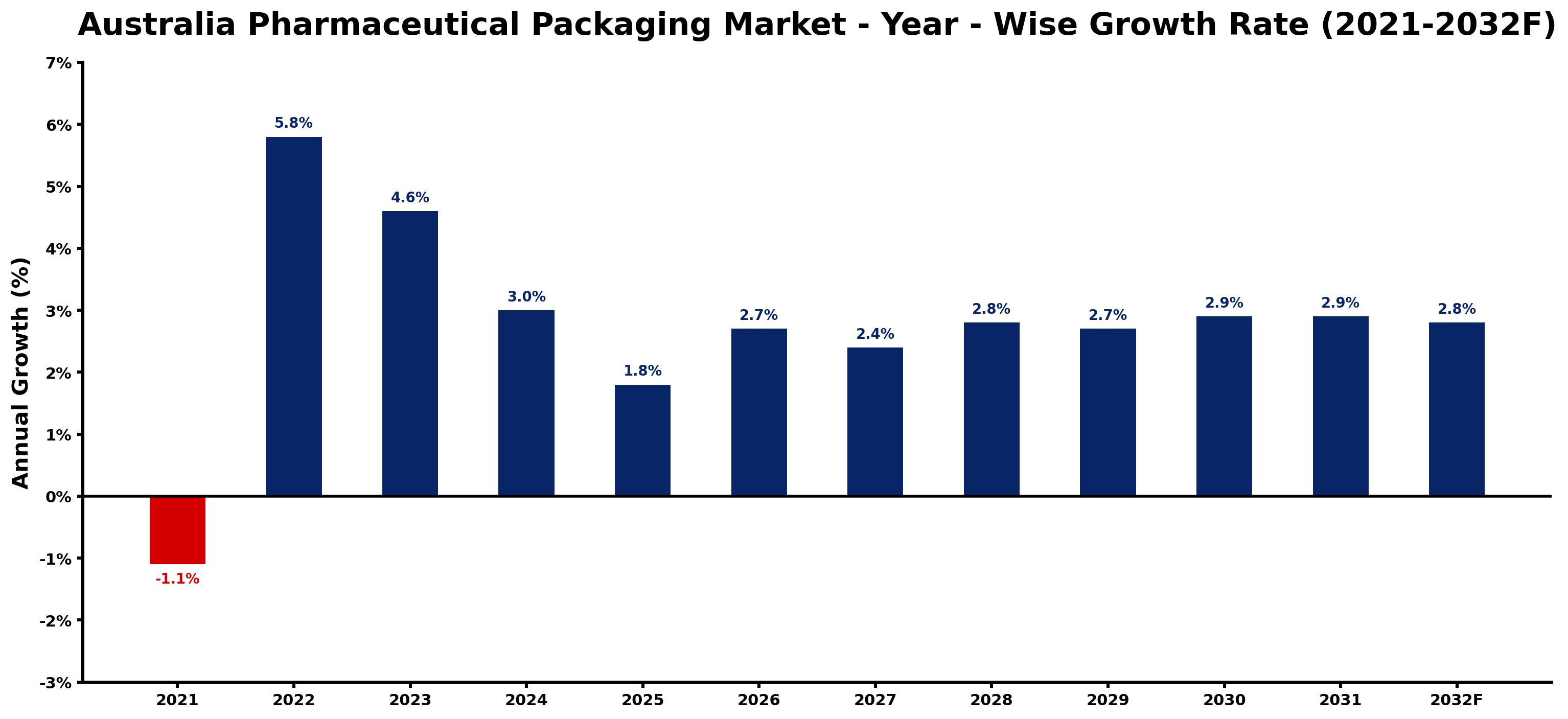
The table below presents the year wise growth rates along with the key drivers influencing the market
| Year | Growth Rate | Major Drivers |
| 2021 | -1.1% | Supply chain disruptions due to global shipping challenges hindered timely delivery and increased costs for pharmaceutical packaging. |
| 2022 | 5.8% | Increased focus on sustainability prompted a transition to eco-friendly packaging solutions. |
| 2023 | 4.6% | Technological innovations enhanced packaging safety and compliance, boosting market confidence. |
| 2024 | 3.0% | Online pharmacies gained traction, altering traditional packaging requirements and logistics. |
| 2025 | 1.8% | Investment in local manufacturing capabilities reduced dependency on foreign packaging suppliers. |
| 2026 | 2.7% | Regulatory frameworks began emphasizing traceability, impacting packaging design and materials. |
| 2027 | 2.4% | Consumer preferences shifted towards personalized medicine, necessitating diverse packaging formats. |
| 2028 | 2.8% | Collaborations among pharmaceutical companies and packaging firms improved operational efficiencies. |
| 2029 | 2.7% | International trade agreements influenced import/export dynamics of pharmaceutical packaging materials. |
| 2030 | 2.9% | Emerging technologies like blockchain enhanced supply chain transparency and packaging integrity. |
| 2031 | 2.9% | Aging demographics increased medication adherence, amplifying demand for user-friendly packaging. |
| 2032 | 2.8% | Market consolidation among packaging firms fostered innovation and competitive pricing strategies. |
Note - Market size estimations and growth projections presented in this report are based on 6Wresearch's advanced forecasting approach, validated with industry datasets as of June 2026.
Australia Pharmaceutical Packaging Market Synopsis
The Australia Pharmaceutical Packaging Market is projected to reach 2.7% and witness significant growth during the forecast period (2026-2032). This burgeoning market is primarily driven by the increasing demand for generic drugs and heightened healthcare spending within the region. The rising need for safety and convenience in pharmaceutical products has further invigorated the market's expansion. Additionally, the use of plastic packaging in drug delivery systems is becoming increasingly prevalent due to its lightweight, cost-effective, and easily customizable nature, which offers distinct advantages over traditional materials such as glass and metal. As a result, diverse types of plastic containers, including bottles, blister packs, and vials, are seeing a surge in demand, thereby bolstering the growth of the pharmaceutical packaging industry in Australia.
Australia Pharmaceutical Packaging Market Growth Drivers
Several factors are contributing to the growth of the Australia Pharmaceutical Packaging Market. Firstly, the increasing adoption of generic drugs is a significant driver, as these medications require efficient and secure packaging solutions. Secondly, the escalating healthcare expenditure is pushing healthcare providers and pharmaceutical companies to invest in enhanced packaging technologies that improve safety and compliance.
- The demand for convenience in drug delivery systems necessitates innovative packaging designs that cater to patients' needs.
- Plastic materials have become the preferred choice for manufacturers due to their favorable properties, such as durability and flexibility.
- Advanced printing technologies are facilitating better product differentiation, enabling brands to enhance their market presence through attractive packaging designs.
- Growing awareness of patient safety and adherence to strict regulations surrounding labeling and safety standards are driving manufacturers to invest in modernized technologies.
- The increasing number of contract manufacturing organizations contributes to the overall market growth, as these entities require efficient packaging solutions for various drugs.
Australia Pharmaceutical Packaging Market Trends and Opportunities
The Australia Pharmaceutical Packaging Market is witnessing several notable trends that present opportunities for various stakeholders. One significant trend is the move towards sustainable packaging solutions. As environmental concerns continue to rise, pharmaceutical companies are increasingly seeking biodegradable and recyclable materials.
- Integration of smart packaging technologies, such as QR codes and NFC-enabled packages, enhances traceability and supply chain transparency.
- Personalized medicine is driving the need for customized packaging solutions that cater to specific patient demographics and conditions.
- Digital transformation within the pharmaceutical sector is encouraging the adoption of automated packaging systems, reducing labor costs, and improving efficiency.
- The emphasis on child-resistant packaging designs is becoming more pronounced to ensure safety for vulnerable populations.
- Collaborative efforts between pharmaceutical companies and packaging manufacturers are leading to innovative solutions that address emerging market needs.
Australia Pharmaceutical Packaging Market Challenges and Restraints
Despite the growth prospects in the Australia Pharmaceutical Packaging Market, several challenges could impede progress. The stringent regulations imposed by government authorities necessitate adherence to high safety and quality standards, which can increase production costs for manufacturers.
- The volatility in raw material prices, particularly for plastics, can create supply chain disruptions and affect profitability.
- Competition among packaging manufacturers leads to pricing pressures, which can adversely impact margins.
- Maintaining compliance with evolving regulations requires ongoing investment in technology and processes.
- The rapid pace of technological advancements necessitates continuous innovation, which can be challenging for smaller manufacturers.
- Market saturation in certain segments may hinder growth opportunities and limit the potential for new entrants.
Australia Pharmaceutical Packaging Market Government Investment and Initiatives
The Australian government plays a crucial role in enhancing the pharmaceutical packaging landscape through various investments and initiatives. Financial incentives aimed at research and development are helping manufacturers innovate packaging solutions that meet safety and sustainability criteria. Furthermore, public spending on healthcare is fostering an environment conducive to growth in the pharmaceutical sector, directly impacting packaging requirements.
- Initiatives promoting the adoption of environmentally friendly packaging materials align with Australia's commitment to sustainability.
- Government-funded programs supporting the pharmaceutical industry help drive advancements in packaging technologies.
- Public health campaigns emphasize the importance of safety in drug delivery, influencing packaging regulations.
- Collaboration between government agencies and industry stakeholders is enhancing standards for packaging safety and efficiency.
- Support for training and development in packaging technologies ensures that the industry maintains a skilled workforce.
Australia Pharmaceutical Packaging Market Latest Developments (May 2025 - June 2026)
Recent developments in the Australia Pharmaceutical Packaging Market highlight a trend towards increased integration of technology within the packaging sector. There has been a marked interest in smart packaging solutions, with many companies exploring the use of IoT devices to improve product traceability and safety. Additionally, advancements in printing technologies have enabled brands to enhance their packaging designs, focusing on visual appeal and compliance with regulatory requirements. The rise in collaborations between pharmaceutical companies and packaging experts indicates a strategic approach towards addressing market needs and consumer preferences. Furthermore, as public health initiatives become more prominent, packaging solutions that prioritize user safety are gaining traction, influencing design and material selection across the industry.
Australia Pharmaceutical Packaging Market - Key Attractiveness of the Report
- 10 Years of Market Numbers
- Historical Data Starting from 2022 to 2025
- Base Year: 2025
- Forecast Data until 2032
- Key Performance Indicators Impacting the Market
- Major Upcoming Developments and Projects
Key Highlights of the Report:
- Australia Pharmaceutical Packaging Market Outlook
- Market Size of Australia Pharmaceutical Packaging Market, 2025
- Forecast of Australia Pharmaceutical Packaging Market, 2032F
- Historical Data and Forecast of Australia Pharmaceutical Packaging Revenues & Volume for the Period 2022-2032F
- Australia Pharmaceutical Packaging Market Trend Evolution
- Australia Pharmaceutical Packaging Market Drivers and Challenges
- Australia Pharmaceutical Packaging Price Trends
- Australia Pharmaceutical Packaging Porter's Five Forces
- Australia Pharmaceutical Packaging Industry Life Cycle
- Historical Data and Forecast of Australia Pharmaceutical Packaging Market Revenues & Volume By Material Types for the Period 2022-2032F
- Historical Data and Forecast of Australia Pharmaceutical Packaging Market Revenues & Volume By Plastics & Polymers for the Period 2022-2032F
- Historical Data and Forecast of Australia Pharmaceutical Packaging Market Revenues & Volume By Paper & Paperboard for the Period 2022-2032F
- Historical Data and Forecast of Australia Pharmaceutical Packaging Market Revenues & Volume By Glass for the Period 2022-2032F
- Historical Data and Forecast of Australia Pharmaceutical Packaging Market Revenues & Volume By Aluminum Foil for the Period 2022-2032F
- Historical Data and Forecast of Australia Pharmaceutical Packaging Market Revenues & Volume By Others for the Period 2022-2032F
- Historical Data and Forecast of Australia Pharmaceutical Packaging Market Revenues & Volume By Product Types for the Period 2022-2032F
- Historical Data and Forecast of Australia Pharmaceutical Packaging Market Revenues & Volume By Primary Pharmaceutical Packaging for the Period 2022-2032F
- Historical Data and Forecast of Australia Pharmaceutical Packaging Market Revenues & Volume By Secondary Pharmaceutical Packaging for the Period 2022-2032F
- Historical Data and Forecast of Australia Pharmaceutical Packaging Market Revenues & Volume By Tertiary Pharmaceutical Packaging for the Period 2022-2032F
- Historical Data and Forecast of Australia Pharmaceutical Packaging Market Revenues & Volume By End-users for the Period 2022-2032F
- Historical Data and Forecast of Australia Pharmaceutical Packaging Market Revenues & Volume By Pharmaceutical Manufacturing for the Period 2022-2032F
- Historical Data and Forecast of Australia Pharmaceutical Packaging Market Revenues & Volume By Retail Pharmacy for the Period 2022-2032F
- Historical Data and Forecast of Australia Pharmaceutical Packaging Market Revenues & Volume By Contract Packaging for the Period 2022-2032F
- Historical Data and Forecast of Australia Pharmaceutical Packaging Market Revenues & Volume By Institutional Pharmacy for the Period 2022-2032F
- Historical Data and Forecast of Australia Pharmaceutical Packaging Market Revenues & Volume By Others for the Period 2022-2032F
- Australia Pharmaceutical Packaging Import Export Trade Statistics
- Market Opportunity Assessment By Material Types
- Market Opportunity Assessment By Product Types
- Market Opportunity Assessment By End-users
- Australia Pharmaceutical Packaging Top Companies Market Share
- Australia Pharmaceutical Packaging Competitive Benchmarking By Technical and Operational Parameters
- Australia Pharmaceutical Packaging Company Profiles
- Australia Pharmaceutical Packaging Key Strategic Recommendations






































