Australia Photographic Film Processing Chemicals Market: Import Trend Analysis
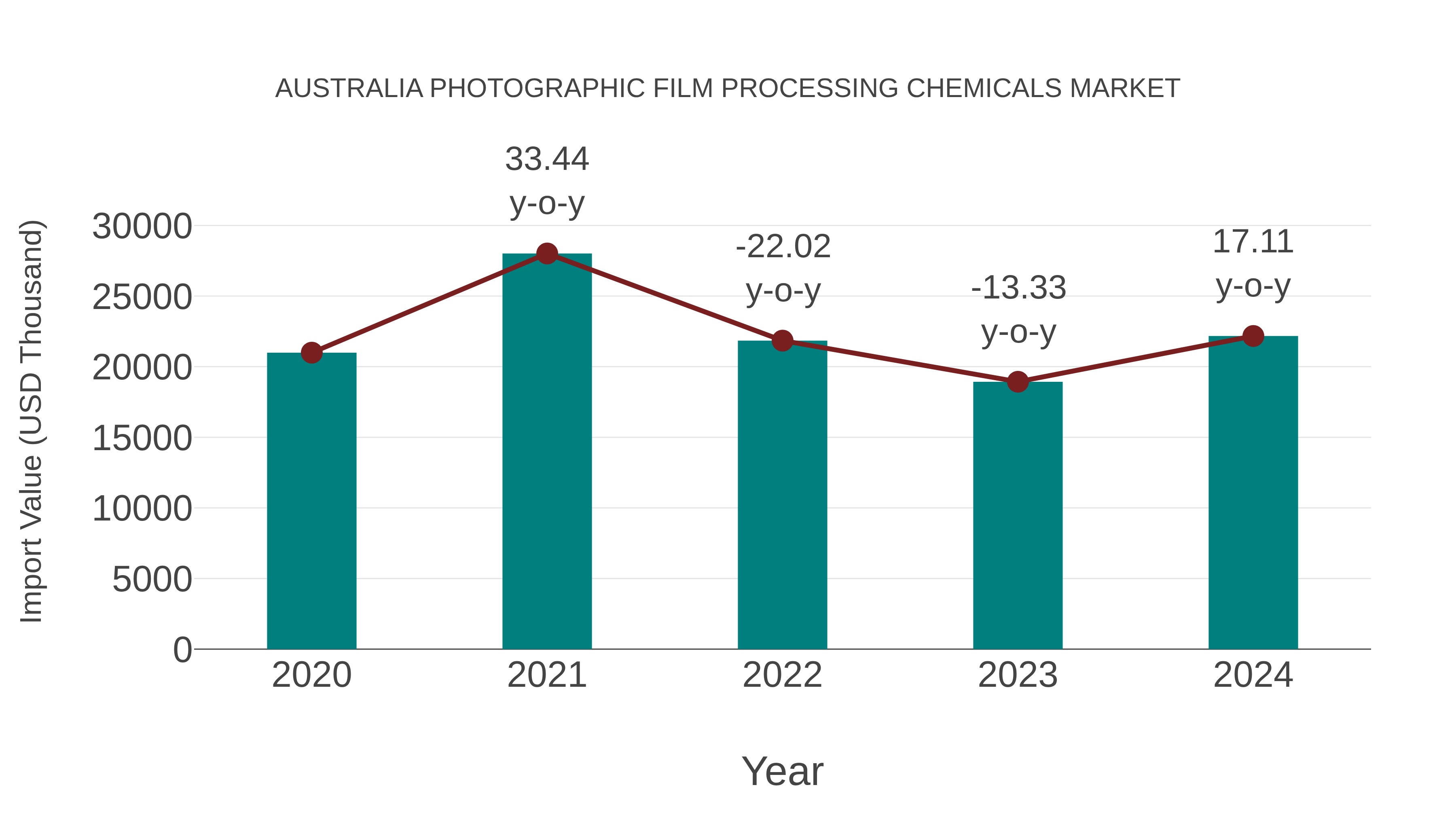
Australia`s import trend for photographic film processing chemicals experienced a notable growth rate of 17.11% from 2023 to 2024, with a compound annual growth rate (CAGR) of 1.38% from 2020 to 2024. This surge can be attributed to a shift in demand towards higher-quality processing chemicals, reflecting market stability and evolving consumer preferences in the industry.
Australia Photographic Film Processing Chemicals Market Highlights
| Report Name | Australia Photographic Film Processing Chemicals Market |
| Forecast period | 2025-2031 |
| CAGR | 6.8% |
| Growing Sector | Chemical |
Topics Covered in the Australia Photographic Film Processing Chemicals Market Report
The Australia Photographic Film Processing Chemicals market report thoroughly covers the market by function, by type and competitive Landscape. The report provides an unbiased and detailed analysis of the on-going market trends, opportunities/high growth areas, and market drivers which would help the stakeholders to devise and align their market strategies according to the current and future market dynamics.
Australia Photographic Film Processing Chemicals Market Synopsis
The Australia photographic film processing chemicals market has significant growth prospects influenced by several factors. While the advent of digital photography has led to a decline in traditional Australia Photographic Film Processing Chemical Market has accomplished major success and is projected to attain more in the coming years due to the iincreased demand for film photography, advancements in technology, and a growing focus on environmentally friendly options. The market is also going through certain challenges that can hamper its growth to a certain extent in the near future.
According to 6Wresearch, Australia Photographic Film Processing Chemicals market size is projected to grow at a CAGR of 6.8% during 2025-2031. One of the major drivers for the growth of the market is the growing awareness about environmental impact. As people become more conscious of their carbon footprint, there is a shift towards using traditional and eco-friendly methods of photography. This includes the use of photographic film processing chemicals that are less harmful to the environment. Despite the widespread use of digital cameras and smartphones, there has been high interest in analog photography among professionals. This has led to an increase in demand for film-processing chemicals.
However, despite growth and demand in the market, there are some challenges faced by the Australia Photographic Film Processing Chemical market that hinder the growth of the market. One of the main challenges is the rise of digital photography. With the advancement in technology and the widespread use of smartphones, people are now moving towards digital photography. This has resulted in a decline in demand for traditional film-processing chemicals. Another challenge is the increasing competition from international players. With the ease of global trade, it is now easier for international companies to enter the Australian market and offer competitive products at lower prices.
Government Initiatives Introduced in the Australia Photographic Film Processing Chemicals Market
The government has taken several initiatives to boost the Photographic Film Processing Chemical market in Australia. One of the initiatives is the Research and Development (R&D) Tax Incentive, to encourage companies to engage in research and development activities, including those in the photographic film processing chemical market. The Australian government has also taken steps to promote and support the use of sustainable and environmentally friendly practices in the photographic industry. The Australian Pesticides and Veterinary Medicines Authority (APVMA) is responsible for regulating the use of chemicals in various industries, including photography.
Key Players in the Australia Photographic Film Processing Chemicals Market
Some of the key players in the Australia Photographic Film Processing Chemical Market include names Fujifilm Holdings Corporation, Kodak Alaris, Dfouni Chemicals, Tetenal Australia Pty Ltd., and Ilford Imaging Europe GmbH. These key players in the Australia photographic film processing chemical market play an important role in providing high-quality and innovative products for the photography industry.
Future Insights of the Australia Photographic Film Processing Chemicals Market
The Australia Photographic Film Processing Chemical Market is witnessing significant growth in the future driven by the increased demand for film photography, advancements in technology, and a growing focus on environmentally friendly options. With the continued advancements in technology and growing consumer preferences, this market is expected to continue to thrive in the coming years. The government initiatives have played a significant role in supporting and promoting the growth of the photographic film processing chemical market in Australia.
Market Analysis by Type
According to Ravi Bhandari, Research Head, 6Wresearch, key products include Sodium Thiosulfate, commonly used as a fixer that makes the developed film image permanent. Sodium Hydroxide acts as a pH adjuster in some developer formulations. Water serves as the universal solvent in which all chemicals are dissolved. Acetic Acid is often used as a stop bath, halting the development process. Potassium Alum is employed in the fixing bath to harden the gelatin of the film and paper emulsions. Potassium Bromide is added to developer solutions as an anti-fogging agent to ensure clarity of images. Lastly, Sodium Sulfite acts as a preservative in many developer formulations, preventing oxidation and prolonging the life of the developing solution. Together, these products underpin the analog photography development process, each playing a crucial role in delivering high-quality photographic results.
Market Analysis by Function
The activator category has witnessed huge growth in the market. The growth is driven by the development of new and improved film processing chemicals has made the process more efficient and cost-effective, further driving the market growth.
Key Attractiveness of the Report
- 10 Years Market Numbers.
- Historical Data Starting from 2021 to 2024.
- Base Year: 2024.
- Forecast Data until 2031.
- Key Performance Indicators Impacting the Market.
- Major Upcoming Developments and Projects.
Key Highlights of the Report:
- Australia Photographic Film Processing Chemicals Market Overview
- Australia Photographic Film Processing Chemicals Market Outlook
- Market Size of Australia Photographic Film Processing Chemicals Market, 2025
- Forecast of Australia Photographic Film Processing Chemicals Market, 2032
- Historical Data and Forecast of Australia Photographic Film Processing Chemicals Revenues & Volume for the Period 2022-2032F
- Australia Photographic Film Processing Chemicals Market Trend Evolution
- Australia Photographic Film Processing Chemicals Market Drivers and Challenges
- Australia Photographic Film Processing Chemicals Price Trends
- Australia Photographic Film Processing Chemicals Porter's Five Forces
- Australia Photographic Film Processing Chemicals Industry Life Cycle
- Historical Data and Forecast of Australia Photographic Film Processing Chemicals Market Revenues & Volume By Function for the Period 2022-2032F
- Historical Data and Forecast of Australia Photographic Film Processing Chemicals Market Revenues & Volume By Development Agent for the Period 2022-2032F
- Historical Data and Forecast of Australia Photographic Film Processing Chemicals Market Revenues & Volume By Activator for the Period 2022-2032F
- Historical Data and Forecast of Australia Photographic Film Processing Chemicals Market Revenues & Volume By Preservative for the Period 2022-2032F
- Historical Data and Forecast of Australia Photographic Film Processing Chemicals Market Revenues & Volume By Restrainer for the Period 2022-2032F
- Historical Data and Forecast of Australia Photographic Film Processing Chemicals Market Revenues & Volume By Solvents for the Period 2022-2032F
- Historical Data and Forecast of Australia Photographic Film Processing Chemicals Market Revenues & Volume By Neutralizer for the Period 2022-2032F
- Historical Data and Forecast of Australia Photographic Film Processing Chemicals Market Revenues & Volume By Hardener for the Period 2022-2032F
- Historical Data and Forecast of Australia Development Agent Photographic Film Processing Chemicals Market Revenues & Volume By Buffer for the Period 2022-2032F
- Historical Data and Forecast of Australia Photographic Film Processing Chemicals Market Revenues & Volume By Type for the Period 2022-2032F
- Historical Data and Forecast of Australia Photographic Film Processing Chemicals Market Revenues & Volume By Sodium Thiosulfate for the Period 2022-2032F
- Historical Data and Forecast of Australia Photographic Film Processing Chemicals Market Revenues & Volume By Sodium Hydroxide for the Period 2022-2032F
- Historical Data and Forecast of Australia Photographic Film Processing Chemicals Market Revenues & Volume By Water for the Period 2022-2032F
- Historical Data and Forecast of Australia Photographic Film Processing Chemicals Market Revenues & Volume By Acetic Acid for the Period 2022-2032F
- Historical Data and Forecast of Australia Photographic Film Processing Chemicals Market Revenues & Volume By Potassium Alum for the Period 2022-2032F
- Historical Data and Forecast of Australia Photographic Film Processing Chemicals Market Revenues & Volume By Potassium Bromide for the Period 2022-2032F
- Historical Data and Forecast of Australia Photographic Film Processing Chemicals Market Revenues & Volume By Sodium Sulfite for the Period 2022-2032F
- Historical Data and Forecast of Australia Photographic Film Processing Chemicals Market Revenues & Volume By Other Chemicals for the Period 2022-2032F
- Australia Photographic Film Processing Chemicals Import Export Trade Statistics
- Market Opportunity Assessment By Function
- Market Opportunity Assessment By Type
- Australia Photographic Film Processing Chemicals Top Companies Market Share
- Australia Photographic Film Processing Chemicals Competitive Benchmarking, By Technical and Operational Parameters
- Australia Photographic Film Processing Chemicals Company Profiles
- Australia Photographic Film Processing Chemicals Key Strategic Recommendations
Markets Covered
The Australia Photographic Film Processing Chemicals market report provides a detailed analysis of the following market segments:
By Function
- Development Agent
- Activator
- Preservative
- Restrainer
- Solvents
- Neutralizer
- Hardenerr
- Buffer
By Type
- Sodium Thiosulfate
- Sodium Hydroxide
- Water
- Acetic Acid
- Potassium Alum
- Potassium Bromide
- Sodium Sulfite
- Other Chemicals






































