Australia Photosensitive Semiconductor Device Market Size, Share & Growth Rate
The Australia Photosensitive Semiconductor Device Market was estimated at USD 471 Million in 2025 and is projected to reach USD 626 Million by 2032, growing at a CAGR of 4.1% from 2026 to 2032. This growth trajectory is fueled by advancements in imaging technologies, as well as the increasing demand for imaging sensors across various sectors, including medical diagnostics and industrial automation. Moreover, the rising adoption of solar energy solutions is significantly contributing to the expansion of this dynamic market.
Australia Photosensitive Semiconductor Device Market Year-wise Growth Rate and Key Drivers
This graph highlights how the Australia Photosensitive Semiconductor Device Market has steadily grown over the years, supported by major growth factors.
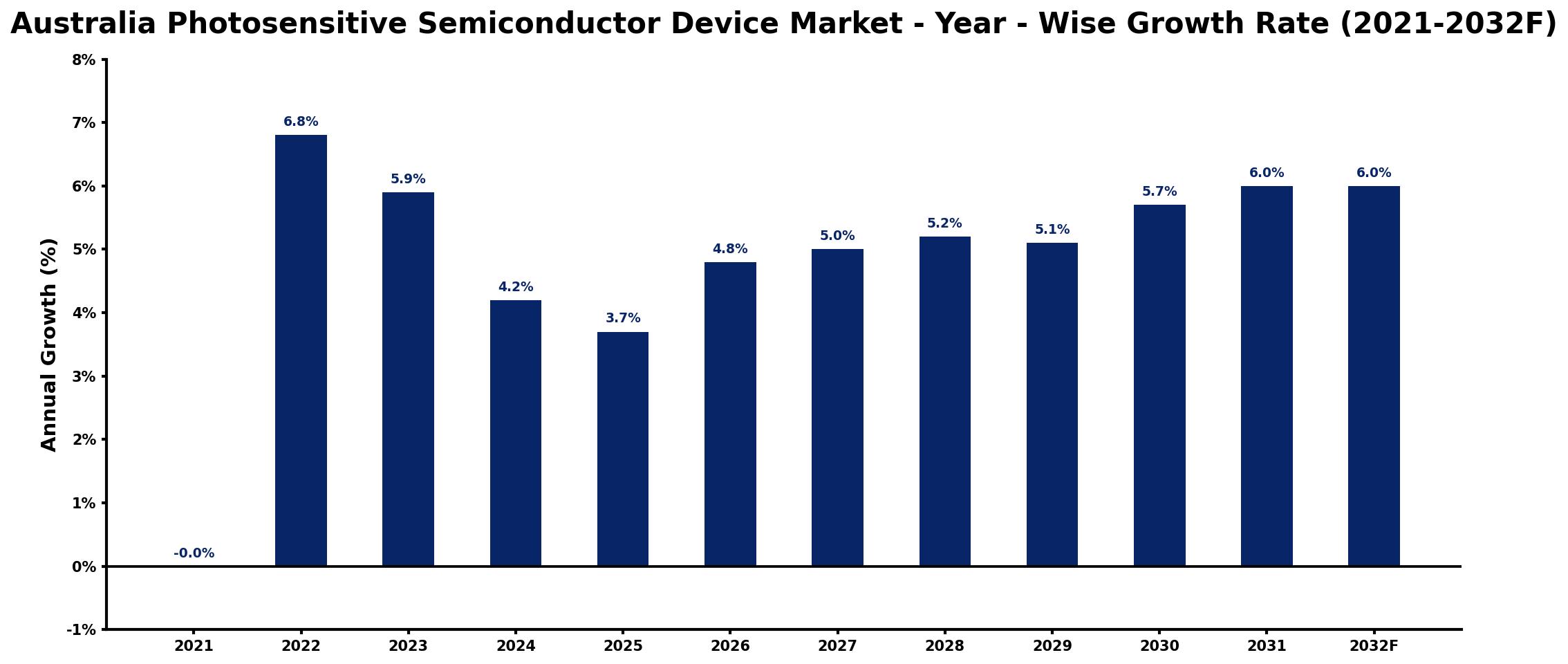
The table below presents the year‑wise growth rates along with the key drivers influencing the market
| Year | Growth Rate | Major Drivers |
| 2021 | -0.0% | Emerging market technology investments |
| 2022 | 6.8% | Increased renewable energy applications |
| 2023 | 5.9% | Growing demand for smart lighting |
| 2024 | 4.2% | Expansion of electric vehicle infrastructure |
| 2025 | 3.7% | Rising interest in energy efficiency |
| 2026 | 4.8% | Innovations in industrial automation |
| 2027 | 5.0% | Growth in consumer electronics sector |
| 2028 | 5.2% | Enhanced research funding initiatives |
| 2029 | 5.1% | Development of advanced imaging solutions |
| 2030 | 5.7% | Surge in telecommunications upgrades |
| 2031 | 6.0% | stronger distribution network expansion |
| 2032 | 6.0% | Increased adoption of IoT applications |
Note: Market size estimations and growth projections presented in this report are based on 6Wresearch's proprietary forecasting methodology, utilizing the latest available industry data, government publications, and primary research inputs.
Australia Photosensitive Semiconductor Device Market Synopsis
The demand for high-performance imaging sensors is surging in Australia, with applications spanning from security systems to advanced medical imaging equipment. As consumers and industries increasingly rely on cutting-edge technology, the need for photosensitive semiconductor devices is becoming more pronounced, leading to market growth.
Furthermore, innovations in low-light and high-speed sensor technologies are enhancing the capabilities of existing applications, thereby driving further investments in research and development. This progression underscores the importance of photosensitive semiconductors as critical components in various electronic systems.
Australia Photosensitive Semiconductor Device Market Key Takeaways
- The market is experiencing robust growth, driven by diverse applications in consumer electronics and medical diagnostics.
- Investments in solar energy solutions present significant opportunities for market players.
- Technological advancements in imaging sensors are enhancing performance across multiple sectors.
- Local companies face challenges from global competitors, requiring innovative approaches to capture market share.
- The Australian government actively supports the semiconductor industry through favorable policies and tariff amendments.
Evaluation of Restraints in Australia Photosensitive Semiconductor Device Market
Despite the promising growth trajectory, the Australia Photosensitive Semiconductor Device Market faces notable restraints. High research and development costs act as a significant barrier, limiting the ability of local firms to innovate and compete effectively. Moreover, the presence of dominant global semiconductor manufacturers poses challenges for Australian companies striving to establish a foothold in the market. As technology advances rapidly, continuous innovation becomes essential, making it crucial for local entities to invest wisely in emerging trends and technologies.
Australia Photosensitive Semiconductor Device Market Trends
Emerging trends in the Australia Photosensitive Semiconductor Device Market are shaping the landscape significantly. For instance, the integration of artificial intelligence with imaging technologies is paving the way for smarter sensor applications across various industries. Additionally, the growing emphasis on sustainability has sparked increased investment in photovoltaic applications, further reinforcing the relevance of photosensitive semiconductors in renewable energy sectors. As automation and smart technologies evolve, the demand for advanced imaging sensors is expected to rise, fostering continued innovation and development in this space.
Australia Photosensitive Semiconductor Device Market Opportunities
Investment opportunities abound within the Australia Photosensitive Semiconductor Device Market, particularly in sectors such as solar energy, medical imaging, and cutting-edge sensor technologies. The development of enhanced photodetectors and CMOS image sensors is projected to drive growth in the electronics sector, while the renewable energy industry stands to benefit from advancements in photovoltaic applications. As companies explore these avenues, the potential for lucrative returns on investment continues to attract interest from stakeholders seeking to capitalize on the market's expansion.
Government Initiatives in the Australia Photosensitive Semiconductor Device Market
The Australian government recognizes the importance of photosensitive semiconductor devices as essential components in modern electronics. To bolster the semiconductor industry, initiatives have been introduced to ensure local manufacturers have access to vital materials necessary for production. Recent customs tariff amendments facilitate the duty-free importation of critical items used in semiconductor manufacturing, thereby supporting local companies in enhancing their production capabilities and competitiveness.
Future Insights of the Australia Photosensitive Semiconductor Device Market
Looking ahead to the period from 2026 to 2032, the Australia Photosensitive Semiconductor Device Market is poised for a transformative phase. Innovations in imaging technologies, coupled with heightened demand across various applications, will drive substantial growth. As the industry adapts to new trends such as AI integration and sustainability initiatives, market participants must remain agile and responsive. This forward momentum, coupled with supportive government policies, positions Australia as a key player in the global semiconductor landscape.
Australia Photosensitive Semiconductor Device Market Latest Developments (2025 - 2026)
Recent industry developments indicate a shift towards increased collaboration among research institutions and private sector companies, focusing on advancing photosensitive technologies. Efforts to integrate artificial intelligence into imaging systems are gaining traction, with pilot projects being initiated across various sectors. Furthermore, there is a notable increase in investments targeting the development of high-performance sensors, particularly for medical applications. These trends are reflective of a broader commitment to innovation within the Australian photosensitive semiconductor landscape.
Australia Photosensitive Semiconductor Device Market - Key Attractiveness of the Report
- 10 Years of Market Numbers
- Historical Data Starting from 2022 to 2025
- Base Year: 2025
- Forecast Data until 2032
- Key Performance Indicators Impacting the Market
- Major Upcoming Developments and Projects
Key Highlights of the Report:
- Australia Photosensitive Semiconductor Device Market Outlook
- Market Size of Australia Photosensitive Semiconductor Device Market, 2025
- Forecast of Australia Photosensitive Semiconductor Device Market, 2032
- Historical Data and Forecast of Australia Photosensitive Semiconductor Device Revenues & Volume for the Period 2022-2032F
- Australia Photosensitive Semiconductor Device Market Trend Evolution
- Australia Photosensitive Semiconductor Device Market Drivers and Challenges
- Australia Photosensitive Semiconductor Device Price Trends
- Australia Photosensitive Semiconductor Device Porter's Five Forces
- Australia Photosensitive Semiconductor Device Industry Life Cycle
- Historical Data and Forecast of Australia Photosensitive Semiconductor Device Market Revenues & Volume By Device for the Period 2022-2032F
- Historical Data and Forecast of Australia Photosensitive Semiconductor Device Market Revenues & Volume By Photocell for the Period 2022-2032F
- Historical Data and Forecast of Australia Photosensitive Semiconductor Device Market Revenues & Volume By Photodiode for the Period 2022-2032F
- Historical Data and Forecast of Australia Photosensitive Semiconductor Device Market Revenues & Volume By Phototransistor for the Period 2022-2032F
- Historical Data and Forecast of Australia Photosensitive Semiconductor Device Market Revenues & Volume By Photoresistor for the Period 2022-2032F
- Historical Data and Forecast of Australia Photosensitive Semiconductor Device Market Revenues & Volume By Photo IC for the Period 2022-2032F
- Historical Data and Forecast of Australia Photosensitive Semiconductor Device Market Revenues & Volume By End User for the Period 2022-2032F
- Historical Data and Forecast of Australia Photosensitive Semiconductor Device Market Revenues & Volume By Automotive and Transportation for the Period 2022-2032F
- Historical Data and Forecast of Australia Photosensitive Semiconductor Device Market Revenues & Volume By Consumer Electronics for the Period 2022-2032F
- Historical Data and Forecast of Australia Photosensitive Semiconductor Device Market Revenues & Volume By Aerospace and Defence for the Period 2022-2032F
- Historical Data and Forecast of Australia Photosensitive Semiconductor Device Market Revenues & Volume By Healthcare for the Period 2022-2032F
- Historical Data and Forecast of Australia Photosensitive Semiconductor Device Market Revenues & Volume By Industrial for the Period 2022-2032F
- Historical Data and Forecast of Australia Photosensitive Semiconductor Device Market Revenues & Volume By Security and Survelliance for the Period 2022-2032F
- Australia Photosensitive Semiconductor Device Import Export Trade Statistics
- Market Opportunity Assessment By Device
- Market Opportunity Assessment By End User
- Australia Photosensitive Semiconductor Device Top Companies Market Share
- Australia Photosensitive Semiconductor Device Competitive Benchmarking By Technical and Operational Parameters
- Australia Photosensitive Semiconductor Device Company Profiles
- Australia Photosensitive Semiconductor Device Key Strategic Recommendations






































