Australia Planting Equipment Market Size, Share & Growth Rate
The Australia Planting Equipment Market was estimated at USD 151 Million in 2025 and is projected to reach USD 177 Million by 2032, growing at a CAGR of 2.3% from 2026 to 2032. This positive growth trajectory is propelled by a significant shift towards precision farming technologies, which offer farmers the means to optimize planting processes and enhance crop yields. The integration of automated systems and GPS-guided planting solutions further supports the rising efficiency demands in the agricultural sector.
Australia Planting Equipment Market Year-wise Growth Rate and Key Drivers
This graph highlights how the Australia Planting Equipment Market has steadily grown over the years, supported by major growth factors.
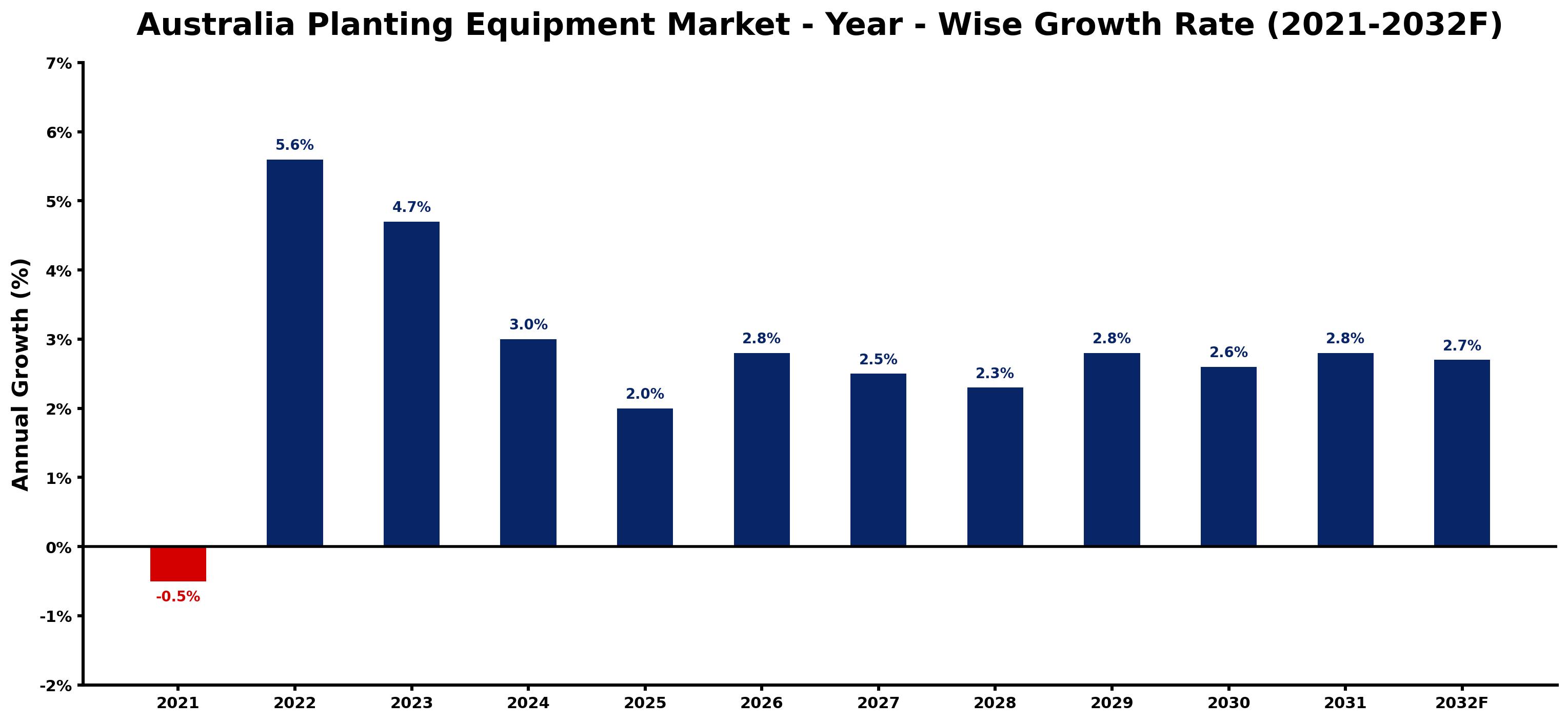
The table below presents the year‑wise growth rates along with the key drivers influencing the market
| Year | Growth Rate | Major Drivers |
| 2021 | -0.5% | Rapid growth in telecom and data center sectors |
| 2022 | 5.6% | Growing renewable energy integration projects |
| 2023 | 4.7% | Growing urbanization and commercial development |
| 2024 | 3.0% | Growing renewable energy integration projects |
| 2025 | 2.0% | Increasing smart city development projects |
| 2026 | 2.8% | Rising electricity demand across industries |
| 2027 | 2.5% | Expansion of transportation and logistics networks |
| 2028 | 2.3% | Rapid growth in telecom and data center sectors |
| 2029 | 2.8% | Rising electricity demand across industries |
| 2030 | 2.6% | Government infrastructure modernization initiatives |
| 2031 | 2.8% | Government infrastructure modernization initiatives |
| 2032 | 2.7% | Growing renewable energy integration projects |
Note - Market size estimations and growth projections presented in this report are based on 6Wresearch's advanced forecasting approach, validated with industry datasets as of June 2026.
Australia Planting Equipment Market Synopsis
A noticeable trend within the Australia Planting Equipment Market is the increasing investment in high-tech machinery by farmers seeking to maximize their productivity. With soil health and crop yields becoming more paramount, advanced planting equipment is seen as essential to achieving these goals. This shift is particularly evident among larger agricultural enterprises that are equipped to absorb the costs of cutting-edge technologies.
Moreover, the Australian government actively promotes farm mechanization, which translates into an uptick in demand for innovative planting solutions. This initiative reflects a broader commitment to improve agricultural performance and sustainability across the country, ensuring farmers are equipped with modern tools to meet today's challenges.
Australia Planting Equipment Market Key Takeaways
- Significant growth is driven by advancements in precision farming technology.
- Automated and GPS-enabled planting machines are becoming a staple in modern agriculture.
- Government incentives play a crucial role in promoting farm mechanization.
- High initial costs remain a barrier for smaller farming operations.
- Investment opportunities exist in smart planting machinery and automated systems.
Evaluation of Restraints in Australia Planting Equipment Market
Despite its growth potential, the Australia Planting Equipment Market faces several restraints that hinder its overall expansion. The initial investment required for advanced planting machinery can be prohibitive, particularly for small to medium-sized farmers. This financial barrier is exacerbated by the rapid pace of technological advancement, which can render new equipment obsolete quickly. Additionally, farmers often contend with seasonal fluctuations in agricultural output, which directly impacts their purchasing capacity and willingness to invest in new machinery.
Australia Planting Equipment Market Trends
Current trends in the Australia Planting Equipment Market highlight a growing inclination towards sustainability and eco-friendly practices. Farmers are increasingly prioritizing planting equipment that minimizes soil disruption and promotes biodiversity. Additionally, the rise of data analytics in agriculture is paving the way for smarter planting solutions that leverage real-time data to optimize planting decisions and enhance operational efficiency. This focus on sustainability, combined with technological innovation, is shaping the future landscape of planting operations in Australia.
Australia Planting Equipment Market Opportunities
The Australia Planting Equipment Market presents several promising investment opportunities, particularly in the development and adoption of smart planting technology. As farmers aim to improve yields while managing costs, demand for innovative automated seeding systems is likely to increase. Furthermore, the move towards precision agriculture offers fertile ground for investors interested in technology that aids in minimizing resource wastage and maximizing output efficiency. These opportunities are not just lucrative but are also aligned with the broader agricultural trends towards sustainability and efficiency.
Government Initiatives in the Australia Planting Equipment Market
The Australian government actively encourages the mechanization of agriculture through various policies and initiatives designed to support farmers. By offering subsidies for the purchase of advanced planting equipment, the government aims to reduce the financial burden on farmers while promoting modern agricultural practices. Additionally, agricultural machinery policies ensure that farming equipment meets stringent performance and safety standards, further facilitating a reliable and innovative market landscape for planting equipment.
Future Insights of the Australia Planting Equipment Market
Looking ahead, the Australia Planting Equipment Market is poised for substantial evolution from 2026 to 2032. As technology continues to advance, we expect to see a greater prevalence of smart machinery that integrates artificial intelligence and machine learning capabilities. These innovations will likely enhance the precision and efficiency of planting operations, making farming more sustainable and productive. Moreover, as government support for farm mechanization continues, the market may witness increased participation from small to medium-sized farms seeking to modernize their practices.
Australia Planting Equipment Market Latest Developments (May 2025 - June 2026)
In recent months, the Australia Planting Equipment Market has experienced a shift towards more integrated systems that combine planting with data analytics. Manufacturers are focusing on developing equipment that not only plants seeds but also gathers data on soil conditions and crop performance. This trend is expected to enhance farm management capabilities and drive efficiency gains. Additionally, various regional agricultural expos and trade shows have showcased innovative planting technologies, indicating a strong interest from the farming community in adopting new solutions.
Australia Planting Equipment Market - Key Attractiveness of the Report
- 10 Years of Market Numbers
- Historical Data Starting from 2022 to 2025
- Base Year: 2025
- Forecast Data until 2032
- Key Performance Indicators Impacting the Market
- Major Upcoming Developments and Projects
Key Highlights of the Report:
- Australia Planting Equipment Market Outlook
- Market Size of Australia Planting Equipment Market, 2025
- Forecast of Australia Planting Equipment Market, 2032
- Historical Data and Forecast of Australia Planting Equipment Revenues & Volume for the Period 2022-2032F
- Australia Planting Equipment Market Trend Evolution
- Australia Planting Equipment Market Drivers and Challenges
- Australia Planting Equipment Price Trends
- Australia Planting Equipment Porter's Five Forces
- Australia Planting Equipment Industry Life Cycle
- Historical Data and Forecast of Australia Planting Equipment Market Revenues & Volume By Type for the Period 2022-2032F
- Historical Data and Forecast of Australia Planting Equipment Market Revenues & Volume By Air seeders for the Period 2022-2032F
- Historical Data and Forecast of Australia Planting Equipment Market Revenues & Volume By Seed drills for the Period 2022-2032F
- Historical Data and Forecast of Australia Planting Equipment Market Revenues & Volume By Planters for the Period 2022-2032F
- Historical Data and Forecast of Australia Planting Equipment Market Revenues & Volume By Others for the Period 2022-2032F
- Historical Data and Forecast of Australia Planting Equipment Market Revenues & Volume By Design for the Period 2022-2032F
- Historical Data and Forecast of Australia Planting Equipment Market Revenues & Volume By Mechanical for the Period 2022-2032F
- Historical Data and Forecast of Australia Planting Equipment Market Revenues & Volume By Automatic for the Period 2022-2032F
- Historical Data and Forecast of Australia Planting Equipment Market Revenues & Volume By Crop Type for the Period 2022-2032F
- Historical Data and Forecast of Australia Planting Equipment Market Revenues & Volume By Cereals & grains for the Period 2022-2032F
- Historical Data and Forecast of Australia Planting Equipment Market Revenues & Volume By Oilseeds & pulses for the Period 2022-2032F
- Historical Data and Forecast of Australia Planting Equipment Market Revenues & Volume By Fruits & vegetables for the Period 2022-2032F
- Historical Data and Forecast of Australia Planting Equipment Market Revenues & Volume By Others for the Period 2022-2032F
- Australia Planting Equipment Import Export Trade Statistics
- Market Opportunity Assessment By Type
- Market Opportunity Assessment By Design
- Market Opportunity Assessment By Crop Type
- Australia Planting Equipment Top Companies Market Share
- Australia Planting Equipment Competitive Benchmarking By Technical and Operational Parameters
- Australia Planting Equipment Company Profiles
- Australia Planting Equipment Key Strategic Recommendations






































