Australia Platform as a Service (PaaS) Market Size & Growth Rate (2026-2032)
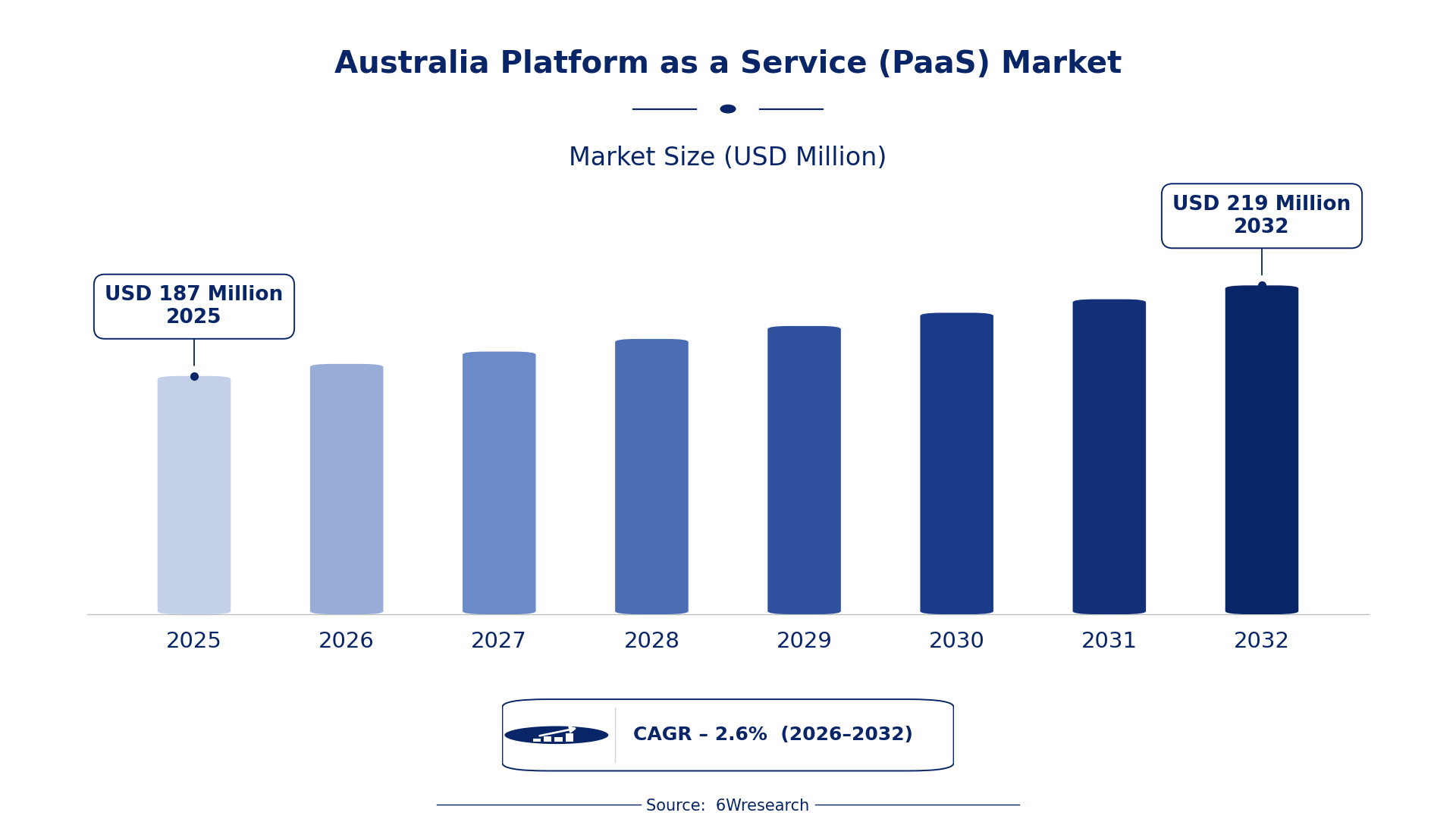
The Australia Platform as a Service (PaaS) Market was estimated at USD 187 Million in 2025 and is projected to reach USD 219 Million by 2032, growing at a CAGR of 2.6% from 2026 to 2032.
Australia Platform as a Service (PaaS) Market Synopsis
Australia's PaaS market is currently experiencing substantial growth, driven by an increasing demand for cloud-based application development. Businesses are increasingly adopting AI-powered solutions that enhance scalability and streamline development processes, positioning PaaS as a critical component of modern IT strategies.
The shift towards containerization and advanced analytics is also fueling market expansion. Organizations are focused on improving developer productivity and accelerating time-to-market for software applications, making PaaS a strategic choice for a wide range of industries.
Australia Platform as a Service (PaaS) Market Year-wise Growth Rate and Key Drivers
This graph illustrates the annual growth rates of the Australia Platform as a Service (PaaS) Market from 2021 to 2032, highlighting a steady upward trajectory and projected expansion over the forecast period.
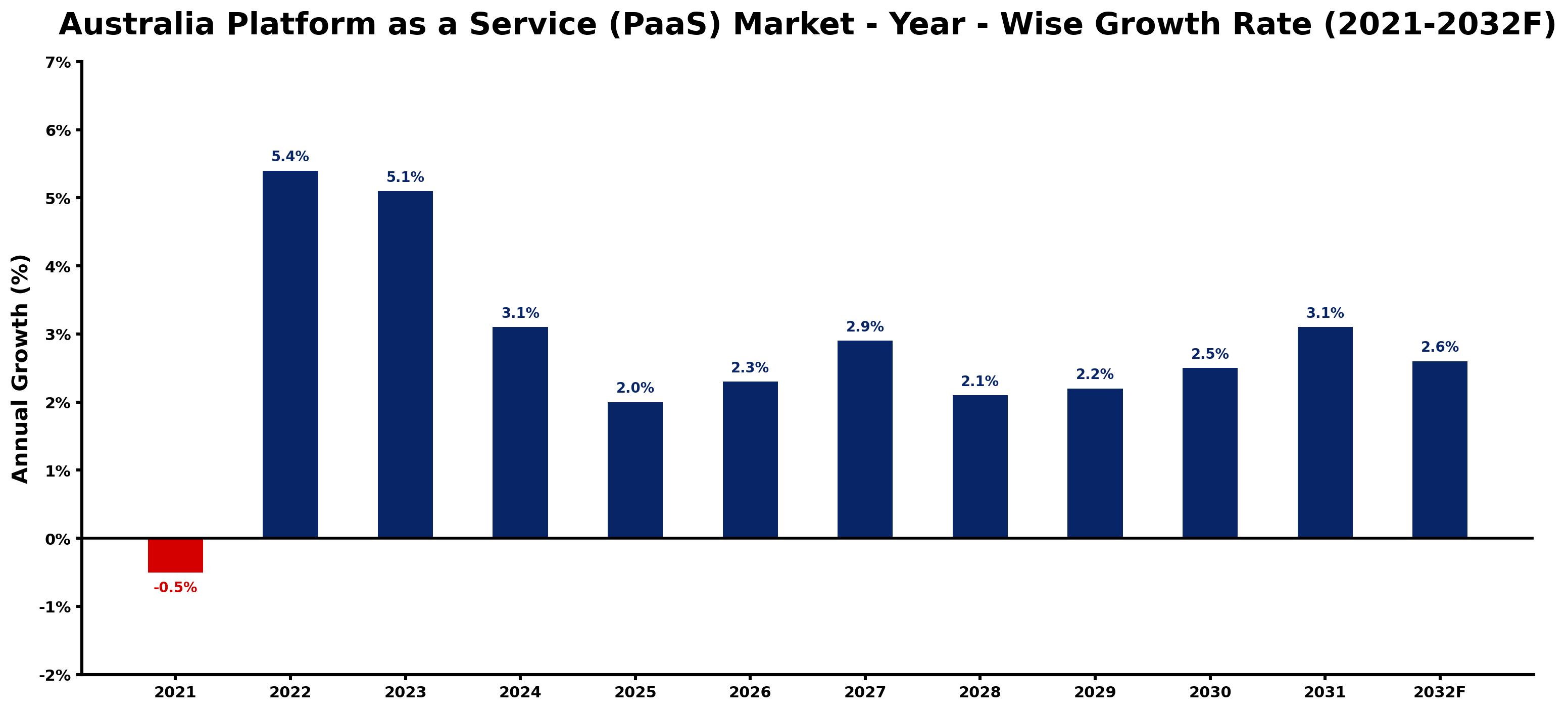
The table below presents the year‑wise growth rates along with the key drivers influencing the market
| Year | Growth Rate | Major Drivers |
| 2021 | -0.5% | AUS government tightened data sovereignty regulations impacting PaaS adoption. |
| 2022 | 5.4% | Australian government promoting cloud adoption through digital economy initiatives |
| 2023 | 5.1% | Increased demand for remote work solutions from local enterprises |
| 2024 | 3.1% | Growing startup ecosystem in Sydney boosting PaaS adoption |
| 2025 | 2.0% | Enhanced data privacy laws driving secure cloud service usage |
| 2026 | 2.3% | Investment in AI by Australian firms increasing developer activity |
| 2027 | 2.9% | Rising focus on sustainability encouraging cloud efficiency practices |
| 2028 | 2.1% | Local education institutions adopting PaaS for technology training |
| 2029 | 2.2% | Increase in software development projects utilizing local PaaS solutions |
| 2030 | 2.5% | Government funding for tech innovation fostering PaaS growth |
| 2031 | 3.1% | Greater collaboration among tech hubs enhancing cloud service development |
| 2032 | 2.6% | Local enterprises seeking cost-effective solutions driving PaaS demand |
Note: Market size estimations and growth projections presented in this report are based on 6Wresearch's proprietary forecasting methodology, utilizing the latest available industry data, government publications, and primary research inputs.
Australia Platform as a Service (PaaS) Market Key Takeaways
Below are some of the specific key takeaways from the market, including:
- Increasing adoption of AI-driven PaaS solutions is enhancing scalability and efficiency in software development.
- Containerization trends are improving application deployment speed and performance.
- Focus on reducing time-to-market is pushing businesses to integrate PaaS solutions into their IT infrastructure.
- High costs of platform deployment pose challenges for small to medium-sized enterprises.
- Investment opportunities exist in sectors like healthcare and finance, driven by the demand for cloud-based services.
Evaluation of Restraints in Australia Platform as a Service (PaaS) Market
Despite its growth trajectory, the Australia PaaS market faces notable restraints that can impede its potential. High deployment costs deter many businesses from fully integrating PaaS solutions, especially small and medium-sized enterprises with limited budgets. on top of that, the complexity of managing multi-tenant environments can lead to operational challenges, making it difficult for organizations to effectively utilize PaaS offerings. Compounding these issues is the ongoing shortage of skilled developers, which limits the capability of companies to leverage PaaS solutions to their fullest extent.
Australia Platform as a Service (PaaS) Market Trends
Several key trends are shaping the Australia PaaS market. The rise of AI and machine learning is particularly noteworthy, as businesses seek to incorporate intelligent analytics into their applications. This trend is complemented by the growth of microservices architecture, which allows for more agile software development and deployment. on top of that, organizations are increasingly prioritizing security and compliance, spurred by regulatory requirements and the need to protect sensitive data. This focus is leading to the development of more secure PaaS solutions tailored to meet stringent compliance standards.
Australia Platform as a Service (PaaS) Market Opportunities
The PaaS market in Australia presents multiple opportunities for growth and investment. With businesses seeking to modernize their applications and infrastructure, the demand for AI-based PaaS solutions is on the rise. Opportunities exist to enhance real-time scalability, particularly for industries such as healthcare, finance, and manufacturing, which require robust cloud solutions to handle dynamic workloads. Additionally, as organizations strive to improve their DevOps practices, there is a strong demand for platforms that can facilitate better collaboration between development and operations teams.
Government Initiatives in the Australia Platform as a Service (PaaS) Market
Government policies are increasingly shaping the Australia Platform as a Service (PaaS) Market, reflecting a commitment to secure and efficient digital infrastructure. Regulatory frameworks, such as the Privacy Act 1988 and the Australian Cyber Security Strategy, mandate that PaaS providers adhere to strict data protection guidelines. These policies not only ensure consumer data security but also influence the direction of market innovation and service delivery.
- A regulatory framework introduced in 2025 mandates that PaaS providers secure application data and disclose data sharing practices.
- A national digital infrastructure upgrade programme is currently underway, aimed at enhancing cloud service accessibility across various sectors.
- The government is working on a public-private initiative expected to expand cybersecurity measures for cloud services by 2027.
- Ongoing workshops and training programmes are being implemented to address the shortage of skilled developers in the PaaS sector.
Future Insights of the Australia Platform as a Service (PaaS) Market
Looking ahead to 2026-2032, the Australia PaaS market is expected to evolve significantly. The integration of advanced AI capabilities will likely drive further innovation, enabling businesses to develop applications that are not only more efficient but also smarter. As companies increasingly embrace digital transformation, the demand for scalable, secure, and cost-effective PaaS solutions will continue to rise. Organizations that can adapt to these changes and invest in the right technologies will be well-positioned to thrive in this competitive environment.
Australia Platform as a Service (PaaS) Market Latest Developments
Recent developments in the Australia Platform as a Service (PaaS) Market indicate a strong shift towards innovation and enhanced service delivery. Over the past year, various initiatives have been launched to address the needs of businesses seeking cloud-based solutions. The focus has been on improving scalability, security, and integration capabilities.
- A major technology vendor launched a new AI-driven PaaS solution in Q2 2025, aimed at enhancing application performance for enterprises.
- An initiative that began in late 2024 to provide training for developers is currently ongoing, with the goal of addressing skill gaps in the market.
- A partnership between local authorities and tech firms to improve cybersecurity measures for cloud services is expected to roll out by early 2026.
- A new PaaS platform with enhanced real-time analytics capabilities was launched in Q3 2025, attracting interest from various sectors.
Australia Platform as a Service (PaaS) Market - Key Attractiveness of the Report
- 10 Years of Market Numbers
- Historical Data Starting from 2022 to 2025
- Base Year: 2025
- Forecast Data until 2032
- Key Performance Indicators Impacting the Market
- Major Upcoming Developments and Projects
Key Highlights of the Report:
- Australia Platform as a Service (PaaS) Market Outlook
- Market Size of Australia Platform as a Service (PaaS) Market, 2025
- Forecast of Australia Platform as a Service (PaaS) Market, 2032
- Historical Data and Forecast of Australia Platform as a Service (PaaS) Revenues & Volume for the Period 2022-2032F
- Australia Platform as a Service (PaaS) Market Trend Evolution
- Australia Platform as a Service (PaaS) Market Drivers and Challenges
- Australia Platform as a Service (PaaS) Price Trends
- Australia Platform as a Service (PaaS) Porter's Five Forces
- Australia Platform as a Service (PaaS) Industry Life Cycle
- Historical Data and Forecast of Australia Platform as a Service (PaaS) Market Revenues & Volume By Type for the Period 2022-2032F
- Historical Data and Forecast of Australia Platform as a Service (PaaS) Market Revenues & Volume By Application PaaS (aPaaS) for the Period 2022-2032F
- Historical Data and Forecast of Australia Platform as a Service (PaaS) Market Revenues & Volume By Integration PaaS (iPaaS) for the Period 2022-2032F
- Historical Data and Forecast of Australia Platform as a Service (PaaS) Market Revenues & Volume By Database PaaS (dbPaaS) for the Period 2022-2032F
- Historical Data and Forecast of Australia Platform as a Service (PaaS) Market Revenues & Volume By Others for the Period 2022-2032F
- Historical Data and Forecast of Australia Platform as a Service (PaaS) Market Revenues & Volume By Deployment for the Period 2022-2032F
- Historical Data and Forecast of Australia Platform as a Service (PaaS) Market Revenues & Volume By Public for the Period 2022-2032F
- Historical Data and Forecast of Australia Platform as a Service (PaaS) Market Revenues & Volume By Private for the Period 2022-2032F
- Historical Data and Forecast of Australia Platform as a Service (PaaS) Market Revenues & Volume By Market Type for the Period 2022-2032F
- Historical Data and Forecast of Australia Platform as a Service (PaaS) Market Revenues & Volume By APaaS for the Period 2022-2032F
- Historical Data and Forecast of Australia Platform as a Service (PaaS) Market Revenues & Volume By IPaaS for the Period 2022-2032F
- Historical Data and Forecast of Australia Platform as a Service (PaaS) Market Revenues & Volume By DBPaaS for the Period 2022-2032F
- Historical Data and Forecast of Australia Platform as a Service (PaaS) Market Revenues & Volume By Organization Size for the Period 2022-2032F
- Historical Data and Forecast of Australia Platform as a Service (PaaS) Market Revenues & Volume By Large Enterprises for the Period 2022-2032F
- Historical Data and Forecast of Australia Platform as a Service (PaaS) Market Revenues & Volume By SMEs for the Period 2022-2032F
- Historical Data and Forecast of Australia Platform as a Service (PaaS) Market Revenues & Volume By Vertical for the Period 2022-2032F
- Historical Data and Forecast of Australia Platform as a Service (PaaS) Market Revenues & Volume By BFSI for the Period 2022-2032F
- Historical Data and Forecast of Australia Platform as a Service (PaaS) Market Revenues & Volume By Consumer goods and retail for the Period 2022-2032F
- Historical Data and Forecast of Australia Platform as a Service (PaaS) Market Revenues & Volume By Telecommunication for the Period 2022-2032F
- Historical Data and Forecast of Australia Platform as a Service (PaaS) Market Revenues & Volume By IT and ITeS for the Period 2022-2032F
- Historical Data and Forecast of Australia Platform as a Service (PaaS) Market Revenues & Volume By Manufacturing for the Period 2022-2032F
- Historical Data and Forecast of Australia Platform as a Service (PaaS) Market Revenues & Volume By Healthcare and life sciences for the Period 2022-2032F
- Historical Data and Forecast of Australia Platform as a Service (PaaS) Market Revenues & Volume By Energy and utility for the Period 2022-2032F
- Historical Data and Forecast of Australia Platform as a Service (PaaS) Market Revenues & Volume By Others for the Period 2022-2032F
- Australia Platform as a Service (PaaS) Import Export Trade Statistics
- Market Opportunity Assessment By Type
- Market Opportunity Assessment By Deployment
- Market Opportunity Assessment By Market Type
- Market Opportunity Assessment By Organization Size
- Market Opportunity Assessment By Vertical
- Australia Platform as a Service (PaaS) Top Companies Market Share
- Australia Platform as a Service (PaaS) Competitive Benchmarking By Technical and Operational Parameters
- Australia Platform as a Service (PaaS) Company Profiles
- Australia Platform as a Service (PaaS) Key Strategic Recommendations






































