Australia Point Of Sale Terminals Market Size, Share & Growth Rate
The Australia Point Of Sale Terminals Market was estimated at USD 160 Million in 2025 and is projected to reach USD 187 Million by 2032, growing at a CAGR of 2.3% from 2026 to 2032. The trajectory of this market is largely driven by the increasing preference for cashless transactions across various sectors, particularly retail and hospitality. The surge in mobile POS systems and the advent of cloud-based payment solutions are further propelling the demand for innovative and secure payment technologies.
Australia Point Of Sale Terminals Market Year-wise Growth Rate and Key Drivers
This graph highlights how the Australia Point Of Sale Terminals Market has steadily grown over the years, supported by major growth factors.
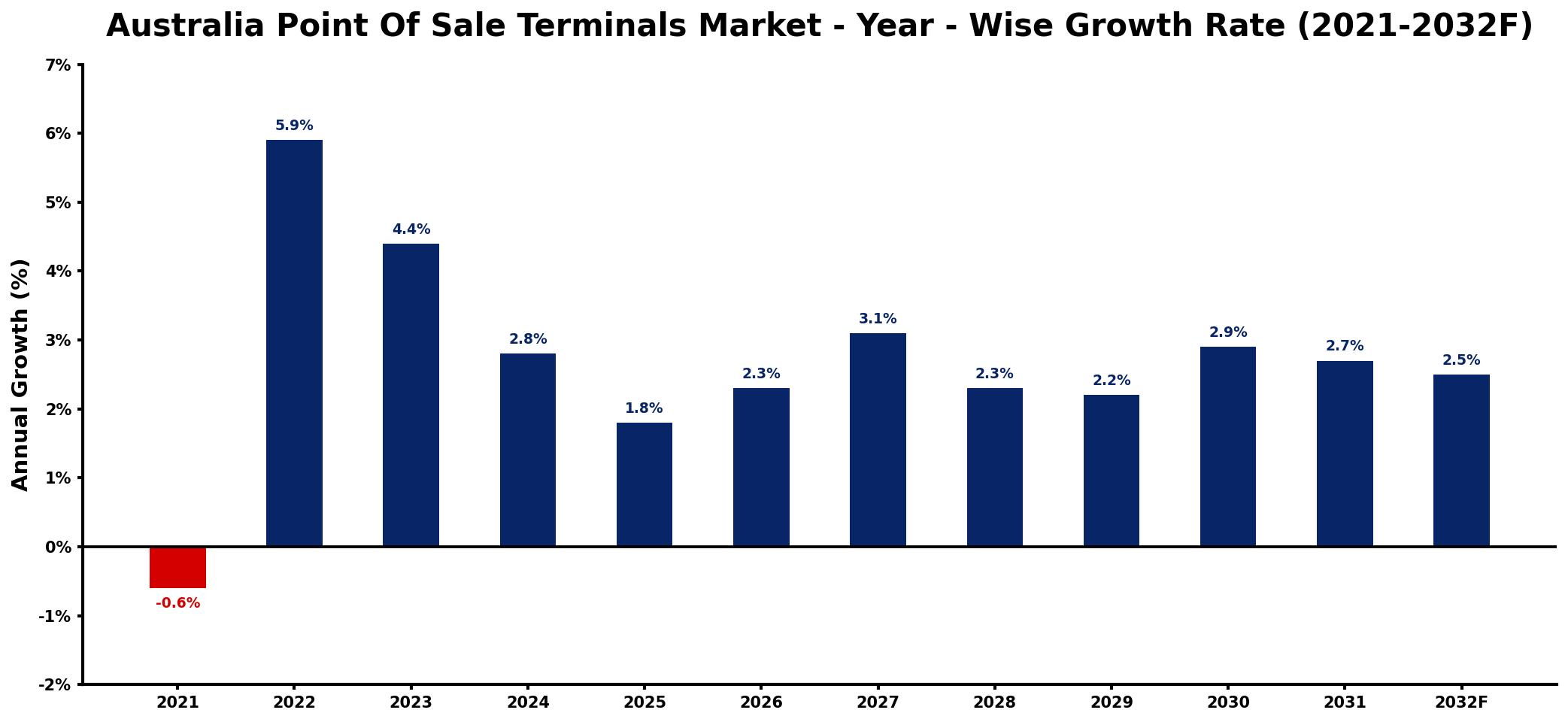
The table below presents the year‑wise growth rates along with the key drivers influencing the market
| Year | Growth Rate | Major Drivers |
| 2021 | -0.6% | decreased consumer spending on technology |
| 2022 | 5.9% | growing demand for contactless payments |
| 2023 | 4.4% | increased retail technology adoption |
| 2024 | 2.8% | expansion of e-commerce platforms |
| 2025 | 1.8% | rising investments in fintech solutions |
| 2026 | 2.3% | enhanced digital payment infrastructure |
| 2027 | 3.1% | growth in small business transactions |
| 2028 | 2.3% | increased mobile payment utilization |
| 2029 | 2.2% | demand for integrated payment solutions |
| 2030 | 2.9% | rising export shipment volumes |
| 2031 | 2.7% | increased domestic production output |
| 2032 | 2.5% | increased focus on customer experience |
Note: Market size estimations and growth projections presented in this report are based on 6Wresearch's proprietary forecasting methodology, utilizing the latest available industry data, government publications, and primary research inputs.
Australia Point Of Sale Terminals Market Synopsis
The strongest force shaping the Australia Point Of Sale Terminals Market right now is the rapid adoption of digital payment solutions. Businesses are increasingly transitioning to contactless transactions, responding to consumer demand for convenience and speed in the payment process.
The retail and hospitality industries are at the forefront of this transformation, leveraging advanced POS systems to enhance customer experiences. However, with the growth of these innovative solutions, traditional POS terminals face obsolescence, pushing vendors to embrace modernization and new technological integrations.
Australia Point Of Sale Terminals Market Key Takeaways
- The market is driven by the increasing adoption of cashless payment systems in key sectors.
- Contactless payment options are becoming a standard in both retail and hospitality environments.
- Cybersecurity concerns are prompting significant investments in data protection measures.
- Cloud-based POS solutions are gaining traction as businesses seek flexible and efficient systems.
- Investment opportunities are emerging through the integration of AI and blockchain technologies.
Evaluation of Restraints in Australia Point Of Sale Terminals Market
Despite robust growth in the Australia Point Of Sale Terminals Market, certain constraints are evident. The rise of mobile and digital payment options is diminishing the demand for traditional POS terminals. Many businesses prefer to invest in more versatile and modern systems, resulting in challenges for legacy providers who need to adapt. Furthermore, the prevalence of cyber threats is a significant deterrent, requiring businesses to allocate resources toward ensuring data security and fraud prevention, which can strain budgets and limit expansion efforts.
Australia Point Of Sale Terminals Market Trends
The Australia Point Of Sale Terminals Market is experiencing noteworthy trends that are reshaping its landscape. The transition toward contactless payments is becoming increasingly evident as consumers prefer the convenience and speed associated with tap-and-go transactions. Additionally, the integration of artificial intelligence in transaction analytics is enhancing operational efficiency, allowing businesses to better understand customer behavior and preferences. The adoption of cloud-based systems is also a significant trend, enabling businesses to manage their payment processes more effectively while reducing upfront costs associated with traditional hardware.
Australia Point Of Sale Terminals Market Opportunities
With the ongoing digitization of payment solutions, substantial growth opportunities exist within the Australia Point Of Sale Terminals Market. Investors are encouraged to explore areas such as the development of contactless payment technologies, the expansion of cloud-based systems, and the utilization of AI for enhanced transaction analytics. Additionally, the potential integration of blockchain technology into payment systems can provide unprecedented security and efficiency, positioning businesses favorably in a competitive landscape.
Government Initiatives in the Australia Point Of Sale Terminals Market
The Australian government plays an essential role in regulating the Point Of Sale Terminals Market. Various regulations under financial and electronic payment standards, including compliance with the Australian Payments Network (AusPayNet), ensure that POS systems meet stringent security protocols. These regulations are especially relevant given the rising tide of cyber threats, reinforcing the need for robust data protection measures. Additionally, the governments emphasis on consumer protection and secure transaction practices aims to foster a trustworthy environment for both merchants and customers.
Future Insights of the Australia Point Of Sale Terminals Market
Looking ahead to 2026-2032, the Australia Point Of Sale Terminals Market is poised for continued evolution. The shift towards mobile and contactless payment methods will likely dominate the landscape, compelling vendors to innovate persistently. As consumer expectations for convenience and security escalate, businesses will be motivated to adopt advanced technologies to remain competitive. Overall, the market will benefit from the growing alignment between technological advancements and consumer preferences, propelling further growth.
Australia Point Of Sale Terminals Market Latest Developments (2025 - 2026)
The Point Of Sale Terminals Market in Australia is witnessing dynamic changes as new technologies emerge and regulations evolve. Notably, there has been a marked increase in the deployment of mobile POS systems across various sectors, driven by the need for flexibility and efficiency. Additionally, ongoing investments in cybersecurity measures are becoming essential as companies strive to protect against rising threats. The market is also seeing advancements in AI-driven analytics, enhancing the way businesses manage customer transactions and insights.
Australia Point Of Sale Terminals Market - Key Attractiveness of the Report
- 10 Years of Market Numbers
- Historical Data Starting from 2022 to 2025
- Base Year: 2025
- Forecast Data until 2032
- Key Performance Indicators Impacting the Market
- Major Upcoming Developments and Projects
Key Highlights of the Report:
- Australia Point Of Sale Terminals Market Outlook
- Market Size of Australia Point Of Sale Terminals Market, 2025
- Forecast of Australia Point Of Sale Terminals Market, 2032
- Historical Data and Forecast of Australia Point Of Sale Terminals Revenues & Volume for the Period 2022-2032F
- Australia Point Of Sale Terminals Market Trend Evolution
- Australia Point Of Sale Terminals Market Drivers and Challenges
- Australia Point Of Sale Terminals Price Trends
- Australia Point Of Sale Terminals Porter's Five Forces
- Australia Point Of Sale Terminals Industry Life Cycle
- Historical Data and Forecast of Australia Point Of Sale Terminals Market Revenues & Volume By Product for the Period 2022-2032F
- Historical Data and Forecast of Australia Point Of Sale Terminals Market Revenues & Volume By Fixed for the Period 2022-2032F
- Historical Data and Forecast of Australia Point Of Sale Terminals Market Revenues & Volume By Mobile for the Period 2022-2032F
- Historical Data and Forecast of Australia Point Of Sale Terminals Market Revenues & Volume By Component for the Period 2022-2032F
- Historical Data and Forecast of Australia Point Of Sale Terminals Market Revenues & Volume By Hardware for the Period 2022-2032F
- Historical Data and Forecast of Australia Point Of Sale Terminals Market Revenues & Volume By Software for the Period 2022-2032F
- Historical Data and Forecast of Australia Point Of Sale Terminals Market Revenues & Volume By Services for the Period 2022-2032F
- Historical Data and Forecast of Australia Point Of Sale Terminals Market Revenues & Volume By Deployment for the Period 2022-2032F
- Historical Data and Forecast of Australia Point Of Sale Terminals Market Revenues & Volume By Cloud for the Period 2022-2032F
- Historical Data and Forecast of Australia Point Of Sale Terminals Market Revenues & Volume By On-premise for the Period 2022-2032F
- Historical Data and Forecast of Australia Point Of Sale Terminals Market Revenues & Volume By End Use for the Period 2022-2032F
- Historical Data and Forecast of Australia Point Of Sale Terminals Market Revenues & Volume By Restaurants for the Period 2022-2032F
- Historical Data and Forecast of Australia Point Of Sale Terminals Market Revenues & Volume By Retail for the Period 2022-2032F
- Historical Data and Forecast of Australia Point Of Sale Terminals Market Revenues & Volume By Hospitality for the Period 2022-2032F
- Historical Data and Forecast of Australia Point Of Sale Terminals Market Revenues & Volume By Healthcare for the Period 2022-2032F
- Historical Data and Forecast of Australia Point Of Sale Terminals Market Revenues & Volume By Warehouse for the Period 2022-2032F
- Historical Data and Forecast of Australia Point Of Sale Terminals Market Revenues & Volume By Entertainment for the Period 2022-2032F
- Historical Data and Forecast of Australia Point Of Sale Terminals Market Revenues & Volume By Others for the Period 2022-2032F
- Australia Point Of Sale Terminals Import Export Trade Statistics
- Market Opportunity Assessment By Product
- Market Opportunity Assessment By Component
- Market Opportunity Assessment By Deployment
- Market Opportunity Assessment By End Use
- Australia Point Of Sale Terminals Top Companies Market Share
- Australia Point Of Sale Terminals Competitive Benchmarking By Technical and Operational Parameters
- Australia Point Of Sale Terminals Company Profiles
- Australia Point Of Sale Terminals Key Strategic Recommendations






































