Australia Policy Management in Telecom Market Size & Growth Rate (2026-2032)
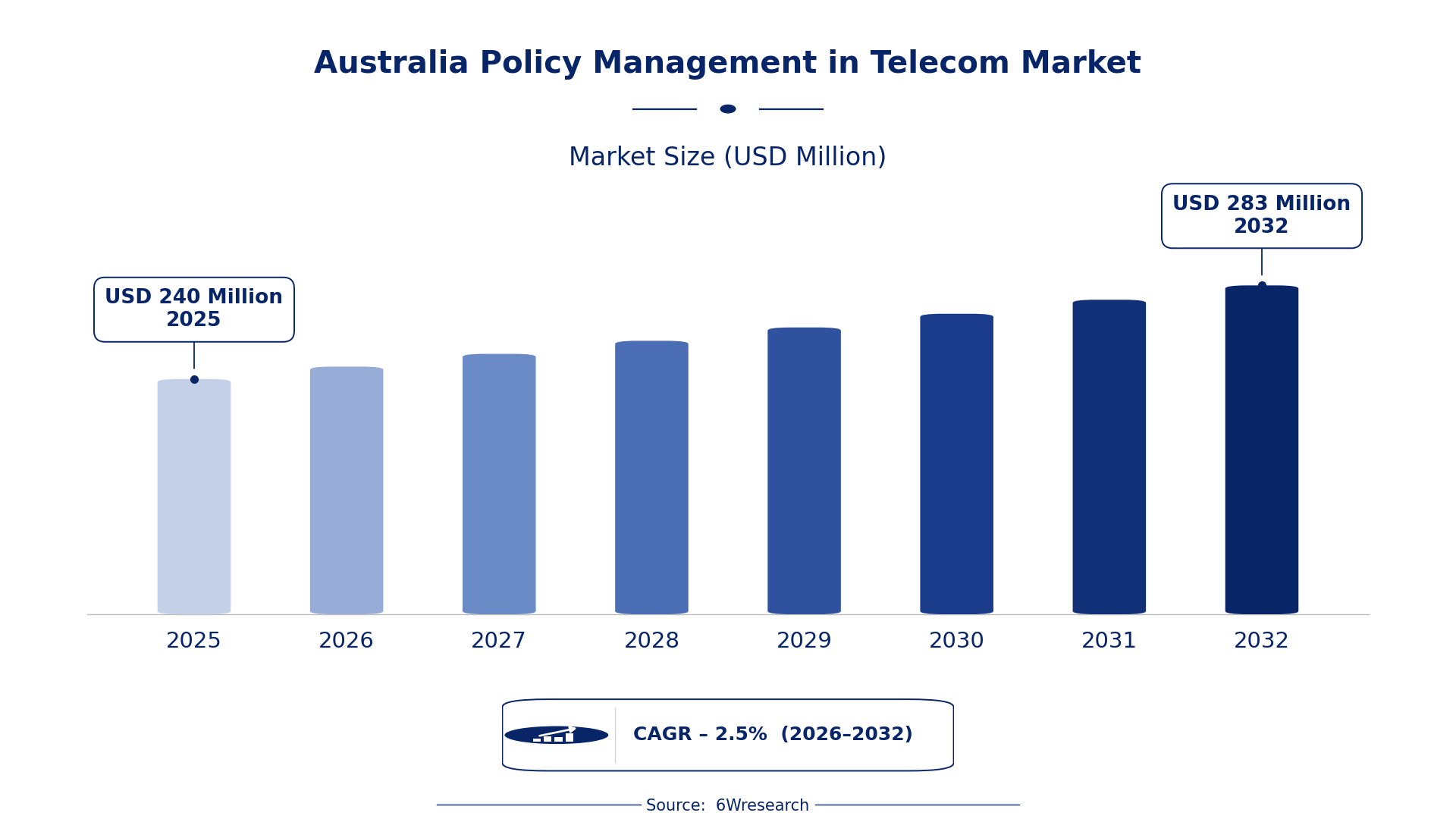
The Australia Policy Management in Telecom Market was estimated at USD 240 Million in 2025 and is projected to reach USD 283 Million by 2032, growing at a CAGR of 2.5% from 2026 to 2032.
Australia Policy Management in Telecom Market Synopsis
The growing complexity of data usage policies and network traffic management is driving the demand for policy management solutions in Australia's telecom sector. Operators are actively seeking tools that optimize resources, especially as they transition to 5G technology and cloud-based systems, which necessitate advanced policy control mechanisms.
Consumer expectations for personalized services are higher than ever, compelling telecom providers to adapt and innovate. With regulatory compliance and data privacy concerns looming large, the landscape of policy management is evolving, presenting both challenges and opportunities for operators across the region.
Australia Policy Management in Telecom Market Year-wise Growth Rate and Key Drivers
This graph illustrates the annual growth rates of the Australia Policy Management in Telecom Market from 2021 to 2032, highlighting a steady upward trajectory and projected expansion over the forecast period.
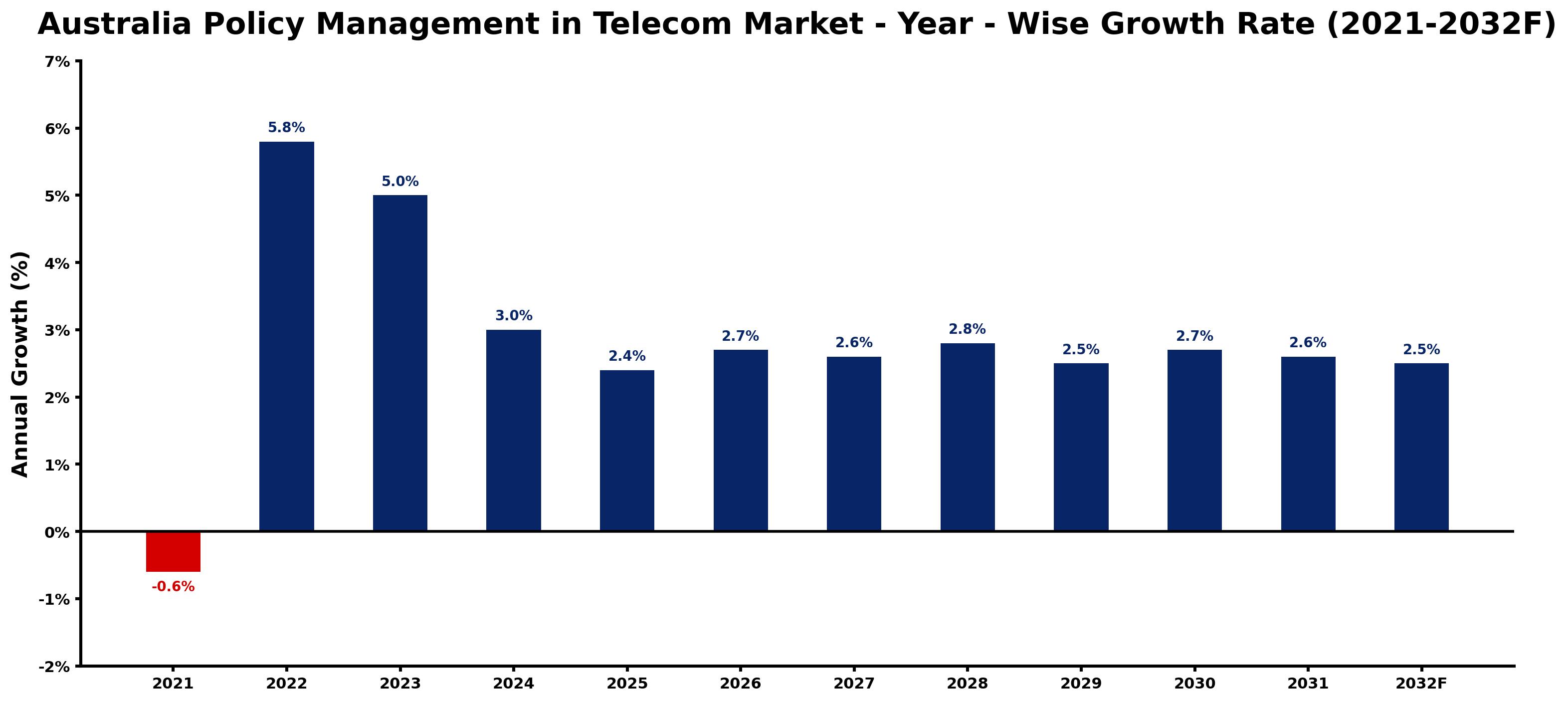
The table below presents the year‑wise growth rates along with the key drivers influencing the market
| Year | Growth Rate | Major Drivers |
| 2021 | -0.6% | ACMA's new regulations stifled telecommunications innovation. |
| 2022 | 5.8% | Telecommunication Regulatory Authority's compliance mandates boost policy initiatives. |
| 2023 | 5.0% | Strengthening digital privacy laws encourage enhanced policy management. |
| 2024 | 3.0% | 5G rollout increases regulatory scrutiny and policy needs. |
| 2025 | 2.4% | Government grants incentivizing digital innovation in telecommunications. |
| 2026 | 2.7% | Rise in consumer demand for data privacy regulations. |
| 2027 | 2.6% | Increased competition prompts stricter policy enforcement across telecom. |
| 2028 | 2.8% | Telecommunications Consumer Ombudsman advocates for policy reforms. |
| 2029 | 2.5% | Focus on sustainable telecom practices drives regulatory adjustments. |
| 2030 | 2.7% | Cloud-based policy management solutions gain popularity among telecoms. |
| 2031 | 2.6% | Regulatory frameworks adapt to evolving cybersecurity threats. |
| 2032 | 2.5% | Policy alignment with international telecom standards enhances compliance. |
Note: Market size estimations and growth projections presented in this report are based on 6Wresearch's proprietary forecasting methodology, utilizing the latest available industry data, government publications, and primary research inputs.
Australia Policy Management in Telecom Market Key Takeaways
Below are some of the specific key takeaways from the market, including:
- The shift to 5G is intensifying the demand for advanced policy management solutions.
- Cloud-based policy management solutions are gaining traction among telecom operators.
- AI integration is increasingly being adopted for real-time policy enforcement.
- Regulatory compliance is shaping market evolution and investment strategies.
- Investment opportunities are emerging in AI-based platforms and enterprise markets.
Evaluation of Restraints in Australia Policy Management in Telecom Market
The Australia Policy Management in Telecom Market grapples with several constraints. The complexity of multi-network environments creates a challenging backdrop for effective policy enforcement. Legacy systems, often limited in scalability, hinder the transition to more modern, cloud-based platforms. Additionally, operators face increasing costs related to adapting to stringent regulatory compliance requirements, which can stifle innovation and slow down the rollout of new solutions.
Australia Policy Management in Telecom Market Trends
A noticeable trend in the market is the increasing adoption of AI-driven solutions for dynamic policy enforcement, which enables operators to respond swiftly to network demands. Furthermore, the growing emphasis on personalized data plans reflects a broader industry shift towards enhancing the customer experience. As regulatory frameworks evolve, more telecom companies are investing in compliance automation technologies to mitigate risks while ensuring customer data privacy.
Australia Policy Management in Telecom Market Opportunities
Investment opportunities abound as operators seek to adapt to the complexities of data management. Developing AI-based policy management platforms stands out as a key avenue for growth, particularly as enterprises increasingly demand tailored solutions. Additionally, expanding service portfolios to include enterprise markets can significantly contribute to revenue streams as businesses look for sophisticated policy management tools.
Government Initiatives in the Australia Policy Management in Telecom Market
Government policy is a critical factor influencing the Australia Policy Management in Telecom Market. Regulatory bodies are actively shaping the framework under which telecom operators function, with a focus on data protection and consumer privacy. Support for research initiatives and tax incentives is currently fostering innovation in policy management solutions, thereby enhancing the operational capabilities of telecom players.
- A recent initiative launched in 2025 focuses on providing grants for technology development aimed at enhancing policy management systems.
- A current program is underway that mandates telecom operators to comply with new billing transparency regulations, scheduled for implementation by mid-2026.
- Upcoming plans include a national digital infrastructure upgrade programme expected to commence in 2027, targeting improvements in data management capabilities.
- In 2026, the government is set to review existing policies to further streamline compliance processes for telecom operators.
- Ongoing discussions are aimed at establishing partnerships with private sector firms to enhance investment in telecom infrastructure.
Future Insights of the Australia Policy Management in Telecom Market
Looking ahead to 2026-2032, the Australia Policy Management in Telecom Market is expected to undergo substantial transformation. As 5G technology becomes more entrenched, operators will need to refine their policy management strategies to effectively handle increasing data demands. Innovation in AI and machine learning will continue to drive the evolution of real-time policy enforcement, allowing telecom providers to stay competitive and responsive to customer needs. Furthermore, heightened regulatory scrutiny will compel companies to adapt swiftly and invest in compliance solutions that ensure consumer trust and data security.
Australia Policy Management in Telecom Market Latest Developments
In the past year, activity within the Australia Policy Management in Telecom Market has been marked by a focus on innovation and regulatory alignment. Companies are ramping up efforts to deploy cloud-based solutions while enhancing their capabilities in AI. As the sector navigates new consumer expectations and regulatory landscapes, developments in policy management are more critical than ever.
- A major technology vendor initiated a pilot program in early 2025 for a new cloud-based policy management platform that has successfully reduced operational costs for participating operators.
- An enterprise that began its digital transformation project in late 2025 is currently integrating AI into their policy management processes, aimed at achieving better customer engagement.
- A rollout planned for mid-2026 will introduce enhanced analytics features into existing policy management solutions, targeting improved network resource allocation.
- In Q1 2026, a regional operator announced a partnership with an AI firm to develop predictive analytics tools for real-time policy adjustments, which is expected to launch in late 2026.
Australia Policy Management in Telecom Market - Key Attractiveness of the Report
- 10 Years of Market Numbers
- Historical Data Starting from 2022 to 2025
- Base Year: 2025
- Forecast Data until 2032
- Key Performance Indicators Impacting the Market
- Major Upcoming Developments and Projects
Key Highlights of the Report:
- Australia Policy Management in Telecom Market Outlook
- Market Size of Australia Policy Management in Telecom Market, 2025
- Forecast of Australia Policy Management in Telecom Market, 2032
- Historical Data and Forecast of Australia Policy Management in Telecom Revenues & Volume for the Period 2022-2032F
- Australia Policy Management in Telecom Market Trend Evolution
- Australia Policy Management in Telecom Market Drivers and Challenges
- Australia Policy Management in Telecom Price Trends
- Australia Policy Management in Telecom Porter's Five Forces
- Australia Policy Management in Telecom Industry Life Cycle
- Historical Data and Forecast of Australia Policy Management in Telecom Market Revenues & Volume By Network for the Period 2022-2032F
- Historical Data and Forecast of Australia Policy Management in Telecom Market Revenues & Volume By Fixed for the Period 2022-2032F
- Historical Data and Forecast of Australia Policy Management in Telecom Market Revenues & Volume By Wireless for the Period 2022-2032F
- Historical Data and Forecast of Australia Policy Management in Telecom Market Revenues & Volume By Component for the Period 2022-2032F
- Historical Data and Forecast of Australia Policy Management in Telecom Market Revenues & Volume By Solutions for the Period 2022-2032F
- Historical Data and Forecast of Australia Policy Management in Telecom Market Revenues & Volume By Services for the Period 2022-2032F
- Historical Data and Forecast of Australia Policy Management in Telecom Market Revenues & Volume By Deployment for the Period 2022-2032F
- Historical Data and Forecast of Australia Policy Management in Telecom Market Revenues & Volume By Cloud for the Period 2022-2032F
- Historical Data and Forecast of Australia Policy Management in Telecom Market Revenues & Volume By On-Premises for the Period 2022-2032F
- Australia Policy Management in Telecom Import Export Trade Statistics
- Market Opportunity Assessment By Network
- Market Opportunity Assessment By Component
- Market Opportunity Assessment By Deployment
- Australia Policy Management in Telecom Top Companies Market Share
- Australia Policy Management in Telecom Competitive Benchmarking By Technical and Operational Parameters
- Australia Policy Management in Telecom Company Profiles
- Australia Policy Management in Telecom Key Strategic Recommendations






































