Australia Polio Vaccine Market Size, Share & Growth Rate
The Australia Polio Vaccine Market was estimated at USD 200 Million in 2025 and is projected to reach USD 235 Million by 2032, growing at a CAGR of 2.3% from 2026 to 2032. This growth trajectory is driven by persistent efforts to maintain high immunization coverage across diverse populations, as well as the government's commitment to supporting national immunization initiatives. The collaborative framework established with international health organizations also plays a significant role in reinforcing vaccine accessibility and implementation strategies.
Australia Polio Vaccine Market Year-wise Growth Rate and Key Drivers
This graph highlights how the Australia Polio Vaccine Market has steadily grown over the years, supported by major growth factors.
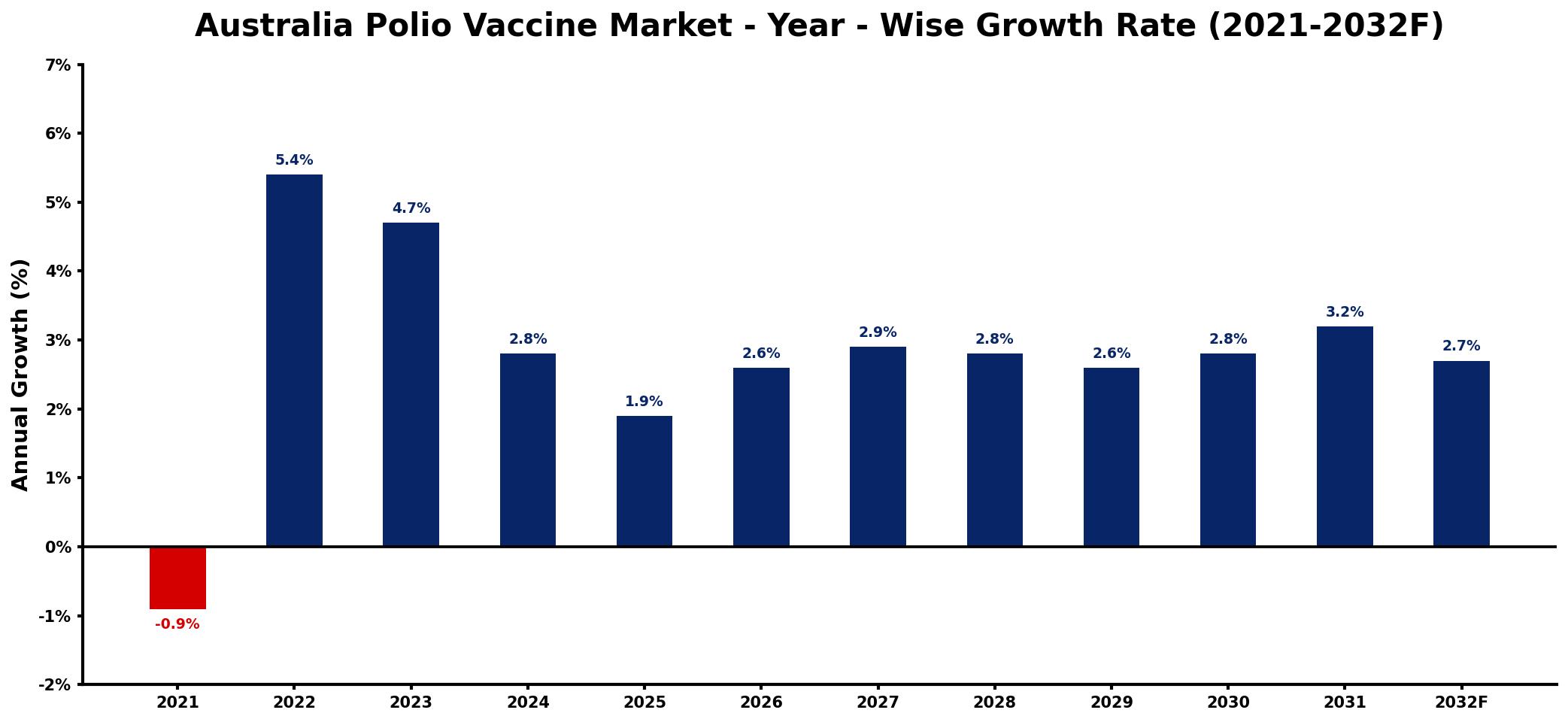
The table below presents the year‑wise growth rates along with the key drivers influencing the market
| Year | Growth Rate | Major Drivers |
| 2021 | -0.9% | decrease in healthcare funding allocations |
| 2022 | 5.4% | increased public health awareness campaigns |
| 2023 | 4.7% | rising investment in immunization programs |
| 2024 | 2.8% | growing demand for preventive healthcare |
| 2025 | 1.9% | expansion of healthcare infrastructure projects |
| 2026 | 2.6% | enhanced international collaboration efforts |
| 2027 | 2.9% | increased government health policy support |
| 2028 | 2.8% | surge in global health initiatives |
| 2029 | 2.6% | development of new healthcare technologies |
| 2030 | 2.8% | rising consumer health consciousness trends |
| 2031 | 3.2% | growing partnerships with NGOs |
| 2032 | 2.7% | increased pharmaceutical industry usage |
Note: Market size estimations and growth projections presented in this report are based on 6Wresearch's proprietary forecasting methodology, utilizing the latest available industry data, government publications, and primary research inputs.
Australia Polio Vaccine Market Synopsis
Australia's polio vaccine market is in a stable condition, supported by comprehensive national immunization initiatives that aim to eradicate the disease. While polio is not a prevalent health concern domestically, continuous vaccination efforts are critical to mitigate the risk of outbreaks, particularly in light of increased global mobility.
Despite the near-eradication of polio, the market faces challenges such as declining vaccination rates in certain communities and logistical hurdles in remote areas. Ongoing public health initiatives and government interventions are essential to address these issues, ensuring that vaccination efforts remain robust and effective.
Australia Polio Vaccine Market Key Takeaways
- The market benefits from robust government support and partnerships with global health organizations.
- Continued vaccination efforts are critical to preventing the re-emergence of polio in Australia.
- Declining vaccination rates in some communities present ongoing challenges for the market.
- Investment opportunities exist in combination vaccine development and healthcare market expansions.
- Strict regulatory frameworks ensure vaccine quality and safety, impacting market dynamics.
Evaluation of Restraints in Australia Polio Vaccine Market
The Australia Polio Vaccine Market experiences notable restraints, primarily stemming from its unique public health landscape. With vaccination rates already high, the demand for polio vaccines has diminished, complicating the economic viability for manufacturers. This limited market activity necessitates government intervention to maintain vaccine stockpiles and continue public immunization campaigns, which can impact overall profitability. Additionally, manufacturers must navigate stringent regulatory approvals and quality control standards, which can further restrict market entry and product development.
Australia Polio Vaccine Market Trends
The market is witnessing several significant trends that shape its future landscape. A pronounced shift towards combination vaccines is emerging, as healthcare providers seek to streamline immunization protocols and improve vaccine compliance among populations. Furthermore, the integration of advanced surveillance systems is enhancing the monitoring of vaccination uptake, driving efforts to address gaps in coverage. Public health campaigns are also increasingly focused on education and outreach to combat vaccine hesitancy, ensuring that communities remain informed about the importance of immunization against polio.
Australia Polio Vaccine Market Opportunities
As the global health community continues to work towards the eradication of polio, substantial investment opportunities are present in Australias polio vaccine market. Innovations in vaccine development, particularly in creating combination vaccines that address multiple diseases, are gaining traction. Additionally, there is room for expanding healthcare outreach into underserved regions, which can bolster vaccination efforts and foster greater community engagement. The ongoing collaboration with international health organizations further opens doors for funding and technical support, enhancing local capabilities.
Government Initiatives in the Australia Polio Vaccine Market
The Australian government implements comprehensive national immunization policies aimed at eradicating polio and ensuring public health safety. Stringent guidelines govern vaccine safety, distribution, and administration, aimed at maintaining high-quality vaccine supplies. Public health programs are actively engaged in ongoing vaccination efforts, focusing on outreach and education to uphold community participation in immunization campaigns.
Future Insights of the Australia Polio Vaccine Market
Looking forward to 2026-2032, the Australia Polio Vaccine Market is expected to evolve significantly. With the integration of advanced technologies in vaccine delivery and monitoring, the efficiency of immunization campaigns will likely improve. Continued emphasis on education will further aid in sustaining vaccination rates across diverse demographics. Global partnerships and the potential for innovative product offerings will also shape the market, ensuring that Australia remains committed to preventing any resurgence of polio.
Australia Polio Vaccine Market Latest Developments (2025 - 2026)
Recent initiatives have seen a renewed focus on increasing immunization rates, particularly in regions with historically lower uptake. Public health campaigns are being rolled out to raise awareness about the importance of maintaining polio vaccinations. Simultaneously, local health authorities are exploring new logistical strategies to improve access to vaccines in remote areas, ensuring that every community has the opportunity to participate in immunization efforts.
Australia Polio Vaccine Market - Key Attractiveness of the Report
- 10 Years of Market Numbers
- Historical Data Starting from 2022 to 2025
- Base Year: 2025
- Forecast Data until 2032
- Key Performance Indicators Impacting the Market
- Major Upcoming Developments and Projects
Key Highlights of the Report:
- Australia Polio Vaccine Market Outlook
- Market Size of Australia Polio Vaccine Market, 2025
- Forecast of Australia Polio Vaccine Market, 2032
- Historical Data and Forecast of Australia Polio Vaccine Revenues & Volume for the Period 2022-2032F
- Australia Polio Vaccine Market Trend Evolution
- Australia Polio Vaccine Market Drivers and Challenges
- Australia Polio Vaccine Price Trends
- Australia Polio Vaccine Porter's Five Forces
- Australia Polio Vaccine Industry Life Cycle
- Historical Data and Forecast of Australia Polio Vaccine Market Revenues & Volume By Type for the Period 2022-2032F
- Historical Data and Forecast of Australia Polio Vaccine Market Revenues & Volume By Oral Polio Vaccine (OPV) for the Period 2022-2032F
- Historical Data and Forecast of Australia Polio Vaccine Market Revenues & Volume By Inactivated Poliomyelitis Vaccine (IPV) for the Period 2022-2032F
- Historical Data and Forecast of Australia Polio Vaccine Market Revenues & Volume By Application for the Period 2022-2032F
- Historical Data and Forecast of Australia Polio Vaccine Market Revenues & Volume By Public for the Period 2022-2032F
- Historical Data and Forecast of Australia Polio Vaccine Market Revenues & Volume By Private for the Period 2022-2032F
- Australia Polio Vaccine Import Export Trade Statistics
- Market Opportunity Assessment By Type
- Market Opportunity Assessment By Application
- Australia Polio Vaccine Top Companies Market Share
- Australia Polio Vaccine Competitive Benchmarking By Technical and Operational Parameters
- Australia Polio Vaccine Company Profiles
- Australia Polio Vaccine Key Strategic Recommendations






































