Australia Processed Meat Market: Import Trend Analysis
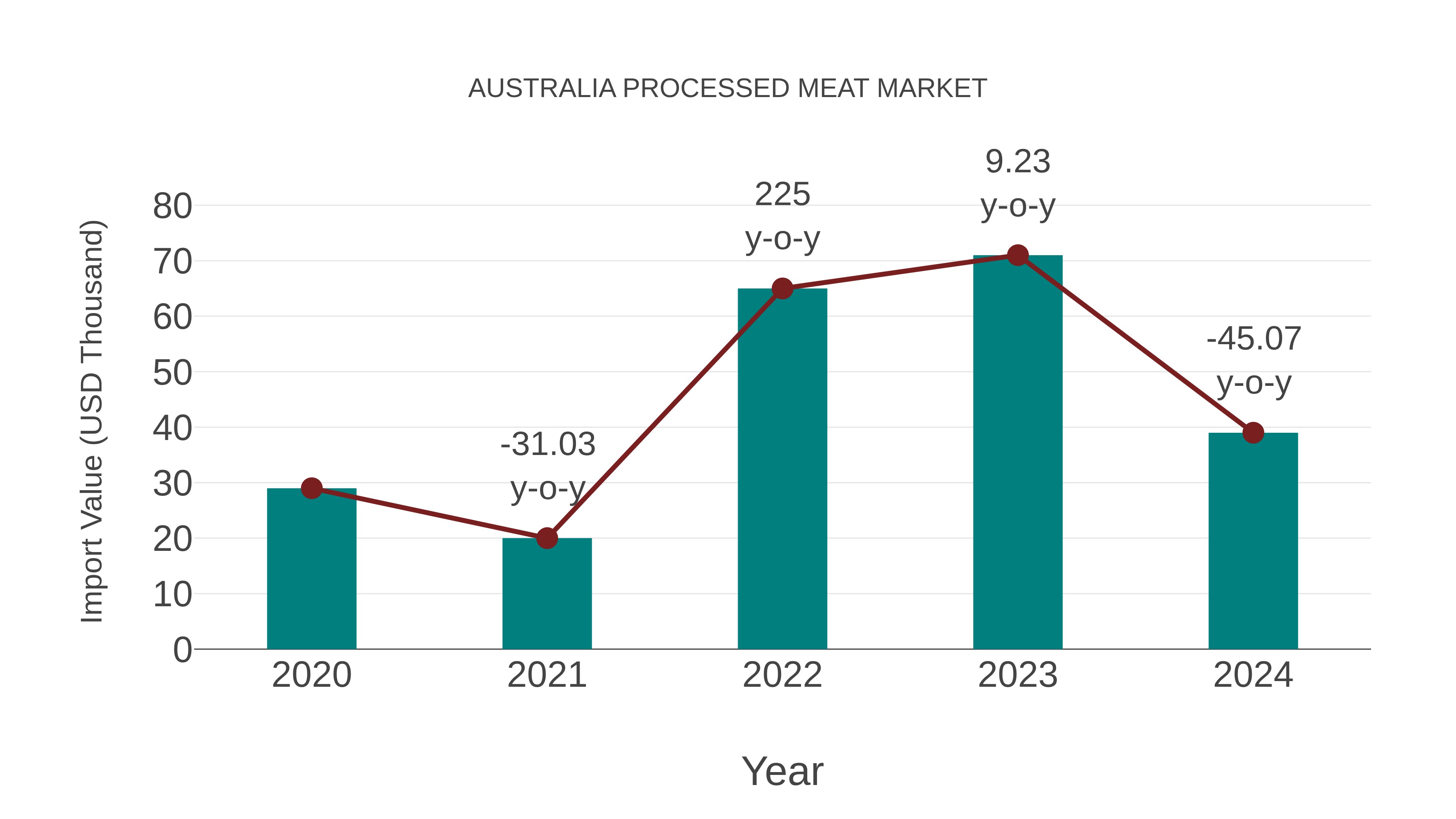
In the Australia processed meat market, the import trend experienced a notable decline from 2023 to 2024, with a growth rate of -45.07%. However, the compound annual growth rate (CAGR) for imports over the period 2020-2024 stood at 7.69%. This decline in import momentum in 2024 could be attributed to shifting consumer preferences or changes in trade policies affecting the market stability.
Topics Covered in the Australia Processed Meat Market Report
The Australia Processed Meat Market report thoroughly covers the market by Meat type, by product type, by application and by distribution channel. The market report provides an unbiased and detailed analysis of the ongoing market trends, opportunities/high growth areas, and market drivers which would help the stakeholders to devise and align their market strategies according to the current and future market dynamics.
Australia Processed Meat Market Synopsis
The Australia Processed Meat Market is dynamic and evolving and is projected to attain steady growth in the coming years driven by increasing demand for convenience foods, rising disposable income, and changing consumer preferences towards ready-to-eat meals. The market is also going through certain challenges that can hamper its growth to a certain extent in the near future.
According to 6Wresearch, the Australia Processed Meat Market size is expected to grow at a significant CAGR of 5.20% during 2025-2031. This growth is propelled by increasing demand for convenience foods, rising disposable income, and changing consumer preferences towards ready-to-eat meals. Processed Meat being a convenient and ready-to-eat food option has gained significant market share in Australia. Also, the rise in food service establishments such as restaurants, cafes, and fast-food chains has contributed to the growth of this market. These establishments often use processed Meat in their menu items, leading to a higher demand for the product. Additionally, the increasing popularity of online food delivery services has also contributed to the growth of the processed Meat market in Australia.
The growing awareness of the importance of protein-rich diets and the popularity of high-protein diets among fitness enthusiasts and health-conscious consumers contribute to the demand for processed meats. The growing demand for processed Meat can also be attributed to the busy lifestyles in Australia, with busy lifestyles and a working population processed Meat offers a quick and easy solution for meal preparation. These factors will influence the Australian Processed Meat Market Growth.
Some of the challenges include high competition, price sensitivity and changing consumer preferences. The processed Meat market in Australia faces high competition from raw meat and plant based alternatives. This competition can impact the demand and hamper the market growth. Moreover, increasing production costs, including raw material costs and energy expenses, can lead to upward pressure on prices, potentially impacting demand, especially among budget-conscious consumers. Shifting consumer preferences towards healthier, natural, and plant-based alternatives pose a challenge to the processed meat market.
Australia Processed Meat Industry: Leading Players
Some of the key players operating in the Australia Processed Meat market include JBS Australia Pty Limited, Inghams Group Limited and Primo Smallgoods Holdings Pty Ltd. These companies dominate the market due to their strong presence and extensive distribution networks across the country. Currently, JBS Australia holds the largest share in the Processed Meat market in Australia.
Australia Processed Meat Market: Government Regulations
Government regulations play a significant role in the Australia Processed Meat Market. FSANZ sets standards for food safety, labelling, additives, and contaminants, which apply to processed meat products sold in the Australian market. The regulations ensure that processed meat products meet hygiene and safety standards throughout the production, processing, and distribution process. Meat Standards Australia is a voluntary grading and labelling system for beef and sheepmeat in Australia, which aims to improve the eating quality and consistency of meat products. Additionally, Australian Competition and Consumer Commission (ACCC) enforces competition and consumer laws to ensure fair trading practices and protect consumers from misleading or deceptive conduct.
Future Insights of the Market
Several factors will shape the future of the market.The demand for Processed Meat products is expected to rise as consumers look for convenient ready to eat food options.Additionally, The growing popularity of plant-based diets and flexitarian lifestyles is expected to drive demand for plant-based alternatives to traditional processed meats. Producers may innovate with plant-based ingredients to develop meat-free alternatives that mimic the taste, texture and appearance of conventional processed meats, appealing to environmentally conscious consumers and those seeking meat-free options.
Market Segmentation by Meat Type
According to Dhaval, Research Manager, 6Wresearch, Poultry holds the dominant share in the processed meat market in Australia. The high consumption of chicken and other poultry products is due to their affordability and lower fat content compared to other types of meat.
Market Segmentation by Product Type
On the basis of the Product Type, the canned meat segment is expected to witness significant growth during the forecast period. This can be attributed to the increasing demand for canned meat products due to their longer shelf life and convenience of consumption.
Market Segmentation by Application
On the basis of the Application, the commercial segment is expected to drive market growth in the future due to the increasing demand for processed meat products from restaurants, fast-food chains, and other foodservice establishments.
Market Segmentation by Distribution Channel
On the basis of the Distribution Channel, the supermarkets/hypermarkets segment holds the largest market share in the distribution channel category. This can be attributed to the wide availability of processed meat products in these stores and the convenience of one-stop shopping for consumers.
Key Attractiveness of the Report
- 10 Years Market Numbers.
- Historical Data Starting from 2021 to 2024.
- Base Year: 2024
- Forecast Data until 2031.
- Key Performance Indicators Impacting the Market.
- Major Upcoming Developments and Projects.
Key Highlights of the Report:
- Australia Processed Meat Market Outlook
- Market Size of Australia Processed Meat Market, 2025
- Forecast of Australia Processed Meat Market, 2032
- Historical Data and Forecast of Australia Processed Meat Revenues & Volume for the Period 2022-2032F
- Australia Processed Meat Market Trend Evolution
- Australia Processed Meat Market Drivers and Challenges
- Australia Processed Meat Price Trends
- Australia Processed Meat Porter's Five Forces
- Australia Processed Meat Industry Life Cycle
- Historical Data and Forecast of Australia Processed Meat Market Revenues & Volume By Meat Type for the Period 2022-2032F
- Historical Data and Forecast of Australia Processed Meat Market Revenues & Volume By Poultry for the Period 2022-2032F
- Historical Data and Forecast of Australia Processed Meat Market Revenues & Volume By Beef for the Period 2022-2032F
- Historical Data and Forecast of Australia Processed Meat Market Revenues & Volume By Pork for the Period 2022-2032F
- Historical Data and Forecast of Australia Processed Meat Market Revenues & Volume By Others for the Period 2022-2032F
- Historical Data and Forecast of Australia Processed Meat Market Revenues & Volume By Product Type for the Period 2022-2032F
- Historical Data and Forecast of Australia Processed Meat Market Revenues & Volume By Frozen for the Period 2022-2032F
- Historical Data and Forecast of Australia Processed Meat Market Revenues & Volume By Chilled for the Period 2022-2032F
- Historical Data and Forecast of Australia Processed Meat Market Revenues & Volume By Canned for the Period 2022-2032F
- Historical Data and Forecast of Australia Processed Meat Market Revenues & Volume By Application for the Period 2022-2032F
- Historical Data and Forecast of Australia Processed Meat Market Revenues & Volume By Commercial for the Period 2022-2032F
- Historical Data and Forecast of Australia Processed Meat Market Revenues & Volume By Residential for the Period 2022-2032F
- Historical Data and Forecast of Australia Processed Meat Market Revenues & Volume By Distribution Channel for the Period 2022-2032F
- Historical Data and Forecast of Australia Processed Meat Market Revenues & Volume By HoReCa for the Period 2022-2032F
- Historical Data and Forecast of Australia Processed Meat Market Revenues & Volume By Supermarkets/Hypermarkets for the Period 2022-2032F
- Historical Data and Forecast of Australia Processed Meat Market Revenues & Volume By Convenience Stores for the Period 2022-2032F
- Historical Data and Forecast of Australia Processed Meat Market Revenues & Volume By Independent Retailers for the Period 2022-2032F
- Historical Data and Forecast of Australia Processed Meat Market Revenues & Volume By Others for the Period 2022-2032F
- Australia Processed Meat Import Export Trade Statistics
- Market Opportunity Assessment By Meat Type
- Market Opportunity Assessment By Product Type
- Market Opportunity Assessment By Application
- Market Opportunity Assessment By Distribution Channel
- Australia Processed Meat Top Companies Market Share
- Australia Processed Meat Competitive Benchmarking By Technical and Operational Parameters
- Australia Processed Meat Company Profiles
- Australia Processed Meat Key Strategic Recommendations
Market Covered
The report offers a comprehensive study of the subsequent market segments:
By Meat Type
- Poultry
- Beef
- Pork
- Others
By Product Type
- Frozen
- Chilled
- Canned
By Application
- Commercial
- Residential
By Distribution Channel
- HoReCa
- Supermarkets/Hypermarkets
- Convenience Stores
- Independent Retailers
- Others






































