Australia Professional Lighting Market Summary
The australia professional lighting market was estimated at USD 210 Million in 2025 and is projected to reach USD 246 Million by 2032, growing at a CAGR of 2.4% from 2026 to 2032.
Australia Professional Lighting Market Year-wise Growth Rate and Key Drivers
This graph highlights how the Australia Professional Lighting Market has steadily grown over the past five years, supported by major growth factors.
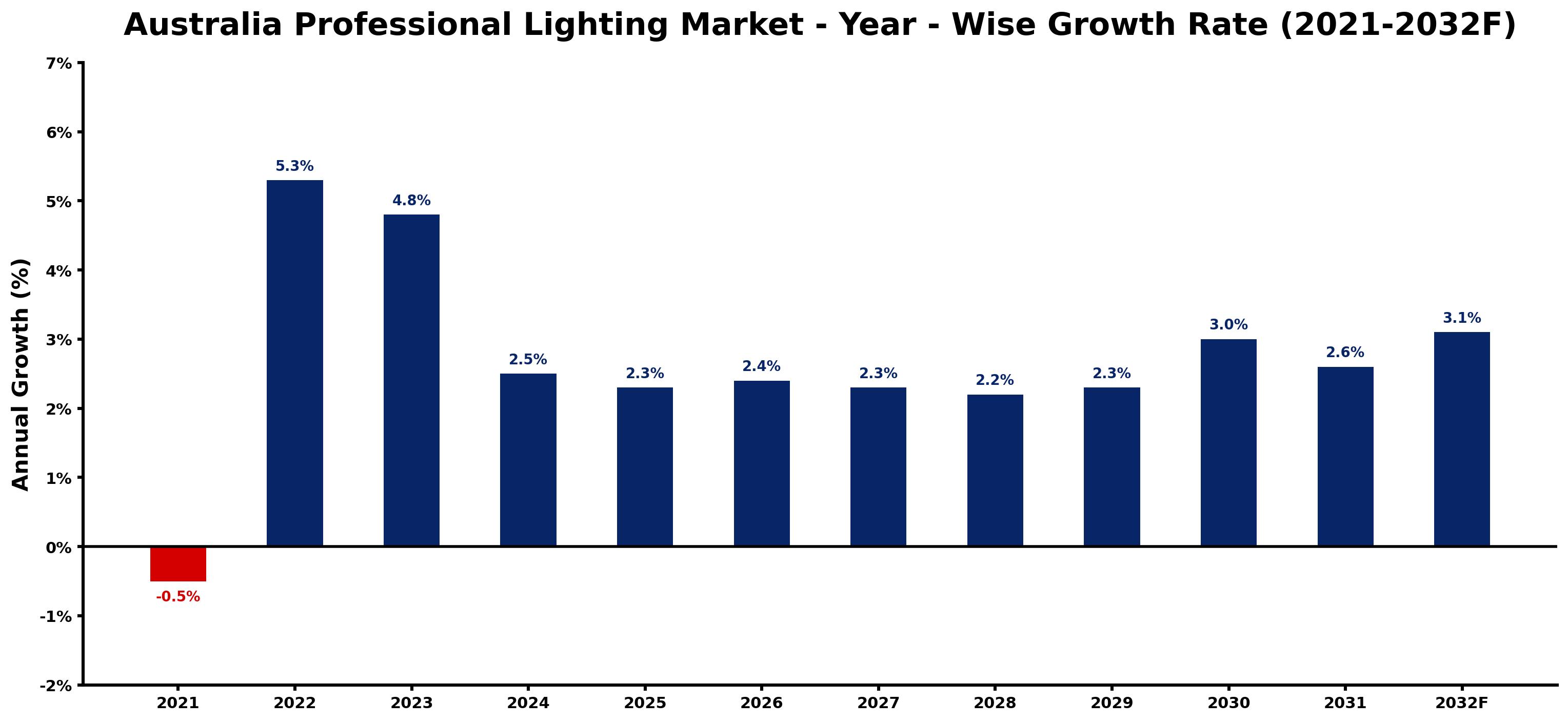
The table below presents the year wise growth rates along with the key drivers influencing the market
| Year | Growth Rate | Major Drivers |
| 2021 | -0.5% | Heightened competition from energyefficient alternatives diminished demand for traditional professional lighting solutions. |
| 2022 | 5.3% | Corporate budgets prioritized energy-efficient lighting systems for operational cost savings. |
| 2023 | 4.8% | Architectural firms increasingly integrated smart lighting into sustainable design projects. |
| 2024 | 2.5% | Technological advancements in LED technology significantly enhanced product performance expectations. |
| 2025 | 2.3% | Urban developments necessitated innovative lighting for safety and aesthetic considerations. |
| 2026 | 2.4% | Local manufacturers improved supply chain efficiencies, reducing lead times for projects. |
| 2027 | 2.3% | Public events promoted the importance of dynamic lighting to enhance visitor experiences. |
| 2028 | 2.2% | Emerging smart city initiatives showcased advanced lighting solutions for urban infrastructure. |
| 2029 | 2.3% | Renewable energy integration drove the demand for compatible lighting systems in commercial sectors. |
| 2030 | 3.0% | Smart home technology adoption transformed consumer preferences towards intelligent lighting devices. |
| 2031 | 2.6% | Increased awareness of climate change influenced choices for sustainable lighting products. |
| 2032 | 3.1% | Collaborative efforts among industry stakeholders fostered innovation in lighting technologies. |
Note - Market size estimations and growth projections presented in this report are based on 6Wresearch's advanced forecasting approach, validated with industry datasets as of June 2026.
Australia Professional Lighting Market Synopsis
The Australia Professional Lighting Market is projected to reach 2.4% and witness significant growth during the forecast period (2026-2032). This market is being driven by the increasing demand for energy-efficient and environmentally friendly lighting systems, along with the rapid adoption of LED technology across luminaries. Moreover, the rising popularity of intelligent and connected lighting solutions is reshaping the landscape of professional lighting in Australia. This comprehensive market report provides insights into the dynamics, market drivers, and trends shaping the future of professional lighting in Australia.
Australia Professional Lighting Market Growth Drivers
A multitude of factors are propelling the growth of the Australia Professional Lighting Market. Key drivers include:
- Enhanced energy efficiency: The increasing focus on reducing energy consumption is prompting businesses and organizations to adopt energy-efficient lighting solutions, thereby contributing to market expansion.
- Technological advancements: The introduction and widespread acceptance of LED technology have revolutionized the professional lighting sector, delivering increased longevity and lower operational costs compared to traditional lighting options.
- Shift towards sustainability: With growing awareness of environmental issues, many sectors are prioritizing sustainability and opting for environmentally friendly lighting products, which is stimulating demand within the market.
- Rise in smart lighting solutions: The integration of smart technology in lighting systems is gaining traction, driven by the need for enhanced control, efficiency, and connectivity in commercial and industrial applications.
- Urbanization and infrastructure development: As urban areas continue to grow, the demand for professional lighting solutions in newly developed infrastructure projects, including commercial spaces and public areas, is also on the rise.
Australia Professional Lighting Market Trends and Opportunities
The Australia Professional Lighting Market is witnessing notable trends that are creating opportunities for growth and innovation. These trends include:
- Increased automation: The growing demand for automated lighting solutions in commercial and residential settings is shaping product development, as businesses look for enhanced control and energy savings.
- Integration of IoT: The Internet of Things (IoT) is increasingly being incorporated into professional lighting systems, enabling improved data collection, real-time monitoring, and enhanced user experience.
- Focus on design: There is a growing emphasis on aesthetics in lighting design, prompting manufacturers to develop innovative fixtures that not only serve functional purposes but also enhance the beauty of spaces.
- Expansion in sectors: The professional lighting sector is expanding its reach into various industries, including healthcare, retail, and hospitality, creating new avenues for growth.
- Government incentives: Various government initiatives aimed at promoting energy efficiency and sustainability are encouraging companies to invest in advanced lighting solutions, further driving market growth.
Australia Professional Lighting Market Challenges and Restraints
While there are numerous growth drivers, the Australia Professional Lighting Market also faces certain challenges that may hinder its progress:
- High initial costs: The upfront investment required for advanced lighting solutions can deter potential buyers, particularly small- and medium-sized enterprises.
- Rapid technological changes: The fast-paced nature of technological advancements in lighting can pose challenges for manufacturers to keep up with trends and consumer expectations.
- Market competition: The presence of a highly competitive market landscape can lead to price wars and reduced profit margins for companies operating within the sector.
- Regulatory compliance: Compliance with stringent regulations and standards related to energy efficiency and environmental impact can impose additional operational challenges for companies.
- Consumer perception: Some consumers may still have misconceptions about the benefits and performance of modern lighting technologies compared to traditional solutions, affecting market penetration.
Australia Professional Lighting Market Government Investment and Initiatives
The Australian government has been proactive in fostering growth within the professional lighting market through various initiatives and investments. Policies focusing on energy efficiency and sustainability are driving public spending in innovative lighting technologies. Government programs promoting the adoption of LED lighting are particularly prevalent, offering financial incentives and grants to businesses and organizations transitioning from traditional lighting systems. Additionally, development plans surrounding urban infrastructure projects often include extensive modern lighting solutions, further emphasizing the importance of professional lighting in enhancing public safety and aesthetic appeal. By supporting these initiatives, the government aims to create a more sustainable and energy-efficient environment, aligning with broader environmental goals.
Australia Professional Lighting Market Latest Developments (May 2025 - June 2026)
Between May 2025 and June 2026, the Australia Professional Lighting Market has seen several significant developments. Innovations in smart lighting technologies have gained momentum, with various companies introducing advanced fixtures that incorporate IoT capabilities. Additionally, the focus on sustainability has prompted a surge in product lines designed specifically for energy efficiency. Industry collaborations and partnerships aimed at research and development have also become more common, as stakeholders seek to enhance product offerings and meet the evolving needs of consumers. Moreover, government incentives and programs continue to promote the shift towards LED solutions, significantly influencing market trajectory during this period.
Australia Professional Lighting Market - Key Attractiveness of the Report
- 10 Years of Market Numbers
- Historical Data Starting from 2022 to 2025
- Base Year: 2025
- Forecast Data until 2032
- Key Performance Indicators Impacting the Market
- Major Upcoming Developments and Projects
Key Highlights of the Report:
- Australia Professional Lighting Market Outlook
- Market Size of Australia Professional Lighting Market, 2025
- Forecast of Australia Professional Lighting Market, 2032F
- Historical Data and Forecast of Australia Professional Lighting Revenues & Volume for the Period 2022-2032F
- Australia Professional Lighting Market Trend Evolution
- Australia Professional Lighting Market Drivers and Challenges
- Australia Professional Lighting Price Trends
- Australia Professional Lighting Porter's Five Forces
- Australia Professional Lighting Industry Life Cycle
- Historical Data and Forecast of Australia Professional Lighting Market Revenues & Volume By Light Source for the Period 2022-2032F
- Historical Data and Forecast of Australia Professional Lighting Market Revenues & Volume By LEDs for the Period 2022-2032F
- Historical Data and Forecast of Australia Professional Lighting Market Revenues & Volume By Others (halogen lamps, xenon bulbs, incandescent lamps) for the Period 2022-2032F
- Historical Data and Forecast of Australia Professional Lighting Market Revenues & Volume By Applications for the Period 2022-2032F
- Historical Data and Forecast of Australia Professional Lighting Market Revenues & Volume By Entertainment for the Period 2022-2032F
- Historical Data and Forecast of Australia Professional Lighting Market Revenues & Volume By Stage lighting for the Period 2022-2032F
- Historical Data and Forecast of Australia Professional Lighting Market Revenues & Volume By Medical for the Period 2022-2032F
- Historical Data and Forecast of Australia Professional Lighting Market Revenues & Volume By UV Lamps for the Period 2022-2032F
- Historical Data and Forecast of Australia Professional Lighting Market Revenues & Volume By Others for the Period 2022-2032F
- Australia Professional Lighting Import Export Trade Statistics
- Market Opportunity Assessment By Light Source
- Market Opportunity Assessment By Applications
- Australia Professional Lighting Top Companies Market Share
- Australia Professional Lighting Competitive Benchmarking By Technical and Operational Parameters
- Australia Professional Lighting Company Profiles
- Australia Professional Lighting Key Strategic Recommendations






































