Australia Radio Remote Control Equipment Market Size, Share & Growth Rate
The Australia Radio Remote Control Equipment Market was estimated at USD 136 Million in 2025 and is projected to reach USD 160 Million by 2032, growing at a CAGR of 2.3% from 2026 to 2032. The anticipated growth is driven by an increasing demand for wireless control solutions in industrial automation and construction, where operational efficiency and safety are paramount. Additionally, the rising popularity of consumer electronics that employ radio remote technologies further propels this market forward, showcasing its diverse applications and robust potential.
Australia Radio Remote Control Equipment Market Year-wise Growth Rate and Key Drivers
This graph highlights how the Australia Radio Remote Control Equipment Market has steadily grown over the years, supported by major growth factors.
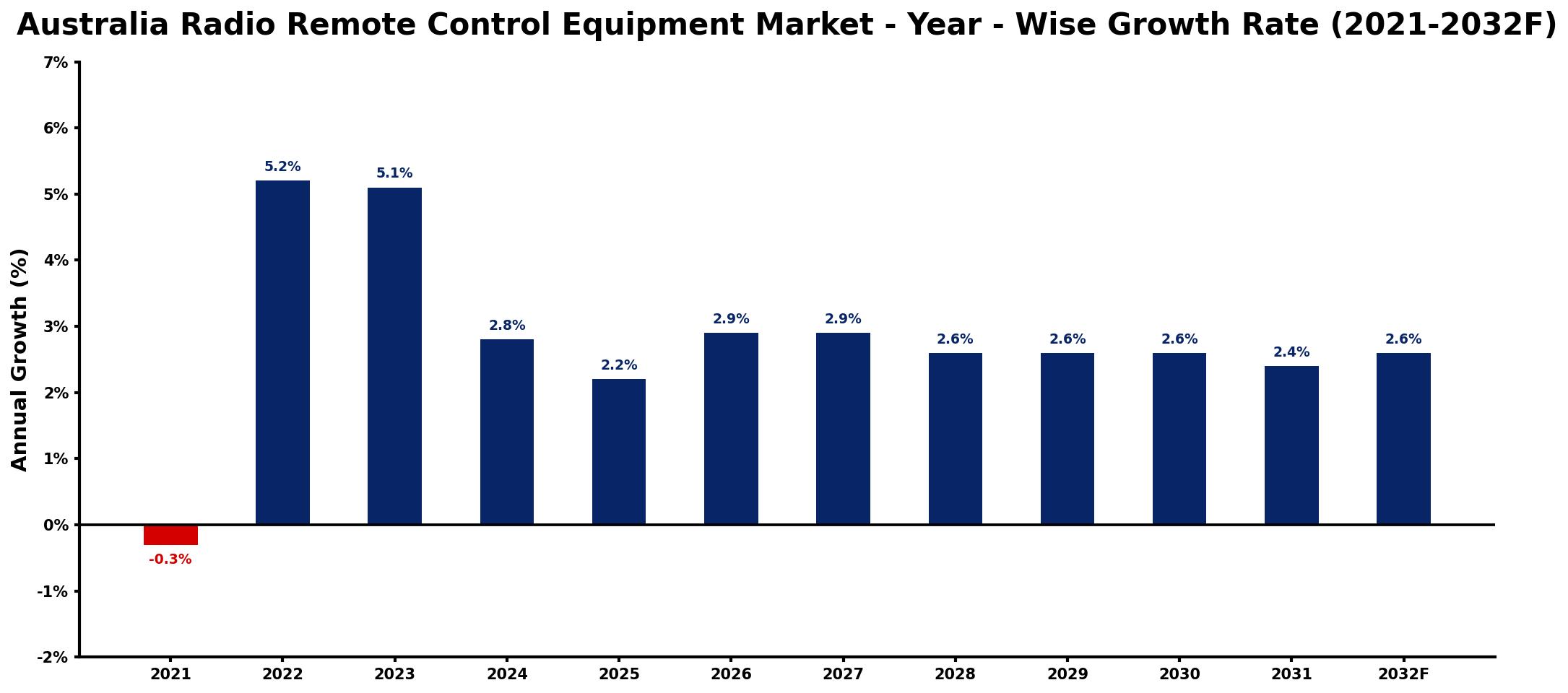
The table below presents the year‑wise growth rates along with the key drivers influencing the market
| Year | Growth Rate | Major Drivers |
| 2021 | -0.3% | decreased industrial automation investments |
| 2022 | 5.2% | increased consumer electronics demand |
| 2023 | 5.1% | growing interest in smart homes |
| 2024 | 2.8% | expansion of drone applications |
| 2025 | 2.2% | rising demand for robotics |
| 2026 | 2.9% | enhanced connectivity in vehicles |
| 2027 | 2.9% | growing industrial IoT solutions |
| 2028 | 2.6% | increased adoption of AI technologies |
| 2029 | 2.6% | improved raw material availability |
| 2030 | 2.6% | growth in agricultural automation |
| 2031 | 2.4% | rising investments in infrastructure |
| 2032 | 2.6% | increased focus on energy efficiency |
Note: Market size estimations and growth projections presented in this report are based on 6Wresearch's proprietary forecasting methodology, utilizing the latest available industry data, government publications, and primary research inputs.
Australia Radio Remote Control Equipment Market Synopsis
A significant demand for radio remote control equipment in Australia is evident, particularly in sectors like construction and robotics. These devices provide essential support in applications such as crane operations, where safe and efficient remote management is critical. The adaptability of these technologies is poised to meet the increasing complexities of modern industrial requirements.
As organizations strive to enhance productivity, the integration of radio remote controls in consumer electronics, notably in gaming and smart devices, is gaining traction. This evolving landscape emphasizes the importance of innovation in radio remote control equipment, highlighting its growing relevance across multiple industries.
Australia Radio Remote Control Equipment Market Key Takeaways
- The market is witnessing a robust CAGR of 2.3% from 2026 to 2032.
- Industrial automation is a key driver, enhancing safety and efficiency in operations.
- Technological advancements are leading to the adoption of innovative wireless control solutions.
- Consumer preferences are shifting towards smart home applications, impacting traditional remote devices.
- Compliance with regulatory standards ensures reliable performance and safety in radio remote control systems.
Evaluation of Restraints in Australia Radio Remote Control Equipment Market
Despite its growth prospects, the Australia Radio Remote Control Equipment Market faces several constraints. One prominent challenge is the increasing competition from alternative technologies such as Bluetooth and Wi-Fi-based remote control systems, which provide greater flexibility and range. Additionally, the high costs associated with radio frequency licensing and the complexities of compliance with safety standards can be significant barriers for manufacturers. Furthermore, as consumer preferences evolve towards integrated smart home systems, there is a marked decline in the demand for conventional radio remote control devices.
Australia Radio Remote Control Equipment Market Trends
Current trends indicate a strong shift towards the integration of advanced technologies within the radio remote control equipment landscape. The rise of automation in industries such as construction and manufacturing is pushing for more sophisticated control systems. Moreover, the fusion of artificial intelligence with remote control solutions is enhancing operational capabilities, reducing latency, and improving overall user experience. There is also a noticeable trend towards energy-efficient designs, aligning with global sustainability goals.
Australia Radio Remote Control Equipment Market Opportunities
The Australian market presents several opportunities for growth and investment, particularly in areas such as industrial automation and robotics. Advanced frequency hopping technologies and ultra-low-latency control systems are poised to attract investment, providing developers with the tools to create more efficient and reliable solutions. Furthermore, the rise in smart home applications opens avenues for innovative product development, tapping into the demand for seamless connectivity and user-friendly interfaces.
Government Initiatives in the Australia Radio Remote Control Equipment Market
The regulatory framework governing the radio remote control equipment market in Australia is primarily shaped by the Australian Communications and Media Authority (ACMA). This authority ensures that all radio remote control devices adhere to stringent safety, electromagnetic compatibility, and operational standards to mitigate interference with other communication technologies. Additionally, the Australian government is actively promoting the incorporation of advanced remote control technologies across sectors such as manufacturing and entertainment, underscoring its commitment to fostering innovation and competitiveness in the industry.
Future Insights of the Australia Radio Remote Control Equipment Market
Looking ahead to the period of 2026-2032, the Australia Radio Remote Control Equipment Market is set to evolve significantly. The increasing emphasis on automation and efficiency in various industries will likely drive demand for sophisticated remote control solutions. As companies seek to leverage cutting-edge technologies, the integration of AI and advanced wireless communication systems will play a pivotal role. Moreover, the ongoing shift towards smart home environments will necessitate innovative product offerings, ensuring that the market remains dynamic and responsive to changing consumer needs.
Australia Radio Remote Control Equipment Market Latest Developments (2025 - 2026)
Recent developments within the Australia Radio Remote Control Equipment Market indicate a growing focus on technological advancements and enhanced user experiences. Companies are increasingly investing in research and development to introduce next-generation remote control systems that offer improved reliability and functionality. Additionally, industry stakeholders are exploring strategic partnerships to expand their product offerings and enhance market reach. This collaborative approach is fostering innovation and ensuring that the industry remains aligned with emerging consumer preferences and technological advancements.
Australia Radio Remote Control Equipment Market - Key Attractiveness of the Report
- 10 Years of Market Numbers
- Historical Data Starting from 2022 to 2025
- Base Year: 2025
- Forecast Data until 2032
- Key Performance Indicators Impacting the Market
- Major Upcoming Developments and Projects
Key Highlights of the Report:
- Australia Radio Remote Control Equipment Market Outlook
- Market Size of Australia Radio Remote Control Equipment Market, 2025
- Forecast of Australia Radio Remote Control Equipment Market, 2032
- Historical Data and Forecast of Australia Radio Remote Control Equipment Revenues & Volume for the Period 2022-2032F
- Australia Radio Remote Control Equipment Market Trend Evolution
- Australia Radio Remote Control Equipment Market Drivers and Challenges
- Australia Radio Remote Control Equipment Price Trends
- Australia Radio Remote Control Equipment Porter's Five Forces
- Australia Radio Remote Control Equipment Industry Life Cycle
- Historical Data and Forecast of Australia Radio Remote Control Equipment Market Revenues & Volume By Type for the Period 2022-2032F
- Historical Data and Forecast of Australia Radio Remote Control Equipment Market Revenues & Volume By Pushbutton for the Period 2022-2032F
- Historical Data and Forecast of Australia Radio Remote Control Equipment Market Revenues & Volume By Joystick for the Period 2022-2032F
- Historical Data and Forecast of Australia Radio Remote Control Equipment Market Revenues & Volume By Application for the Period 2022-2032F
- Historical Data and Forecast of Australia Radio Remote Control Equipment Market Revenues & Volume By Industry & Logistics for the Period 2022-2032F
- Historical Data and Forecast of Australia Radio Remote Control Equipment Market Revenues & Volume By Construction Crane for the Period 2022-2032F
- Historical Data and Forecast of Australia Radio Remote Control Equipment Market Revenues & Volume By Mobile Hydraulics for the Period 2022-2032F
- Historical Data and Forecast of Australia Radio Remote Control Equipment Market Revenues & Volume By Forestry for the Period 2022-2032F
- Historical Data and Forecast of Australia Radio Remote Control Equipment Market Revenues & Volume By Mining for the Period 2022-2032F
- Historical Data and Forecast of Australia Radio Remote Control Equipment Market Revenues & Volume By Others for the Period 2022-2032F
- Australia Radio Remote Control Equipment Import Export Trade Statistics
- Market Opportunity Assessment By Type
- Market Opportunity Assessment By Application
- Australia Radio Remote Control Equipment Top Companies Market Share
- Australia Radio Remote Control Equipment Competitive Benchmarking By Technical and Operational Parameters
- Australia Radio Remote Control Equipment Company Profiles
- Australia Radio Remote Control Equipment Key Strategic Recommendations






































