Australia Refined Petroleum Products Market: Import Trend Analysis
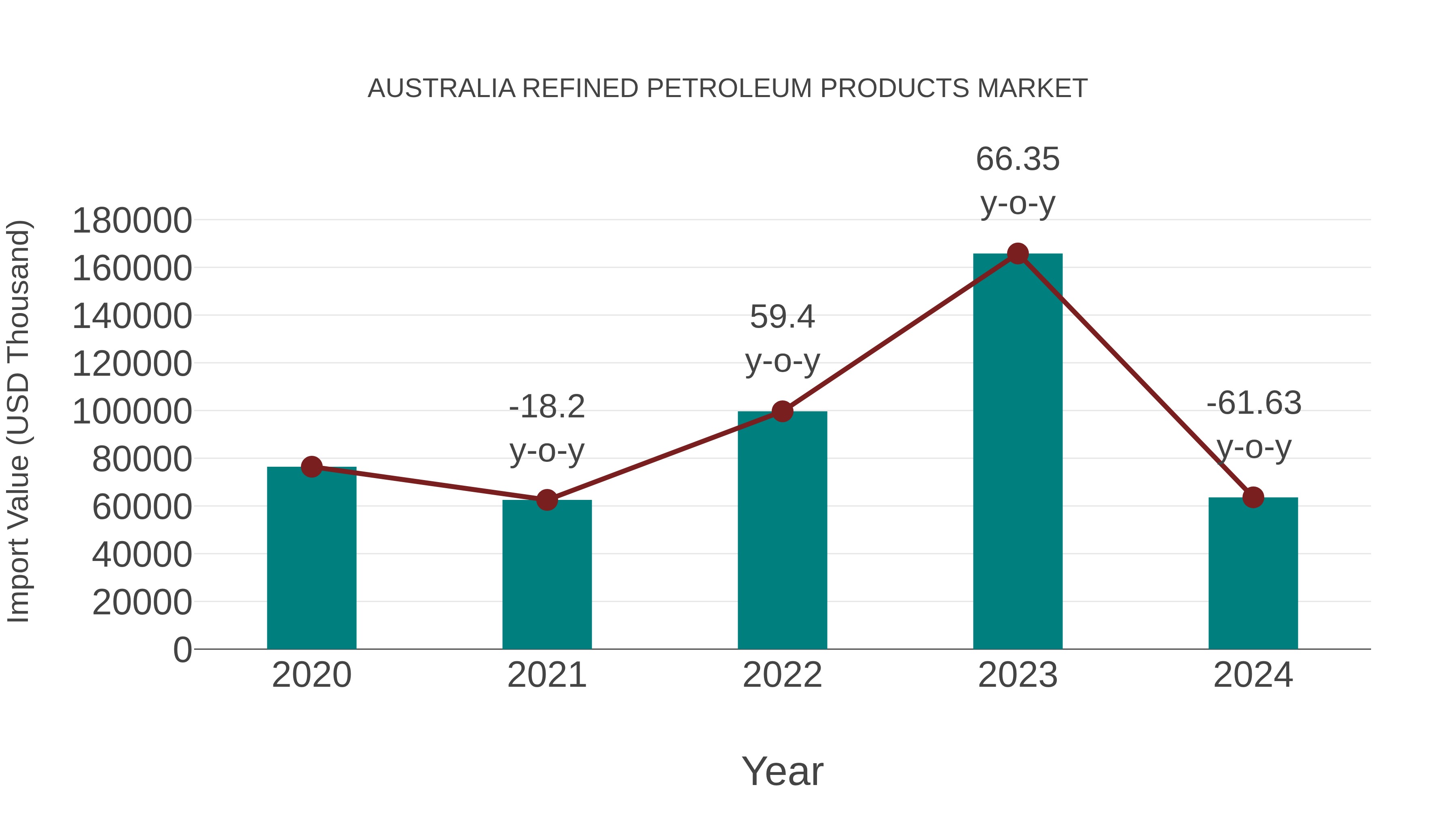
In the Australia refined petroleum products market, the import trend experienced a significant decline from 2023 to 2024, with a notable growth rate of -61.63%. The compound annual growth rate (CAGR) for the period 2020-2024 stood at -4.49%. This sharp decrease in imports can be attributed to shifting demand patterns or potential changes in trade policies impacting market dynamics.
Australia Refined Petroleum Products Market Synopsis
The refined petroleum products market in Australia is influenced by domestic fuel consumption, industrial demand, and global oil price fluctuations. The market encompasses gasoline, diesel, jet fuel, and lubricants used across various sectors, including transportation, manufacturing, and energy. Government policies on emissions reduction and the shift toward alternative energy sources are reshaping the industry`s long-term outlook, with an increasing focus on biofuels and renewable energy integration.
Drivers of the market
Australias demand for refined petroleum products remains strong due to transportation, industrial, and power generation needs. While the shift towards renewable energy is gaining momentum, refined petroleum remains a critical component of the countrys energy mix, influencing market stability.
Challenges of the market
Australias refined petroleum products market struggles with increasing import dependency and environmental regulations. The closure of several domestic refineries has led to greater reliance on imported fuels, exposing the market to global price fluctuations. Additionally, government policies promoting renewable energy and electric vehicles are gradually reducing the demand for traditional petroleum products.
Investment opportunities in the Market
Australia`s refined petroleum products market remains a key sector due to its role in transportation, industrial operations, and energy production. Investment opportunities exist in upgrading domestic refineries for improved efficiency, expanding alternative fuel production, and leveraging government initiatives promoting cleaner fuel technologies and sustainable energy solutions.
Government Policy of the market
The refined petroleum products market in Australia is regulated under the Australian Petroleum Statistics framework and the National Greenhouse and Energy Reporting (NGER) Scheme. The government has policies to reduce dependency on imported fuel, promote fuel security, and regulate emissions from petroleum-based products. Strict environmental standards are in place under the Fuel Quality Standards Act to ensure that refined fuels meet safety and sustainability criteria. Additionally, policies encourage investments in alternative energy sources and biofuels to transition toward cleaner energy solutions while maintaining a stable petroleum supply for industrial and consumer use.
Key Highlights of the Report:
- Australia Refined Petroleum Products Market Outlook
- Market Size of Australia Refined Petroleum Products Market, 2025
- Forecast of Australia Refined Petroleum Products Market, 2032
- Historical Data and Forecast of Australia Refined Petroleum Products Revenues & Volume for the Period 2022-2032F
- Australia Refined Petroleum Products Market Trend Evolution
- Australia Refined Petroleum Products Market Drivers and Challenges
- Australia Refined Petroleum Products Price Trends
- Australia Refined Petroleum Products Porter's Five Forces
- Australia Refined Petroleum Products Industry Life Cycle
- Historical Data and Forecast of Australia Refined Petroleum Products Market Revenues & Volume By Product Type for the Period 2022-2032F
- Historical Data and Forecast of Australia Refined Petroleum Products Market Revenues & Volume By Diesel for the Period 2022-2032F
- Historical Data and Forecast of Australia Refined Petroleum Products Market Revenues & Volume By Gasoline for the Period 2022-2032F
- Historical Data and Forecast of Australia Refined Petroleum Products Market Revenues & Volume By Fuel Oils for the Period 2022-2032F
- Historical Data and Forecast of Australia Refined Petroleum Products Market Revenues & Volume By Kerosene for the Period 2022-2032F
- Historical Data and Forecast of Australia Refined Petroleum Products Market Revenues & Volume By Others for the Period 2022-2032F
- Historical Data and Forecast of Australia Refined Petroleum Products Market Revenues & Volume By Application for the Period 2022-2032F
- Historical Data and Forecast of Australia Refined Petroleum Products Market Revenues & Volume By Fuel for the Period 2022-2032F
- Historical Data and Forecast of Australia Refined Petroleum Products Market Revenues & Volume By Chemical for the Period 2022-2032F
- Historical Data and Forecast of Australia Refined Petroleum Products Market Revenues & Volume By Others for the Period 2022-2032F
- Historical Data and Forecast of Australia Refined Petroleum Products Market Revenues & Volume By Fraction for the Period 2022-2032F
- Historical Data and Forecast of Australia Refined Petroleum Products Market Revenues & Volume By Light Distillates for the Period 2022-2032F
- Historical Data and Forecast of Australia Refined Petroleum Products Market Revenues & Volume By Middle Distillates for the Period 2022-2032F
- Historical Data and Forecast of Australia Refined Petroleum Products Market Revenues & Volume By Heavy Oils for the Period 2022-2032F
- Australia Refined Petroleum Products Import Export Trade Statistics
- Market Opportunity Assessment By Product Type
- Market Opportunity Assessment By Application
- Market Opportunity Assessment By Fraction
- Australia Refined Petroleum Products Top Companies Market Share
- Australia Refined Petroleum Products Competitive Benchmarking By Technical and Operational Parameters
- Australia Refined Petroleum Products Company Profiles
- Australia Refined Petroleum Products Key Strategic Recommendations






































