Australia Relays and Industrial Controls Market Summary
The australia relays and industrial controls market was estimated at USD 157 Million in 2025 and is projected to reach USD 185 Million by 2032, growing at a CAGR of 2.4% from 2026 to 2032.
Australia Relays and Industrial Controls Market Year-wise Growth Rate and Key Drivers
This graph highlights how the Australia Relays and Industrial Controls Market has steadily grown over the past five years, supported by major growth factors.
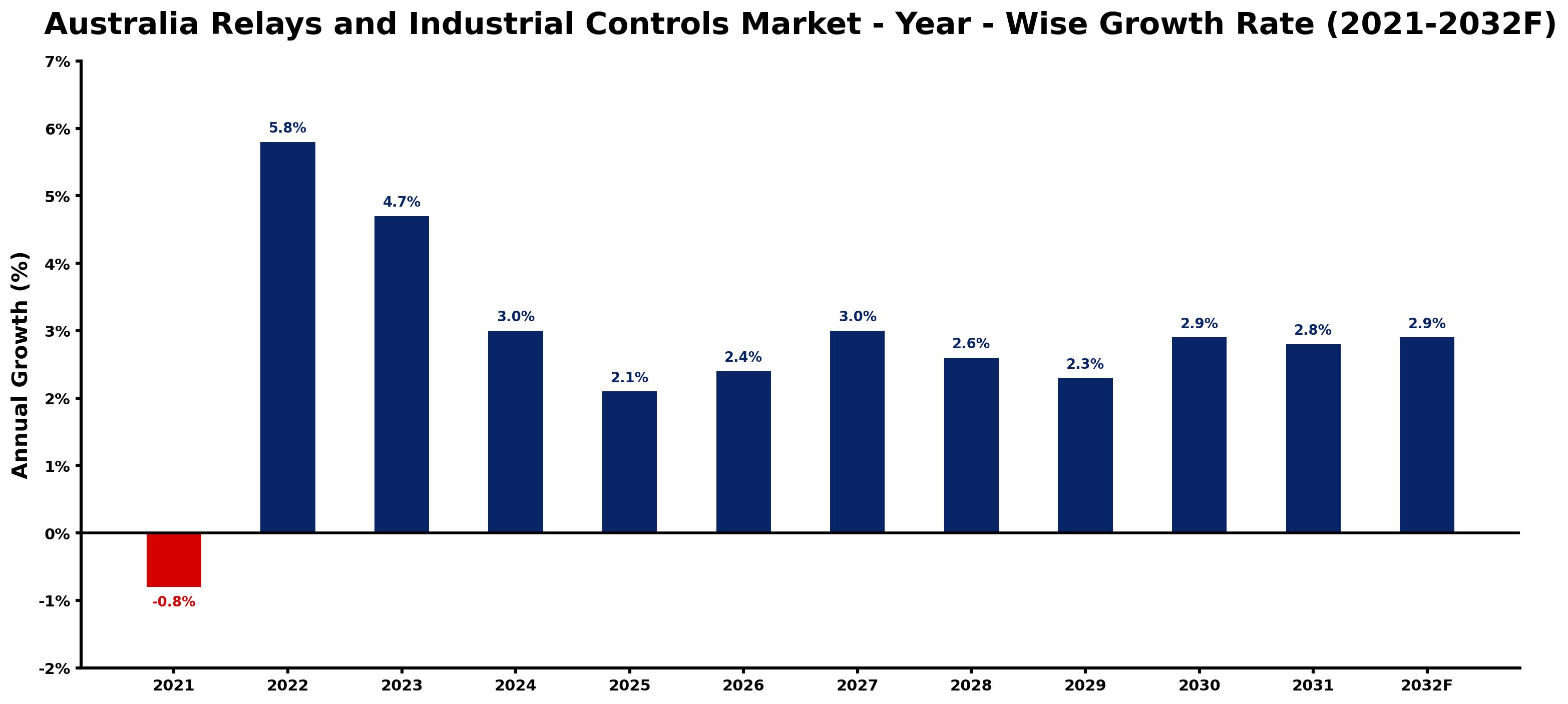
The table below presents the year wise growth rates along with the key drivers influencing the market
| Year | Growth Rate | Major Drivers |
| 2021 | -0.8% | Supply chain disruptions due to pandemicrelated restrictions hindered timely delivery of essential components for industrial controls. |
| 2022 | 5.8% | Emerging technologies emphasize the need for reliable control systems in manufacturing. |
| 2023 | 4.7% | Sustainability shifts prompt organizations to seek energy-efficient relay solutions in Australia. |
| 2024 | 3.0% | Investment in smart grid technology enhances the operational efficiency of industrial controls. |
| 2025 | 2.1% | Data-driven insights drive organizations to upgrade legacy systems for improved performance. |
| 2026 | 2.4% | Collaborative robotics adoption necessitates advanced relays for seamless machine-to-machine communication. |
| 2027 | 3.0% | The mining sector's expansion requires efficient industrial control systems for safety and productivity. |
| 2028 | 2.6% | A push for renewable energy integration demands innovative control solutions in the market. |
| 2029 | 2.3% | Digital transformation initiatives lead companies to integrate smart relays for better monitoring. |
| 2030 | 2.9% | Cybersecurity concerns prompt improved technological upgrades in relay and control systems. |
| 2031 | 2.8% | A shift toward decentralized operations necessitates robust relay systems for remote management. |
| 2032 | 2.9% | Legacy systems nearing end-of-life stimulate investments in modern industrial control solutions. |
Note - Market size estimations and growth projections presented in this report are based on 6Wresearch's advanced forecasting approach, validated with industry datasets as of June 2026.
Australia Relays and Industrial Controls Market Synopsis
The Australia Relays and Industrial Controls Market is projected to reach 2.4% and witness significant growth during the forecast period (2026-2032). The marketplace is increasingly influenced by the adoption of automation across various sectors, driven by the rise of Industry 4.0 and the integration of Internet of Things (IoT) technologies that enhance operational efficiency. Additionally, government-led initiatives focused on industrial digitalization are further propelling growth in this sector. Despite this progress, challenges such as cybersecurity threats and ongoing supply chain constraints continue to shape the market dynamics.
Australia Relays and Industrial Controls Market Growth Drivers
The primary factors fostering growth in the Australia Relays and Industrial Controls Market include the following:
- Increased adoption of industrial automation technologies, which enables businesses to enhance productivity and efficiency while reducing operational costs.
- The emergence of smart factories that utilize advanced relay solutions and intelligent control systems to streamline manufacturing processes.
- Heightened demand for energy-efficient control systems that not only optimize power usage but also contribute to sustainability goals.
- Rising investments in infrastructure development and renewable energy initiatives that necessitate advanced control mechanisms for effective management.
- Growing focus on safety enhancements and precision control mechanisms that are critical in sectors such as transportation, power distribution, and manufacturing.
Australia Relays and Industrial Controls Market Challenges and Restraints
While the Australia Relays and Industrial Controls Market shows promise, it is not without its challenges, which include:
- Supply chain disruptions that impact the availability of advanced components, leading to delays in product development and deployment.
- High import dependency for specialized components, which may affect cost structures and pricing strategies for manufacturers.
- The necessity for continuous innovation in automation and control technologies, resulting in increased research and development costs.
- Cybersecurity risks that arise from the integration of IoT and digital solutions, requiring enhanced protection measures to safeguard operational integrity.
- Market volatility influenced by global economic conditions, which can result in fluctuating demand for industrial controls and relay systems.
Australia Relays and Industrial Controls Market Investment Opportunities
Investment opportunities within the Australia Relays and Industrial Controls Market are burgeoning due to several compelling trends:
- The transition toward digital and IoT-enabled control systems represents a significant opportunity for investments in innovative technologies and infrastructures.
- Growing interest in smart grid solutions necessitates advanced relay technologies that improve energy management and distribution.
- Increasing public and private sector commitments to renewable energy projects create demand for modern control systems that support sustainable practices.
- Adoption of smart building technologies leads to opportunities within the construction and real estate markets for integrated control solutions.
- Compliance with evolving safety and quality regulations encourages investments in high-standard products and innovation across the market.
Australia Relays and Industrial Controls Market Government Investment and Initiatives
The regulatory framework governing the Australia Relays and Industrial Controls Market includes robust policies aimed at fostering growth and ensuring product safety. The Australian Communications and Media Authority (ACMA) and the Electrical Equipment Safety System (EESS) oversee compliance with electrical safety and electromagnetic interference controls. Key initiatives include:
- Government-led funding and incentives aimed at advancing research and development in automation and control systems.
- Support for the establishment of standards that ensure the safety and reliability of electrical devices within the market.
- Public spending on infrastructure projects that necessitate the incorporation of advanced relay technologies for enhanced operational efficiency.
- Promotion of digital transformation efforts across industries to encourage the adoption of smart manufacturing technologies.
- Collaboration with industry stakeholders to align regulatory frameworks with international quality standards for electrical equipment.
Australia Relays and Industrial Controls Market Latest Developments (May 2025 - June 2026)
Recent developments in the Australia Relays and Industrial Controls Market reflect a concerted effort toward innovation and adaptation. The period from May 2025 to June 2026 has seen a marked increase in investment in smart manufacturing technologies. Additionally, regulatory bodies have introduced new standards aimed at improving compliance for IoT-enabled control systems. There has been a surge in partnerships between technology providers and industrial firms focusing on integrating advanced relay systems into existing infrastructures. Furthermore, initiatives to bolster cybersecurity measures have gained momentum, ensuring that as automation increases, risks are mitigated. These trends indicate a proactive approach by industry stakeholders to navigate challenges while capitalizing on emerging opportunities.
Australia Relays and Industrial Controls Market - Key Attractiveness of the Report
- 10 Years of Market Numbers
- Historical Data Starting from 2022 to 2025
- Base Year: 2025
- Forecast Data until 2032
- Key Performance Indicators Impacting the Market
- Major Upcoming Developments and Projects
Key Highlights of the Report:
- Australia Relays and Industrial Controls Market Outlook
- Market Size of Australia Relays and Industrial Controls Market, 2025
- Forecast of Australia Relays and Industrial Controls Market, 2032
- Historical Data and Forecast of Australia Relays and Industrial Controls Revenues & Volume for the Period 2022-2032F
- Australia Relays and Industrial Controls Market Trend Evolution
- Australia Relays and Industrial Controls Market Drivers and Challenges
- Australia Relays and Industrial Controls Price Trends
- Australia Relays and Industrial Controls Porter's Five Forces
- Australia Relays and Industrial Controls Industry Life Cycle
- Historical Data and Forecast of Australia Relays and Industrial Controls Market Revenues & Volume By Control System for the Period 2022-2032F
- Historical Data and Forecast of Australia Relays and Industrial Controls Market Revenues & Volume By Distributed Control System (DCS) for the Period 2022-2032F
- Historical Data and Forecast of Australia Relays and Industrial Controls Market Revenues & Volume By Supervisory Control & Data Acquisition System (SCADA) for the Period 2022-2032F
- Historical Data and Forecast of Australia Relays and Industrial Controls Market Revenues & Volume By Manufacturing Execution System (MES) for the Period 2022-2032F
- Historical Data and Forecast of Australia Relays and Industrial Controls Market Revenues & Volume By Applications for the Period 2022-2032F
- Historical Data and Forecast of Australia Relays and Industrial Controls Market Revenues & Volume By Automotive for the Period 2022-2032F
- Historical Data and Forecast of Australia Relays and Industrial Controls Market Revenues & Volume By Industrial for the Period 2022-2032F
- Historical Data and Forecast of Australia Relays and Industrial Controls Market Revenues & Volume By Communications for the Period 2022-2032F
- Historical Data and Forecast of Australia Relays and Industrial Controls Market Revenues & Volume By Household Appliance for the Period 2022-2032F
- Historical Data and Forecast of Australia Relays and Industrial Controls Market Revenues & Volume By Others for the Period 2022-2032F
- Australia Relays and Industrial Controls Import Export Trade Statistics
- Market Opportunity Assessment By Control System
- Market Opportunity Assessment By Applications
- Australia Relays and Industrial Controls Top Companies Market Share
- Australia Relays and Industrial Controls Competitive Benchmarking By Technical and Operational Parameters
- Australia Relays and Industrial Controls Company Profiles
- Australia Relays and Industrial Controls Key Strategic Recommendations






































