Australia Remote Workplace Services Market Size & Growth Rate (2026-2032)
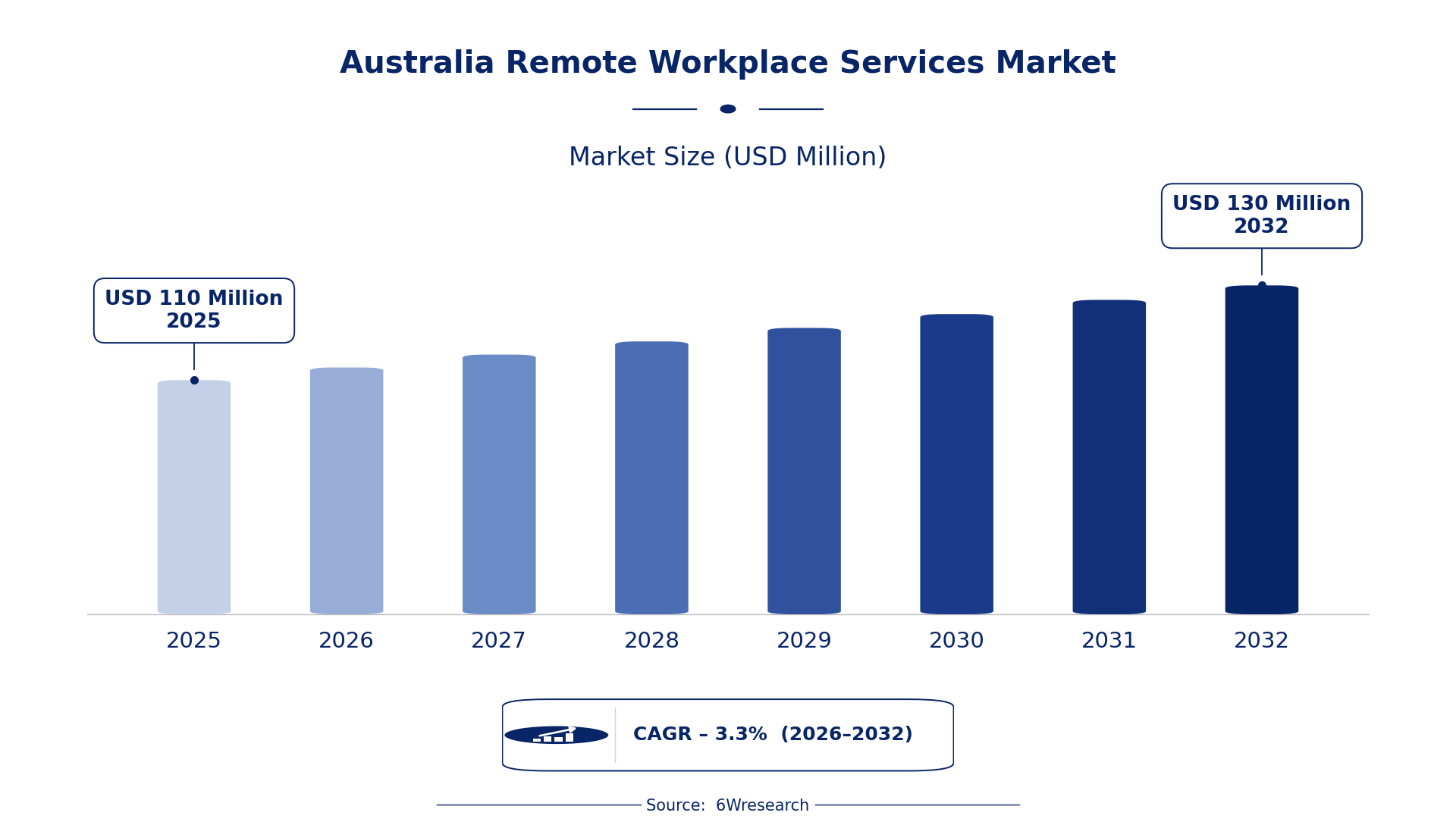
The Australia Remote Workplace Services Market was estimated at USD 110 Million in 2025 and is projected to reach USD 130 Million by 2032, growing at a CAGR of 3.3% from 2026 to 2032.
Australia Remote Workplace Services Market Synopsis
The remote workplace services sector in Australia is witnessing a transformative phase, driven by the shift towards hybrid and remote work models. Companies are increasingly investing in cloud-based solutions and cybersecurity measures to bolster productivity while ensuring data integrity.
With supportive government policies advocating for digital transformation and workplace flexibility, the market is on an upward trajectory. This shift not only enhances workforce efficiency but also reshapes organizational structures to accommodate new working paradigms.
Australia Remote Workplace Services Market Year-wise Growth Rate and Key Drivers
This graph illustrates the annual growth rates of the Australia Remote Workplace Services Market from 2021 to 2032, highlighting a steady upward trajectory and projected expansion over the forecast period.
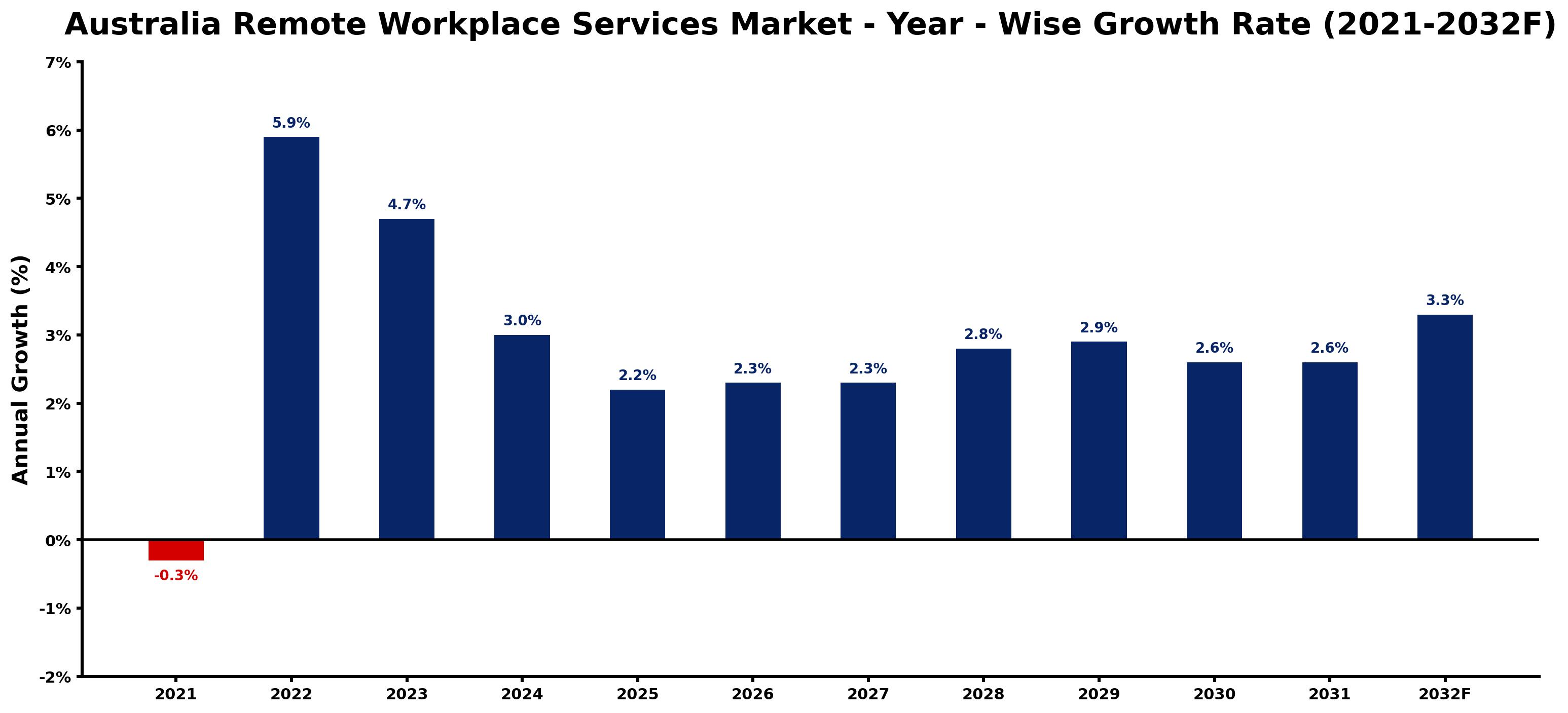
The table below presents the year‑wise growth rates along with the key drivers influencing the market
| Year | Growth Rate | Major Drivers |
| 2021 | -0.3% | Australia's JobKeeper program reduced remote service demand. |
| 2022 | 5.9% | Australian government's support for digital transformation initiatives |
| 2023 | 4.7% | Increased focus on remote work policies by corporations |
| 2024 | 3.0% | Rising adoption of cloud-based collaboration tools in enterprises |
| 2025 | 2.2% | Workplace safety regulations driving remote work technology investments |
| 2026 | 2.3% | Digital literacy programs boosting remote workforce capabilities |
| 2027 | 2.3% | Local businesses adopting hybrid work models for flexibility |
| 2028 | 2.8% | Increased cybersecurity mandates encouraging remote access solutions |
| 2029 | 2.9% | Growth in Australian startups focusing on remote workforce solutions |
| 2030 | 2.6% | Government incentives for telecommuting and productivity enhancements |
| 2031 | 2.6% | Local demand for ergonomic home office equipment rising |
| 2032 | 3.3% | Enhancements in virtual reality tools for team collaboration |
Note: Market size estimations and growth projections presented in this report are based on 6Wresearch's proprietary forecasting methodology, utilizing the latest available industry data, government publications, and primary research inputs.
Australia Remote Workplace Services Market Key Takeaways
Below are some of the specific key takeaways from the market, including:
- The rising demand for secure collaboration tools continues to drive market growth.
- Investment in cloud-based infrastructure is crucial for enhancing user experience.
- Small and medium-sized enterprises (SMEs) represent a significant growth opportunity in the sector.
- Partnerships with telecom and cloud service providers are essential for market expansion.
- Cybersecurity remains a critical focus area as companies adapt to remote work environments.
Evaluation of Restraints in Australia Remote Workplace Services Market
Despite robust growth, the Australia Remote Workplace Services Market faces notable challenges. Cybersecurity threats pose a persistent risk, necessitating substantial investments in secure collaboration tools. on top of that, high infrastructure costs can deter smaller companies from adopting advanced solutions. Compatibility issues with legacy systems complicate integration efforts, hindering operational efficiency and slowing down the market's overall growth.
Australia Remote Workplace Services Market Trends
Several trends are currently shaping the demand for remote workplace services in Australia. A noticeable shift towards hybrid work arrangements has fueled the need for versatile collaboration tools that cater to both in-office and remote employees. on top of that, organizations are increasingly prioritizing data security, leading to a surge in demand for advanced cybersecurity solutions.
The rise of artificial intelligence and machine learning in workplace services is also gaining traction, offering predictive analytics and automated processes that enhance productivity. As companies strive for operational excellence, these trends will likely continue to evolve, further influencing market dynamics.
Australia Remote Workplace Services Market Opportunities
The remote workplace services market in Australia is ripe with investment opportunities. Companies can explore avenues such as developing secure virtual desktop platforms and enhancing real-time collaboration tools. With the increasing adoption of remote work, focusing on small and medium-sized enterprises (SMEs) can yield substantial growth. Collaborations with cloud service providers and telecom companies will further facilitate market expansion, enabling businesses to offer tailored solutions that meet evolving customer needs.
Government Initiatives in the Australia Remote Workplace Services Market
Government policies are crucial in shaping the Australia Remote Workplace Services Market. Regulatory frameworks and public-sector priorities focus on promoting digital transformation and ensuring data privacy in remote work environments. As the government encourages innovation in workplace solutions, these initiatives are set to play a significant role in market growth.
- A recently completed initiative mandated the use of encrypted communication channels for remote work, enhancing data security across sectors.
- A current program is underway to expand the national digital infrastructure, improving access to reliable remote work services.
- A planned public-private partnership aims to develop secure virtual collaboration tools by 2027, targeting SMEs specifically.
- The government has introduced guidelines for remote workplace compliance under the Fair Work Act, ensuring employee rights and data protection.
Future Insights of the Australia Remote Workplace Services Market
Looking ahead to 2026-2032, the Australia Remote Workplace Services Market is set to continue its upward trajectory. As hybrid work models become the norm, demand for integrated solutions that combine security, collaboration, and user experience will rise. Companies that adapt quickly to these changing dynamics, particularly in the realms of cybersecurity and cloud services, will position themselves advantageously for future growth. Innovation in technology, alongside supportive government policies, will further solidify the market's foundation.
Australia Remote Workplace Services Market Latest Developments
In the past year, the Australia Remote Workplace Services Market has seen significant developments reflecting the broader trends of remote work. Organizations are not only enhancing their technological capabilities but also focusing on employee well-being and productivity.
- A major technology vendor launched a new suite of virtual collaboration tools in early 2025, designed to improve user engagement and productivity.
- An initiative focused on cybersecurity training for remote employees began in mid-2025 and remains underway, emphasizing the importance of secure practices.
- A leading regional operator is expected to roll out an advanced cloud-based infrastructure service in Q3 2025 to support hybrid work environments.
- A partnership between telecom companies aimed at expanding 5G access for remote workers was finalized in early 2025, enhancing connectivity options.
Australia Remote Workplace Services Market - Key Attractiveness of the Report
- 10 Years of Market Numbers
- Historical Data Starting from 2022 to 2025
- Base Year: 2025
- Forecast Data until 2032
- Key Performance Indicators Impacting the Market
- Major Upcoming Developments and Projects
Key Highlights of the Report:
- Australia Remote Workplace Services Market Outlook
- Market Size of Australia Remote Workplace Services Market, 2025
- Forecast of Australia Remote Workplace Services Market, 2032
- Historical Data and Forecast of Australia Remote Workplace Services Revenues & Volume for the Period 2022-2032F
- Australia Remote Workplace Services Market Trend Evolution
- Australia Remote Workplace Services Market Drivers and Challenges
- Australia Remote Workplace Services Price Trends
- Australia Remote Workplace Services Porter's Five Forces
- Australia Remote Workplace Services Industry Life Cycle
- Historical Data and Forecast of Australia Remote Workplace Services Market Revenues & Volume By Component for the Period 2022-2032F
- Historical Data and Forecast of Australia Remote Workplace Services Market Revenues & Volume By Solutions for the Period 2022-2032F
- Historical Data and Forecast of Australia Remote Workplace Services Market Revenues & Volume By Services for the Period 2022-2032F
- Historical Data and Forecast of Australia Remote Workplace Services Market Revenues & Volume By Deployment Mode for the Period 2022-2032F
- Historical Data and Forecast of Australia Remote Workplace Services Market Revenues & Volume By On-Premises for the Period 2022-2032F
- Historical Data and Forecast of Australia Remote Workplace Services Market Revenues & Volume By Cloud for the Period 2022-2032F
- Historical Data and Forecast of Australia Remote Workplace Services Market Revenues & Volume By Organization Size for the Period 2022-2032F
- Historical Data and Forecast of Australia Remote Workplace Services Market Revenues & Volume By Large Enterprises for the Period 2022-2032F
- Historical Data and Forecast of Australia Remote Workplace Services Market Revenues & Volume By SMEs for the Period 2022-2032F
- Historical Data and Forecast of Australia Remote Workplace Services Market Revenues & Volume By Vertical for the Period 2022-2032F
- Historical Data and Forecast of Australia Remote Workplace Services Market Revenues & Volume By Telecommunication for the Period 2022-2032F
- Historical Data and Forecast of Australia Remote Workplace Services Market Revenues & Volume By Banking, Financial Services, & Insurance for the Period 2022-2032F
- Historical Data and Forecast of Australia Remote Workplace Services Market Revenues & Volume By IT & ITeS for the Period 2022-2032F
- Historical Data and Forecast of Australia Remote Workplace Services Market Revenues & Volume By Manufacturing for the Period 2022-2032F
- Historical Data and Forecast of Australia Remote Workplace Services Market Revenues & Volume By Retail & Consumer Goods for the Period 2022-2032F
- Historical Data and Forecast of Australia Remote Workplace Services Market Revenues & Volume By Media & Entertainment for the Period 2022-2032F
- Historical Data and Forecast of Australia Remote Workplace Services Market Revenues & Volume By Healthcare & Life Sciences for the Period 2022-2032F
- Historical Data and Forecast of Australia Remote Workplace Services Market Revenues & Volume By Government & Public Sectors for the Period 2022-2032F
- Australia Remote Workplace Services Import Export Trade Statistics
- Market Opportunity Assessment By Component
- Market Opportunity Assessment By Deployment Mode
- Market Opportunity Assessment By Organization Size
- Market Opportunity Assessment By Vertical
- Australia Remote Workplace Services Top Companies Market Share
- Australia Remote Workplace Services Competitive Benchmarking By Technical and Operational Parameters
- Australia Remote Workplace Services Company Profiles
- Australia Remote Workplace Services Key Strategic Recommendations






































