Australia Retail Industry Market Size, Share & Growth Rate
The Australia Retail Industry Market was estimated at USD 207 Million in 2025 and is projected to reach USD 282 Million by 2032, growing at a CAGR of 4.5% from 2026 to 2032. This upward trajectory is largely driven by the ongoing shift towards e-commerce, where consumers increasingly favor the convenience of online shopping. Coupled with this trend is a notable demand for sustainable and locally sourced products, further driving growth within the sector.
Australia Retail Industry Market Year-wise Growth Rate and Key Drivers
This graph highlights how the Australia Retail Industry Market has steadily grown over the years, supported by major growth factors.
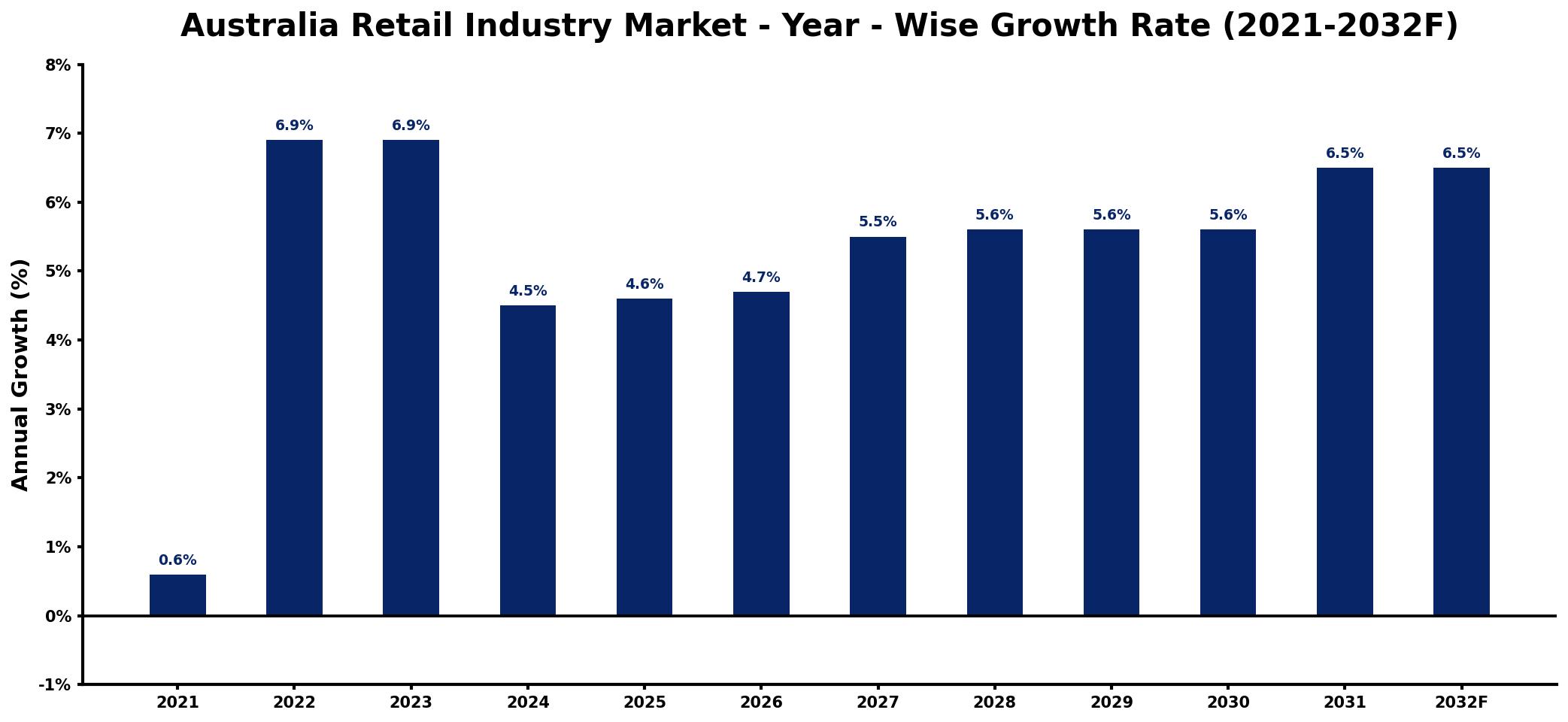
The table below presents the year‑wise growth rates along with the key drivers influencing the market
| Year | Growth Rate | Major Drivers |
| 2021 | 0.6% | E-commerce adoption accelerates rapidly |
| 2022 | 6.9% | Consumer spending rebounds significantly |
| 2023 | 6.9% | Technological innovations drive efficiency |
| 2024 | 4.5% | Sustainable practices gain traction |
| 2025 | 4.6% | Omnichannel strategies enhance engagement |
| 2026 | 4.7% | Local sourcing becomes increasingly popular |
| 2027 | 5.5% | Personalization trends attract consumers |
| 2028 | 5.6% | Digital payment solutions expand usage |
| 2029 | 5.6% | Health and wellness demand rises |
| 2030 | 5.6% | Social media influences purchasing decisions |
| 2031 | 6.5% | Experiential shopping experiences flourish |
| 2032 | 6.5% | Loyalty programs enhance customer retention |
Note: Market size estimations and growth projections presented in this report are based on 6Wresearch's proprietary forecasting methodology, utilizing the latest available industry data, government publications, and primary research inputs.
Australia Retail Industry Market Synopsis
The Australian retail industry is witnessing a substantial transformation, as consumers gravitate towards online platforms that offer seamless shopping experiences. This trend has spurred traditional retailers to invest in advanced omnichannel strategies to remain competitive and relevant. As a result, the integration of technology and sustainability initiatives has become central to many retail strategies.
Demand for sustainable goods is rising, reflecting a shift in consumer values toward eco-friendly practices and transparency in sourcing. This has compelled retailers to rethink their supply chains and product offerings, ensuring they align with these emerging consumer priorities.
Australia Retail Industry Market Key Takeaways
- The market is poised for significant growth, driven by increased consumer spending and digital transformation.
- Shifts in consumer preferences are emphasizing sustainability and the demand for local products.
- Investment in omnichannel retailing is critical for adapting to the changing market landscape.
- Rising operational costs and intense competition from e-commerce pose challenges for traditional retailers.
- Government regulations on consumer protection and labor laws influence market dynamics significantly.
Evaluation of Restraints in Australia Retail Industry Market
The Australia retail market faces several restraints that inhibit its growth potential. Rising operational costs, particularly in labor and rental expenses, are straining profitability for brick-and-mortar retailers who are struggling to maintain competitive pricing against online platforms. Additionally, economic uncertainties, such as inflationary pressures, are causing consumers to adjust their spending habits, further complicating the outlook for traditional retailers. The necessity for rapid adaptation to digital and omnichannel solutions adds another layer of complexity for retailers attempting to thrive in this evolving landscape.
Australia Retail Industry Market Trends
Current trends shaping the Australia retail industry include a pronounced shift towards personalized shopping experiences, facilitated by advancements in data analytics and artificial intelligence. Retailers are increasingly leveraging technology to tailor offerings to individual consumer preferences. Furthermore, the integration of sustainability practices in product development and packaging is gaining traction, aligning with consumer expectations for environmentally responsible choices.
Australia Retail Industry Market Opportunities
Investment opportunities abound as the retail landscape evolves. Expanding e-commerce infrastructure and logistics capabilities, particularly last-mile delivery services, represent significant growth areas. Additionally, retailers that embrace technology to enhance customer engagement, through AI-driven insights and innovative platforms, are likely to see substantial returns. The growing consumer demand for sustainable products also provides avenues for businesses to differentiate themselves in a crowded marketplace.
Government Initiatives in the Australia Retail Industry Market
The Australian government implements various policies that impact the retail sector, focusing on consumer protection and fair trade practices. Regulatory frameworks established by the Australian Competition and Consumer Commission (ACCC) ensure compliance with advertising standards and pricing fairness. Additionally, labor laws mandate equitable wages and conditions for retail employees, which can influence operational costs. Efforts to promote sustainability, including initiatives aimed at reducing plastic use, are also increasingly integrated into retail regulations.
Future Insights of the Australia Retail Industry Market
Looking ahead to 2026-2032, the Australia retail industry is expected to continue its robust growth trajectory, driven primarily by ongoing advancements in digital technology and consumer preferences for seamless shopping experiences. E-commerce will play an increasingly central role, pushing retailers to innovate their supply chains and customer interactions. Furthermore, sustainability will remain a pivotal focus as businesses adapt to consumer demands for responsible retailing, making it essential for retailers to embed eco-friendly practices into their operations.
Australia Retail Industry Market Latest Developments (2025 - 2026)
Recent developments in the Australia retail industry reflect a growing emphasis on digital transformation and consumer-centric strategies. Many retailers are adopting advanced technologies to enhance the shopping experience, including AI-powered customer service tools and integrated e-commerce platforms. Furthermore, there is an increasing trend among retailers to highlight their sustainability efforts, appealing to eco-conscious consumers and differentiating themselves in a competitive market landscape.
Australia Retail Industry Market - Key Attractiveness of the Report
- 10 Years of Market Numbers
- Historical Data Starting from 2022 to 2025
- Base Year: 2025
- Forecast Data until 2032
- Key Performance Indicators Impacting the Market
- Major Upcoming Developments and Projects
Key Highlights of the Report:
- Australia Retail Industry Market Outlook
- Market Size of Australia Retail Industry Market, 2025
- Forecast of Australia Retail Industry Market, 2032
- Historical Data and Forecast of Australia Retail Industry Revenues & Volume for the Period 2022-2032F
- Australia Retail Industry Market Trend Evolution
- Australia Retail Industry Market Drivers and Challenges
- Australia Retail Industry Price Trends
- Australia Retail Industry Porter's Five Forces
- Australia Retail Industry Industry Life Cycle
- Historical Data and Forecast of Australia Retail Industry Market Revenues & Volume By Product for the Period 2022-2032F
- Historical Data and Forecast of Australia Retail Industry Market Revenues & Volume By Food and Beverages for the Period 2022-2032F
- Historical Data and Forecast of Australia Retail Industry Market Revenues & Volume By Personal and Household Care for the Period 2022-2032F
- Historical Data and Forecast of Australia Retail Industry Market Revenues & Volume By Apparel, Footwear, and Accessories for the Period 2022-2032F
- Historical Data and Forecast of Australia Retail Industry Market Revenues & Volume By Furniture, Toys, and Hobby for the Period 2022-2032F
- Historical Data and Forecast of Australia Retail Industry Market Revenues & Volume By Electronic and Household Appliances for the Period 2022-2032F
- Historical Data and Forecast of Australia Retail Industry Market Revenues & Volume By Other Products for the Period 2022-2032F
- Historical Data and Forecast of Australia Retail Industry Market Revenues & Volume By Distribution Channel for the Period 2022-2032F
- Historical Data and Forecast of Australia Retail Industry Market Revenues & Volume By Supermarkets/Hypermarkets for the Period 2022-2032F
- Historical Data and Forecast of Australia Retail Industry Market Revenues & Volume By Convenience Stores for the Period 2022-2032F
- Historical Data and Forecast of Australia Retail Industry Market Revenues & Volume By Department Stores for the Period 2022-2032F
- Historical Data and Forecast of Australia Retail Industry Market Revenues & Volume By Specialty Stores for the Period 2022-2032F
- Historical Data and Forecast of Australia Retail Industry Market Revenues & Volume By Online for the Period 2022-2032F
- Historical Data and Forecast of Australia Retail Industry Market Revenues & Volume By Other Distribution Channels for the Period 2022-2032F
- Australia Retail Industry Import Export Trade Statistics
- Market Opportunity Assessment By Product
- Market Opportunity Assessment By Distribution Channel
- Australia Retail Industry Top Companies Market Share
- Australia Retail Industry Competitive Benchmarking By Technical and Operational Parameters
- Australia Retail Industry Company Profiles
- Australia Retail Industry Key Strategic Recommendations






































