Australia Revolvers Market Size, Share & Growth Rate
The Australia Revolvers Market was estimated at USD 465 Million in 2025 and is projected to reach USD 624 Million by 2032, growing at a CAGR of 4.3% from 2026 to 2032. This growth trajectory is driven primarily by ongoing demand from law enforcement agencies and licensed civilian gun owners, despite the stringent regulations that govern firearm ownership in Australia. The market is also buoyed by the niche interest in collectible and antique revolvers, as sporting shooters increasingly seek specialized models to enhance their experience in competitive environments.
Australia Revolvers Market Year-wise Growth Rate and Key Drivers
This graph highlights how the Australia Revolvers Market has steadily grown over the years, supported by major growth factors.
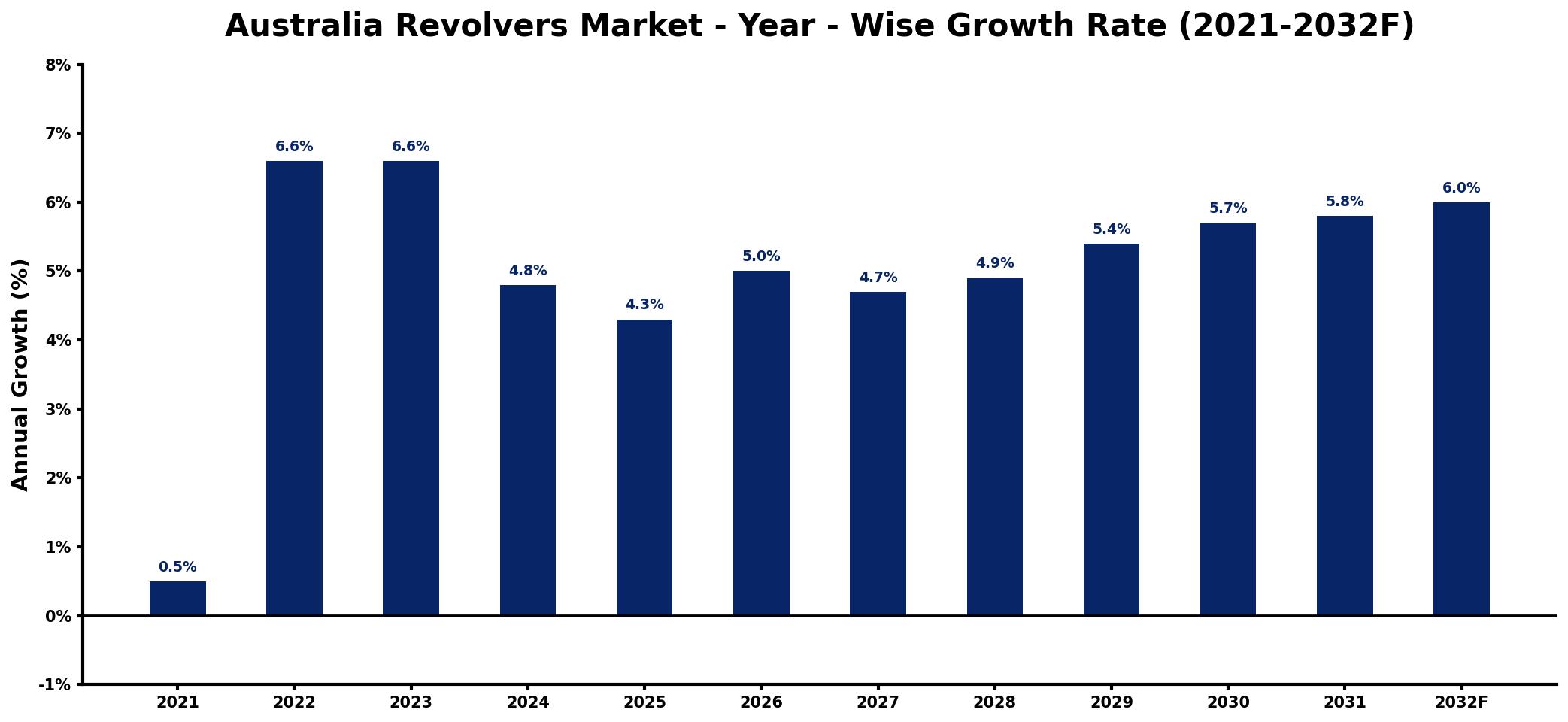
The table below presents the year‑wise growth rates along with the key drivers influencing the market
| Year | Growth Rate | Major Drivers |
| 2021 | 0.5% | Rising interest in personal safety |
| 2022 | 6.6% | Increased law enforcement funding |
| 2023 | 6.6% | Growing demand for self-defense |
| 2024 | 4.8% | Expansion of shooting sports events |
| 2025 | 4.3% | Surge in outdoor recreational activities |
| 2026 | 5.0% | Boost in military procurement contracts |
| 2027 | 4.7% | Enhanced training programs availability |
| 2028 | 4.9% | Growth in collector community interest |
| 2029 | 5.4% | Rising popularity of hunting sports |
| 2030 | 5.7% | Increased media attention on firearms |
| 2031 | 5.8% | improved raw material availability |
| 2032 | 6.0% | Growing online retail presence |
Note: Market size estimations and growth projections presented in this report are based on 6Wresearch's proprietary forecasting methodology, utilizing the latest available industry data, government publications, and primary research inputs.
Australia Revolvers Market Synopsis
While recent years have seen a steady, albeit cautious, interest in revolvers, the market is expected to shift as government policies continue to evolve. Current legislation, such as the National Firearms Agreement, imposes significant restrictions on ownership and sales, which curtails broader market expansion.
However, the enduring interest in revolvers from collectors and sport shooters provides a consistent demand channel. As competition participation grows, particularly within shooting clubs, this segment presents opportunities for targeted marketing and product development tailored to experienced users.
Australia Revolvers Market Key Takeaways
- The Australia revolvers market exhibits a projected CAGR of 4.3%, indicating modest but consistent growth through 2032.
- Government regulations impose significant constraints on market size and dynamics, particularly regarding civilian ownership.
- Demand is primarily driven by law enforcement agencies, security sectors, and the competitive sports shooting community.
- Interest in collectible and antique revolvers remains a niche yet steady market segment.
- Investment opportunities exist in compliance-focused manufacturing and expansion of training programs.
Evaluation of Restraints in Australia Revolvers Market
The revolvers market in Australia faces significant constraints primarily due to stringent government regulations regarding firearm ownership. The National Firearms Agreement enforces rigorous licensing and registration requirements that deter potential buyers and limit market expansion. Additionally, law enforcement agencies are increasingly favoring modern firearms over traditional revolvers, leading to declining demand in this key sector. Import restrictions further complicate the landscape, presenting challenges for international brands attempting to enter or grow within the Australian market.
Australia Revolvers Market Trends
Several trends are shaping the Australia revolvers market landscape. There is a rising appreciation for high-quality, precision-engineered revolvers that meet stringent safety standards. Furthermore, as the interest in recreational shooting continues to grow, more shooting clubs are emerging, facilitating a greater exposure to revolver usage. Technological advancements are also influencing the design and functionality of revolvers, paving the way for innovations aimed at enhancing user experience and safety.
Australia Revolvers Market Opportunities
Despite the restrictions, there are promising avenues for growth and investment within the Australia revolvers market. Opportunities exist in developing revolvers that emphasize safety features and comply with evolving regulations. Moreover, expanding training programs for new and existing gun owners can create additional revenue streams while promoting responsible ownership. As competition grows, marketing specialized products to sport shooters and collectors could further enhance market penetration.
Government Initiatives in the Australia Revolvers Market
The Australian government maintains strict firearm laws, which dictate the regulations surrounding revolver ownership and usage. These laws not only require comprehensive background checks and permits for ownership but also emphasize the importance of secure storage and mandatory training. Recent initiatives focus on promoting responsible gun ownership through educational programs and workshops aimed at both new and experienced shooters, fostering a culture of safety and compliance within the community.
Future Insights of the Australia Revolvers Market
Looking ahead to 2026-2032, the Australia revolvers market is poised for gradual evolution. As interest in sports shooting and collecting continues to rise, there may be a corresponding increase in demand for specialized and high-quality revolvers. Additionally, ongoing government reviews of firearm regulations could potentially ease some constraints, creating a more favorable environment for market growth. The challenge will remain to balance regulation with demand while ensuring that safety remains a priority.
Australia Revolvers Market Latest Developments (2025 - 2026)
Recent developments in the Australia revolvers market indicate a sustained interest in innovative safety features in firearm design. As manufacturers adapt to evolving regulatory standards, there is a noticeable increase in collaborations between industry stakeholders to enhance training programs. Such initiatives aim to engage new users and ensure compliance with existing laws. The focus on expanding educational outreach is paving the way for a more informed consumer base, potentially reshaping the market dynamics in the near future.
Australia Revolvers Market - Key Attractiveness of the Report
- 10 Years of Market Numbers
- Historical Data Starting from 2022 to 2025
- Base Year: 2025
- Forecast Data until 2032
- Key Performance Indicators Impacting the Market
- Major Upcoming Developments and Projects
Key Highlights of the Report:
- Australia Revolvers Market Outlook
- Market Size of Australia Revolvers Market, 2025
- Forecast of Australia Revolvers Market, 2032
- Historical Data and Forecast of Australia Revolvers Revenues & Volume for the Period 2022-2032F
- Australia Revolvers Market Trend Evolution
- Australia Revolvers Market Drivers and Challenges
- Australia Revolvers Price Trends
- Australia Revolvers Porter's Five Forces
- Australia Revolvers Industry Life Cycle
- Historical Data and Forecast of Australia Revolvers Market Revenues & Volume By Product Type for the Period 2022-2032F
- Historical Data and Forecast of Australia Revolvers Market Revenues & Volume By Semi Automatic Revolvers for the Period 2022-2032F
- Historical Data and Forecast of Australia Revolvers Market Revenues & Volume By Single and Double Action Revolvers for the Period 2022-2032F
- Historical Data and Forecast of Australia Revolvers Market Revenues & Volume By Applications for the Period 2022-2032F
- Historical Data and Forecast of Australia Revolvers Market Revenues & Volume By Civil for the Period 2022-2032F
- Historical Data and Forecast of Australia Revolvers Market Revenues & Volume By Military for the Period 2022-2032F
- Australia Revolvers Import Export Trade Statistics
- Market Opportunity Assessment By Product Type
- Market Opportunity Assessment By Applications
- Australia Revolvers Top Companies Market Share
- Australia Revolvers Competitive Benchmarking By Technical and Operational Parameters
- Australia Revolvers Company Profiles
- Australia Revolvers Key Strategic Recommendations






































