Australia Scissors and Shears Market Summary
The australia scissors and shears market was estimated at USD 222 Million in 2025 and is projected to reach USD 259 Million by 2032, growing at a CAGR of 2.9% from 2026 to 2032.
Australia Scissors and Shears Market Year-wise Growth Rate and Key Drivers
This graph highlights how the Australia Scissors and Shears Market has steadily grown over the past five years, supported by major growth factors.
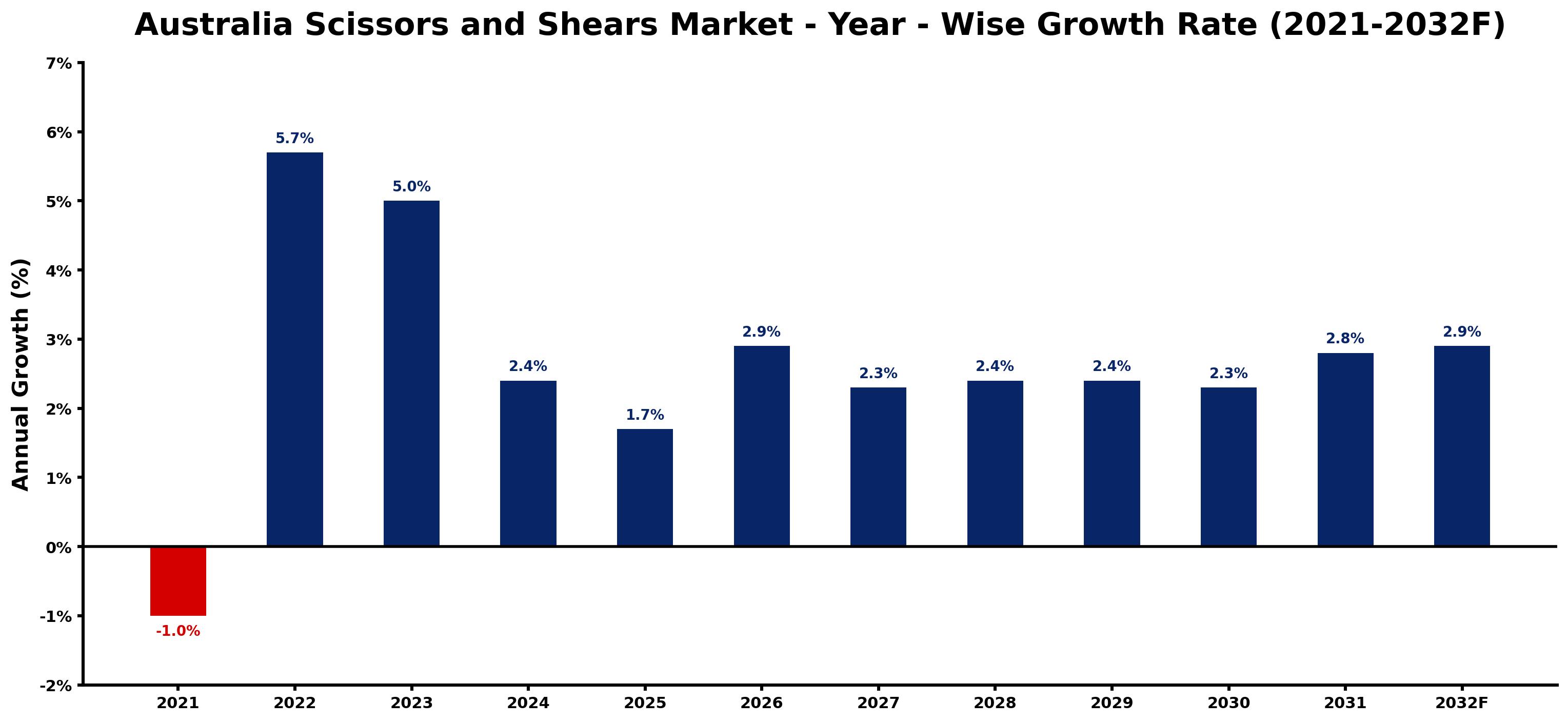
The table below presents the year wise growth rates along with the key drivers influencing the market
| Year | Growth Rate | Major Drivers |
| 2021 | -1.0% | Increased remote work trends diminished demand for professional grooming tools, impacting overall sales in the market. |
| 2022 | 5.7% | Rising popularity of DIY culture has led to more consumer engagement in gardening. |
| 2023 | 5.0% | Urban gardening trends influenced the demand for high-quality shears and scissors. |
| 2024 | 2.4% | Local manufacturers are innovating designs tailored to Australian climate conditions. |
| 2025 | 1.7% | Growing focus on sustainability encourages eco-friendly scissors and shears production. |
| 2026 | 2.9% | E-commerce platforms are expanding, making scissors and shears accessible to all consumers. |
| 2027 | 2.3% | Professional gardening services are increasing, creating a market for premium gardening tools. |
| 2028 | 2.4% | Work-from-home trends boost sales of ergonomic scissors for craft and office use. |
| 2029 | 2.4% | Educational programs about gardening enhance consumer knowledge and product interest. |
| 2030 | 2.3% | Aging population drives demand for easy-to-use and specialized grooming tools. |
| 2031 | 2.8% | Cultural festivals encourage craft activities, raising scissors demand in community events. |
| 2032 | 2.9% | Technological integration in tool design improves functionality and user experience significantly. |
Note - Market size estimations and growth projections presented in this report are based on 6Wresearch's advanced forecasting approach, validated with industry datasets as of June 2026.
Australia Scissors and Shears Market Synopsis
The Australia Scissors and Shears Market is projected to reach 2.9% and witness significant growth during the forecast period (2026-2032). This market serves a variety of sectors, including textiles, food processing, and personal grooming, reflecting a growing demand for high-quality and precision cutting tools, particularly in professional and industrial applications.
Australia Scissors and Shears Market Growth Drivers
Several key factors are propelling the expansion of the Australia Scissors and Shears Market. Firstly, the robust growth of industries such as textiles and household goods is stimulating demand for cutting tools. The rising popularity of DIY crafts and home-based tailoring businesses also plays a significant role in driving market needs. Additionally, advancements in material technology enhance product performance, leading to a preference for specialty shears, including surgical scissors and horticultural pruning shears. Consumer trends towards ergonomic designs further contribute to market growth as they seek comfort and durability.
Australia Scissors and Shears Market Challenges and Restraints
Despite the positive growth outlook, the Australia Scissors and Shears Market faces several challenges. The intense competition from cheaper imported products, particularly from Asian manufacturers, poses a significant threat to local producers. This situation is further complicated by the need for high-quality materials that ensure product durability while maintaining competitive pricing. Furthermore, a notable shift in consumer preferences towards electric cutting tools is limiting the market growth potential for traditional scissors and shears.
- High production costs associated with premium materials can deter price-sensitive consumers.
- Pressure from imports can lead to market share erosion for domestic manufacturers.
- The transition towards electric alternatives can shift consumer spending away from manual cutting tools.
- Regulatory compliance to safety standards can impose additional financial burdens.
- Limited consumer awareness of the benefits of high-quality scissors and shears can restrict market penetration.
Australia Scissors and Shears Market Trends and Opportunities
In the evolving landscape of the Australia Scissors and Shears Market, several trends are emerging that present lucrative opportunities. Investment in premium, ergonomic, and specialized cutting tools is likely to cater to niche consumer segments that prioritize quality and user comfort. The increasing preference for sustainable materials is another trend that can be capitalized on, as eco-conscious consumers seek products that align with their values. Additionally, with the growth of online retail platforms, manufacturers have the opportunity to reach a broader audience, enhancing brand visibility and sales.
- The demand for sustainable materials may lead to innovations in eco-friendly manufacturing processes.
- Ergonomically designed tools are gaining traction as consumers become more health-conscious.
- Online retailing provides an opportunity to diversify distribution channels.
- Specialty tools tailored for specific industries can enhance market penetration.
- Collaboration with DIY and crafting communities can promote product usage and brand loyalty.
Australia Scissors and Shears Market Regional Analysis
Regionally, the Australia Scissors and Shears Market is characterized by a mix of imported premium products and locally manufactured offerings. Urban areas with higher concentrations of retail outlets and industrial operations are expected to see a stronger demand for these cutting tools. As regional industries such as fashion and food processing continually evolve, they will require high-quality tools to maintain standards and efficiency. Rural and suburban areas may also exhibit increasing demand due to the rising popularity of DIY projects. Each region's unique needs and preferences will shape the competitive landscape and dictate market strategies for both local and imported products.
Australia Scissors and Shears Market Government Investment and Initiatives
The government plays a crucial role in shaping the Australia Scissors and Shears Market through various policies and initiatives. Regulatory bodies such as the Australian Competition and Consumer Commission (ACCC) enforce standards ensuring that all scissors and shears, whether imported or locally manufactured, meet safety and durability criteria. Government initiatives aimed at promoting local production can bolster the market by providing funding, training, and resources to manufacturers. Additionally, trade policies that govern the import of essential materials like stainless steel influence production costs and availability, while industry development programs assist in advancing the capabilities of local manufacturers.
Australia Scissors and Shears Market Latest Developments (May 2025 - June 2026)
In the period from May 2025 to June 2026, the Australia Scissors and Shears Market has seen notable developments focused on innovation and sustainability. Manufacturers are increasingly emphasizing the use of advanced materials and ergonomic designs in their products, catering to the evolving consumer demands for quality and comfort. The introduction of new product lines that incorporate sustainable practices has gained traction, resonating with an environmentally conscious consumer base. Additionally, industry players are exploring digital marketing strategies to enhance their online presence and engage with a wider audience, which is becoming critical in the post-pandemic market landscape.
Australia Scissors and Shears Market - Key Attractiveness of the Report
- 10 Years of Market Numbers
- Historical Data Starting from 2022 to 2025
- Base Year: 2025
- Forecast Data until 2032
- Key Performance Indicators Impacting the Market
- Major Upcoming Developments and Projects
Key Highlights of the Report:
- Australia Scissors and Shears Market Outlook
- Market Size of Australia Scissors and Shears Market, 2025
- Forecast of Australia Scissors and Shears Market, 2032
- Historical Data and Forecast of Australia Scissors and Shears Revenues & Volume for the Period 2022-2032F
- Australia Scissors and Shears Market Trend Evolution
- Australia Scissors and Shears Market Drivers and Challenges
- Australia Scissors and Shears Price Trends
- Australia Scissors and Shears Porter's Five Forces
- Australia Scissors and Shears Industry Life Cycle
- Historical Data and Forecast of Australia Scissors and Shears Market Revenues & Volume By Type for the Period 2022-2032F
- Historical Data and Forecast of Australia Scissors and Shears Market Revenues & Volume By Scissors for the Period 2022-2032F
- Historical Data and Forecast of Australia Scissors and Shears Market Revenues & Volume By Shears for the Period 2022-2032F
- Historical Data and Forecast of Australia Scissors and Shears Market Revenues & Volume By Application for the Period 2022-2032F
- Historical Data and Forecast of Australia Scissors and Shears Market Revenues & Volume By Residential for the Period 2022-2032F
- Historical Data and Forecast of Australia Scissors and Shears Market Revenues & Volume By Non-Residential for the Period 2022-2032F
- Australia Scissors and Shears Import Export Trade Statistics
- Market Opportunity Assessment By Type
- Market Opportunity Assessment By Application
- Australia Scissors and Shears Top Companies Market Share
- Australia Scissors and Shears Competitive Benchmarking By Technical and Operational Parameters
- Australia Scissors and Shears Company Profiles
- Australia Scissors and Shears Key Strategic Recommendations






































