Australia Semiconductors and Related Devices Market Summary
The australia semiconductors and related devices market was estimated at USD 453 Million in 2025 and is projected to reach USD 609 Million by 2032, growing at a CAGR of 4.6% from 2026 to 2032.
Australia Semiconductors and Related Devices Market Year-wise Growth Rate and Key Drivers
This graph highlights how the Australia Semiconductors and Related Devices Market has steadily grown over the past five years, supported by major growth factors.
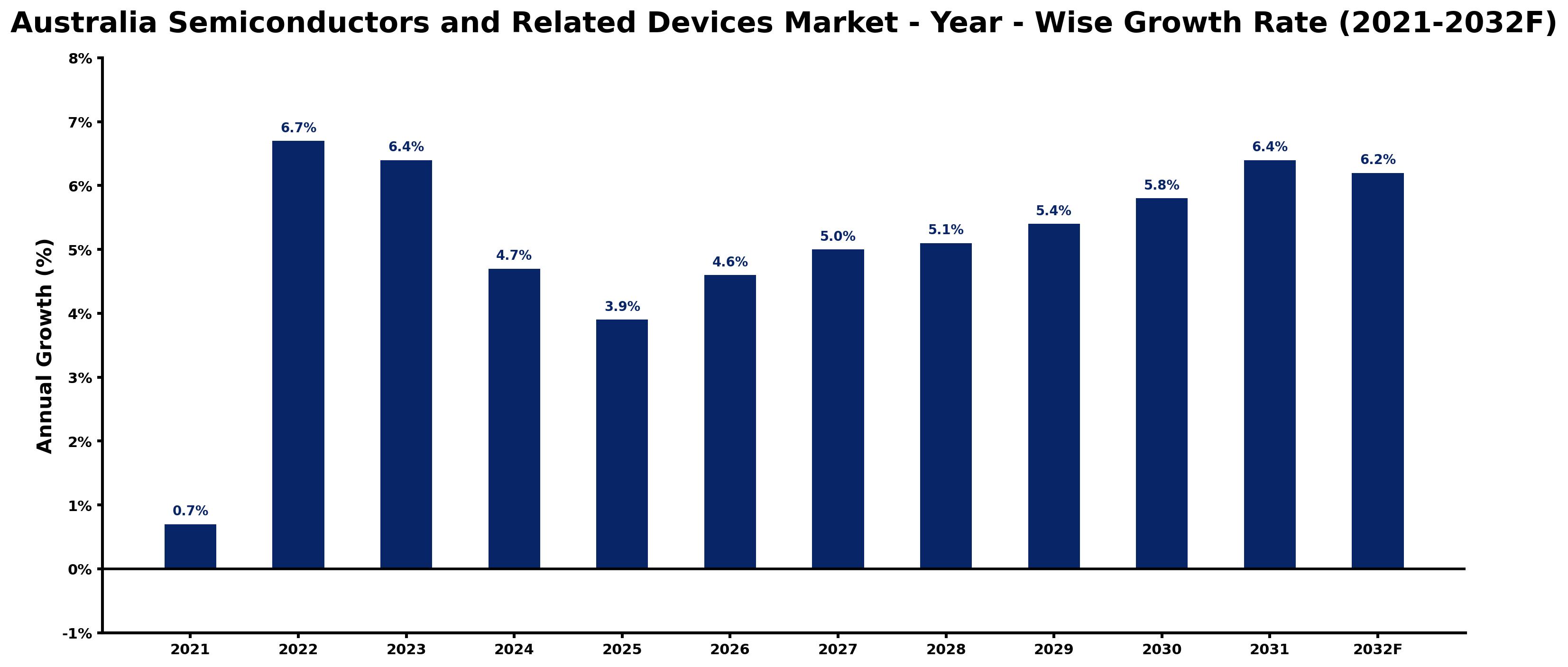
The table below presents the year wise growth rates along with the key drivers influencing the market
| Year | Growth Rate | Major Drivers |
| 2021 | 0.7% | Australia's semiconductor industry benefits from post-pandemic digital transformation needs across sectors. |
| 2022 | 6.7% | Enhancements in telecommunications infrastructure support burgeoning demand for semiconductor applications. |
| 2023 | 6.4% | Local semiconductor production emerges as a key priority amid global supply chain uncertainties. |
| 2024 | 4.7% | Investment in R&D spurs innovation in semiconductor technologies within the Australian market. |
| 2025 | 3.9% | Partnerships between academia and industry catalyze advancements in semiconductor materials and devices. |
| 2026 | 4.6% | Growing electric vehicle adoption necessitates sophisticated semiconductor solutions for improved efficiencies. |
| 2027 | 5.0% | Expanding IoT ecosystems in Australia drive requirements for miniaturized and efficient devices. |
| 2028 | 5.1% | Emerging AI applications create heightened demand for high-performance semiconductor components. |
| 2029 | 5.4% | Sustainability goals prompt semiconductor firms to explore eco-friendly manufacturing processes. |
| 2030 | 5.8% | Integration of advanced manufacturing techniques enhances the competitiveness of Australian semiconductor products. |
| 2031 | 6.4% | Increased global collaborations facilitate technology exchange and bolster local semiconductor capabilities. |
| 2032 | 6.2% | Market consolidation among semiconductor firms leads to greater resource allocation for innovation. |
Note - Market size estimations and growth projections presented in this report are based on 6Wresearch's advanced forecasting approach, validated with industry datasets as of June 2026.
Australia Semiconductors and Related Devices Market Synopsis
The Australia Semiconductors and Related Devices Market is projected to reach 4.6% and witness significant growth during the forecast period (2026-2032). This market encompasses a wide array of electronic components including microprocessors, memory devices, sensors, and integrated circuits. As the demand for innovative electronic solutions continues to rise, driven by sectors such as automotive, healthcare, and telecommunications, the landscape of the semiconductor industry in Australia is evolving rapidly to meet these needs.
Australia Semiconductors and Related Devices Market Growth Drivers
Several key factors are driving the growth of the Australia Semiconductors and Related Devices Market. Firstly, the increasing integration of semiconductor technology across various industries is a significant catalyst. Specifically, the shift towards smart technologies in the automotive sector, such as electric vehicles and autonomous driving systems, relies heavily on advanced semiconductor components. Secondly, the healthcare industry's ongoing digital transformation, propelled by advanced diagnostic systems and patient monitoring devices, is further increasing demand.
- The adoption of Internet of Things (IoT) solutions is expanding the application range of semiconductors, as more devices become interconnected.
- Emerging technologies such as artificial intelligence (AI) necessitate sophisticated semiconductor functionalities to process large datasets efficiently.
- 5G technology rollout requires high-performance semiconductors to support faster data transmission and enhanced connectivity.
- Consumer electronics continue to evolve, with increasing demand for devices like smartphones and wearables, which depend on cutting-edge semiconductor designs.
- Sustainability initiatives are leading to the development of energy-efficient semiconductor solutions, aligning with global efforts to reduce carbon footprints.
Australia Semiconductors and Related Devices Market Challenges and Restraints
Despite the positive outlook, the Australia Semiconductors and Related Devices Market faces several challenges. The complexity of integrated circuit designs has increased, creating hurdles in meeting the diverse needs of modern applications. The rapid evolution of technology necessitates constant innovation, which can strain existing resources and capabilities. Moreover, power consumption and thermal management remain critical issues that manufacturers must address to ensure optimal performance of semiconductor devices.
- Managing the balance between performance and power efficiency is essential as devices become more powerful yet need to conserve energy.
- Supply chain disruptions can impact the availability of raw materials necessary for semiconductor manufacturing, creating production delays.
- The high cost associated with research and development for cutting-edge technologies can pose financial risks to companies in this industry.
- Regulatory compliance and standards vary across regions, adding complexity to market entry strategies for new innovations.
- Competition from international markets intensifies the race for technological advancements, necessitating continuous investment in innovation.
Australia Semiconductors and Related Devices Market Government Investment and Initiatives
The Australian government recognizes the importance of the semiconductors and related devices market as a critical driver for economic growth and technological leadership. Various initiatives have been launched to promote research and development in this sector. Public spending focuses on enhancing collaboration between industry stakeholders and research institutions to bolster innovation.
- Government policies encourage investment in semiconductor technology, aiming to establish Australia as a significant player in the global market.
- Various grants and funding programs have been initiated to support startups and established companies engaged in semiconductor development.
- The government is working on improving infrastructure to facilitate the growth of manufacturing capabilities in the semiconductor space.
- Strategic partnerships with international research bodies and technology firms are being fostered to accelerate knowledge sharing and innovation.
- Public awareness campaigns emphasize the role of semiconductor technology in everyday life, enhancing support for local industries.
Australia Semiconductors and Related Devices Market Latest Developments (May 2025 - June 2026)
Recent developments within the Australia Semiconductors and Related Devices Market indicate a continuing push towards innovation and collaboration. The period has seen an increase in public-private partnerships aimed at advancing semiconductor research and manufacturing processes. These collaborations are expected to create new opportunities for local firms and contribute to the broader technology ecosystem. Furthermore, ongoing projects focused on sustainable semiconductor technologies are gaining traction, as companies strive to align with global environmental sustainability goals.
- Innovations in semiconductor materials, particularly in the area of energy-efficient components, are being prioritized to reduce environmental impact.
- Awareness of cybersecurity within semiconductor applications is leading to the development of more secure semiconductor designs.
- The integration of AI within the semiconductor manufacturing process is streamlining production and enhancing product quality.
- Investment in workforce training and development programs is critical to building expertise in advanced semiconductor technologies.
- The increasing demand for localized manufacturing is prompting discussions on policies to incentivize domestic semiconductor production.
Australia Semiconductors and Related Devices Market - Key Attractiveness of the Report
- 10 Years of Market Numbers
- Historical Data Starting from 2022 to 2025
- Base Year: 2025
- Forecast Data until 2032
- Key Performance Indicators Impacting the Market
- Major Upcoming Developments and Projects
Key Highlights of the Report:
- Australia Semiconductors and Related Devices Market Outlook
- Market Size of Australia Semiconductors and Related Devices Market, 2025
- Forecast of Australia Semiconductors and Related Devices Market, 2032
- Historical Data and Forecast of Australia Semiconductors and Related Devices Revenues & Volume for the Period 2022-2032F
- Australia Semiconductors and Related Devices Market Trend Evolution
- Australia Semiconductors and Related Devices Market Drivers and Challenges
- Australia Semiconductors and Related Devices Price Trends
- Australia Semiconductors and Related Devices Porter's Five Forces
- Australia Semiconductors and Related Devices Industry Life Cycle
- Historical Data and Forecast of Australia Semiconductors and Related Devices Market Revenues & Volume By Types for the Period 2022-2032F
- Historical Data and Forecast of Australia Semiconductors and Related Devices Market Revenues & Volume By Integrated Circuits for the Period 2022-2032F
- Historical Data and Forecast of Australia Semiconductors and Related Devices Market Revenues & Volume By Memory Chips for the Period 2022-2032F
- Historical Data and Forecast of Australia Semiconductors and Related Devices Market Revenues & Volume By Microprocessors for the Period 2022-2032F
- Historical Data and Forecast of Australia Semiconductors and Related Devices Market Revenues & Volume By Others ? for the Period 2022-2032F
- Historical Data and Forecast of Australia Semiconductors and Related Devices Market Revenues & Volume By End-users for the Period 2022-2032F
- Historical Data and Forecast of Australia Semiconductors and Related Devices Market Revenues & Volume By Information Technology for the Period 2022-2032F
- Historical Data and Forecast of Australia Semiconductors and Related Devices Market Revenues & Volume By Aerospace & Defense for the Period 2022-2032F
- Historical Data and Forecast of Australia Semiconductors and Related Devices Market Revenues & Volume By Consumer Electronics for the Period 2022-2032F
- Historical Data and Forecast of Australia Semiconductors and Related Devices Market Revenues & Volume By Automotive for the Period 2022-2032F
- Historical Data and Forecast of Australia Semiconductors and Related Devices Market Revenues & Volume By Healthcare for the Period 2022-2032F
- Historical Data and Forecast of Australia Semiconductors and Related Devices Market Revenues & Volume By Others for the Period 2022-2032F
- Australia Semiconductors and Related Devices Import Export Trade Statistics
- Market Opportunity Assessment By Types
- Market Opportunity Assessment By End-users
- Australia Semiconductors and Related Devices Top Companies Market Share
- Australia Semiconductors and Related Devices Competitive Benchmarking By Technical and Operational Parameters
- Australia Semiconductors and Related Devices Company Profiles
- Australia Semiconductors and Related Devices Key Strategic Recommendations






































