Australia Silica Market: Import Trend Analysis
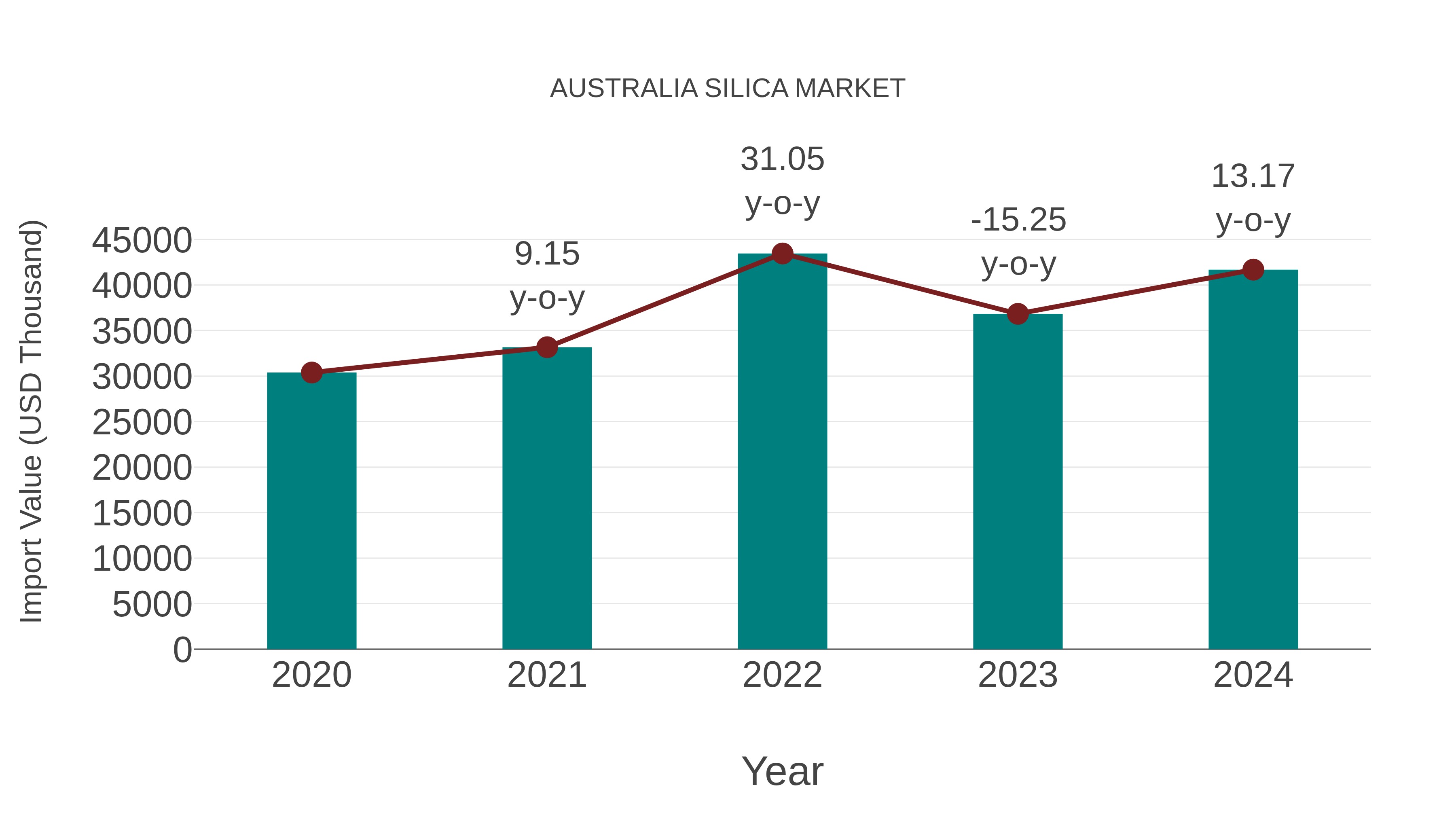
Australia`s silica market witnessed a notable import trend, with a growth rate of 13.17% from 2023 to 2024 and a compound annual growth rate (CAGR) of 8.23% for 2020-2024. This import momentum can be attributed to the increasing demand for silica in various industries, signaling stable market conditions and sustained trade activity.
Australia Silica Market Overview
Silica, a fundamental component in various industries, holds a prominent place in the Australia market. Its applications range from glass manufacturing to electronics and pharmaceuticals. The market dynamics are shaped by the diverse industrial requirements and the continuous exploration of innovative applications for silica in different sectors.
Drivers of the market
The silica market in Australia experiences growth driven by its diverse applications across industries such as glass manufacturing, foundry, and electronics. With a focus on high-quality raw materials, industries seek silica with specific characteristics, including purity and particle size distribution. The market`s expansion is influenced by the continuous demand for silica in glass production, as well as its role in the manufacturing of various industrial products. As technology evolves and industries demand customized silica solutions, the market remains dynamic and responsive to changing consumer needs.
Challenges of the market
The challenge in the Australia Silica market lies in diversifying applications beyond traditional uses. While silica is a fundamental component in various industries, exploring new applications and markets becomes crucial for sustained growth. Adapting to emerging trends and technologies is essential for unlocking the full potential of silica in a rapidly evolving market.
Government Policy of the market
Australia silica market is influenced by diverse applications, including glass manufacturing, electronics, and construction. Government policies addressing resource management and sustainable mining practices shape the silica market`s trajectory. The industry`s development is in line with initiatives aimed at balancing economic growth with environmental conservation.
Key Highlights of the Report:
- Australia Silica Market Outlook
- Market Size of Australia Silica Market, 2025
- Forecast of Australia Silica Market, 2032
- Historical Data and Forecast of Australia Silica Revenues & Volume for the Period 2022-2032F
- Australia Silica Market Trend Evolution
- Australia Silica Market Drivers and Challenges
- Australia Silica Price Trends
- Australia Silica Porter's Five Forces
- Australia Silica Industry Life Cycle
- Historical Data and Forecast of Australia Silica Market Revenues & Volume By Application for the Period 2022-2032F
- Historical Data and Forecast of Australia Silica Market Revenues & Volume By Rubber for the Period 2022-2032F
- Historical Data and Forecast of Australia Silica Market Revenues & Volume By Construction for the Period 2022-2032F
- Historical Data and Forecast of Australia Silica Market Revenues & Volume By Agrochemicals for the Period 2022-2032F
- Historical Data and Forecast of Australia Silica Market Revenues & Volume By Oral Care for the Period 2022-2032F
- Historical Data and Forecast of Australia Silica Market Revenues & Volume By Food & Feed for the Period 2022-2032F
- Historical Data and Forecast of Australia Silica Market Revenues & Volume By Others for the Period 2022-2032F
- Australia Silica Import Export Trade Statistics
- Market Opportunity Assessment By Application
- Australia Silica Top Companies Market Share
- Australia Silica Competitive Benchmarking By Technical and Operational Parameters
- Australia Silica Company Profiles
- Australia Silica Key Strategic Recommendations






































