Australia Slag Cement Market Size, Share & Growth Rate
The Australia Slag Cement Market was estimated at USD 163 Million in 2025 and is projected to reach USD 191 Million by 2032, growing at a CAGR of 2.3% from 2026 to 2032. This growth trajectory is propelled by a growing awareness among construction professionals regarding the benefits of using eco-friendly materials. The increasing governmental support for sustainable building practices further solidifies slag cement's position as a viable alternative in the construction landscape.
Australia Slag Cement Market Year-wise Growth Rate and Key Drivers
This graph highlights how the Australia Slag Cement Market has steadily grown over the years, supported by major growth factors.
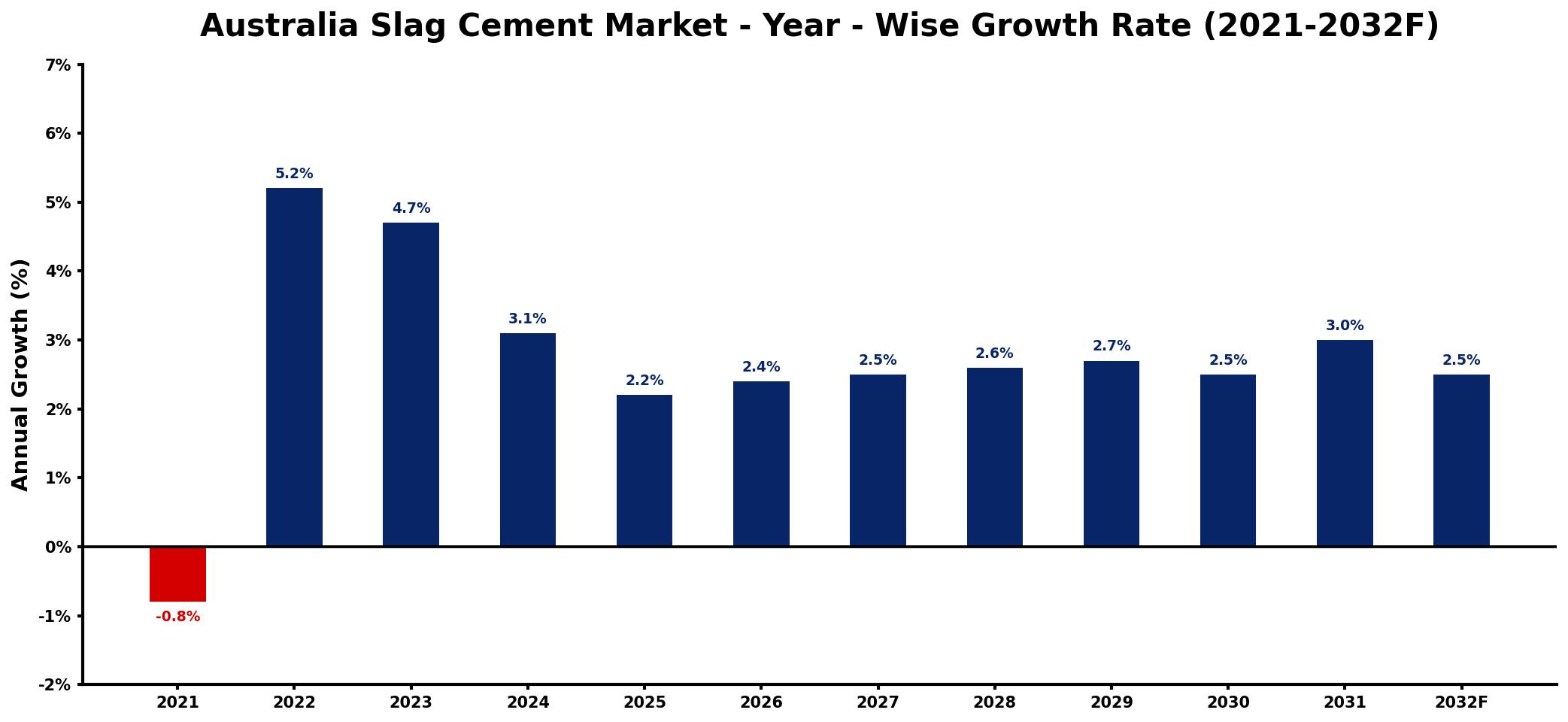
The table below presents the year‑wise growth rates along with the key drivers influencing the market
| Year | Growth Rate | Major Drivers |
| 2021 | -0.8% | construction activity diminished significantly |
| 2022 | 5.2% | infrastructure projects initiated rapidly |
| 2023 | 4.7% | sustainability initiatives gaining momentum |
| 2024 | 3.1% | urban development projects expanding nationwide |
| 2025 | 2.2% | renewable energy investments increasing steadily |
| 2026 | 2.4% | government funding for construction rising |
| 2027 | 2.5% | export markets showing strong demand |
| 2028 | 2.6% | rising demand from electronics |
| 2029 | 2.7% | private sector investments boosting growth |
| 2030 | 2.5% | regulatory support for green building |
| 2031 | 3.0% | increased awareness of eco-friendly solutions |
| 2032 | 2.5% | collaboration among industry stakeholders strengthened |
Note: Market size estimations and growth projections presented in this report are based on 6Wresearch's proprietary forecasting methodology, utilizing the latest available industry data, government publications, and primary research inputs.
Australia Slag Cement Market Synopsis
Slag cement is gaining notable traction in Australia due to its superior durability and reduced carbon footprint compared to traditional cement. The construction sector's push toward sustainable methods is driving builders to explore innovative materials, with slag cement emerging as a frontrunner.
As a byproduct of steel manufacturing, slag cement not only conserves resources but also appeals to environmentally conscious consumers. This duality of being both a sustainable option and a robust building material aligns perfectly with Australias ambitions for greener construction practices.
Australia Slag Cement Market Key Takeaways
- The market is witnessing a steady shift towards eco-friendly building materials, particularly slag cement.
- Government initiatives are playing a crucial role in promoting the use of sustainable materials within the construction industry.
- Increased consumer awareness regarding environmental impact is driving demand for slag cement.
- Despite challenges in market education, the potential for growth remains strong as builders seek durable alternatives.
- Collaborative efforts among stakeholders are essential to overcome misconceptions about slag cement.
Evaluation of Restraints in Australia Slag Cement Market
The primary restraints in the Australia Slag Cement Market stem from a general lack of awareness about its benefits among builders and contractors. This knowledge gap hinders widespread adoption, making it crucial for industry stakeholders to engage in educational initiatives. Furthermore, competition from traditional cement alternatives, often seen as more established products, presents economic challenges that can deter construction companies from integrating slag cement into their projects. Addressing these challenges will be pivotal for the market's growth.
Australia Slag Cement Market Trends
The demand for slag cement is increasingly influenced by trends favoring green building certifications. These certifications often require or incentivize the use of low-carbon materials, which positions slag cement favorably. Additionally, ongoing innovation in the formulation and application of slag cement is enhancing its performance attributes, attracting a broader audience in the construction sector. The emphasis on high-performance concrete is also driving research into improving the quality and applicability of slag cement solutions.
Australia Slag Cement Market Opportunities
Significant growth opportunities exist in niche markets, such as infrastructure projects focused on sustainability. The increasing investment in green buildings and the rehabilitation of existing structures using eco-friendly materials present lucrative avenues for expansion. Additionally, advancements in production technology can reduce costs and improve the availability of slag cement, further enhancing its market appeal.
Government Initiatives in the Australia Slag Cement Market
The Australian government is actively promoting sustainable construction through various regulations and incentives. Policies aimed at reducing the carbon footprint of the construction industry encourage the integration of materials like slag cement. Public spending on green infrastructure projects is also on the rise, providing a conducive environment for the adoption of eco-friendly building materials.
Future Insights of the Australia Slag Cement Market
Looking ahead to 2026-2032, the Australia Slag Cement Market is poised for significant transformation. With increasing governmental and societal pressure for sustainable practices, slag cement is expected to gain a more prominent role in construction projects. Innovations in the production and application processes will likely improve its acceptance, leading to broader use. As awareness grows and education initiatives take root, the market may witness a notable uptick in adoption rates among builders and contractors.
Australia Slag Cement Market Latest Developments (2025 - 2026)
Recent developments in the Australia slag cement industry indicate a strengthened focus on sustainability by both manufacturers and the construction sector. New partnerships aimed at educating builders on the benefits of slag cement are emerging, while R&D efforts are directed toward enhancing its properties and applications. This momentum reflects a collective commitment to integrate more sustainable practices within the Australian construction landscape.
Australia Slag Cement Market - Key Attractiveness of the Report
- 10 Years of Market Numbers
- Historical Data Starting from 2022 to 2025
- Base Year: 2025
- Forecast Data until 2032
- Key Performance Indicators Impacting the Market
- Major Upcoming Developments and Projects
Key Highlights of the Report:
- Australia Slag Cement Market Outlook
- Market Size of Australia Slag Cement Market, 2025
- Forecast of Australia Slag Cement Market, 2032
- Historical Data and Forecast of Australia Slag Cement Revenues & Volume for the Period 2022-2032F
- Australia Slag Cement Market Trend Evolution
- Australia Slag Cement Market Drivers and Challenges
- Australia Slag Cement Price Trends
- Australia Slag Cement Porter's Five Forces
- Australia Slag Cement Industry Life Cycle
- Historical Data and Forecast of Australia Slag Cement Market Revenues & Volume By Product for the Period 2022-2032F
- Historical Data and Forecast of Australia Slag Cement Market Revenues & Volume By Low Heat Cement for the Period 2022-2032F
- Historical Data and Forecast of Australia Slag Cement Market Revenues & Volume By Sulphates resisting cement for the Period 2022-2032F
- Historical Data and Forecast of Australia Slag Cement Market Revenues & Volume By Blast Furnace Slag Cement for the Period 2022-2032F
- Historical Data and Forecast of Australia Slag Cement Market Revenues & Volume By High Alumina Cement for the Period 2022-2032F
- Historical Data and Forecast of Australia Slag Cement Market Revenues & Volume By White Cement for the Period 2022-2032F
- Historical Data and Forecast of Australia Slag Cement Market Revenues & Volume By Coloured cement for the Period 2022-2032F
- Historical Data and Forecast of Australia Slag Cement Market Revenues & Volume By Pozzolanic Cement for the Period 2022-2032F
- Historical Data and Forecast of Australia Slag Cement Market Revenues & Volume By Applications for the Period 2022-2032F
- Historical Data and Forecast of Australia Slag Cement Market Revenues & Volume By Residential Buildings for the Period 2022-2032F
- Historical Data and Forecast of Australia Slag Cement Market Revenues & Volume By Industrial Buildings for the Period 2022-2032F
- Historical Data and Forecast of Australia Slag Cement Market Revenues & Volume By Commercial Buildings for the Period 2022-2032F
- Australia Slag Cement Import Export Trade Statistics
- Market Opportunity Assessment By Product
- Market Opportunity Assessment By Applications
- Australia Slag Cement Top Companies Market Share
- Australia Slag Cement Competitive Benchmarking By Technical and Operational Parameters
- Australia Slag Cement Company Profiles
- Australia Slag Cement Key Strategic Recommendations






































