Australia Smart Doorbell Market Size, Share & Growth Rate
The Australia Smart Doorbell Market was estimated at USD 313 Million in 2025 and is projected to reach USD 409 Million by 2032, growing at a CAGR of 3.9% from 2026 to 2032. This promising growth trajectory is largely attributed to heightened consumer awareness surrounding home security systems and a burgeoning interest in smart home technologies. As homeowners increasingly seek reliable methods to enhance their propertys security, smart doorbells have emerged as a top choice, seamlessly integrating security and connectivity.
Australia Smart Doorbell Market Year-wise Growth Rate and Key Drivers
This graph highlights how the Australia Smart Doorbell Market has steadily grown over the years, supported by major growth factors.
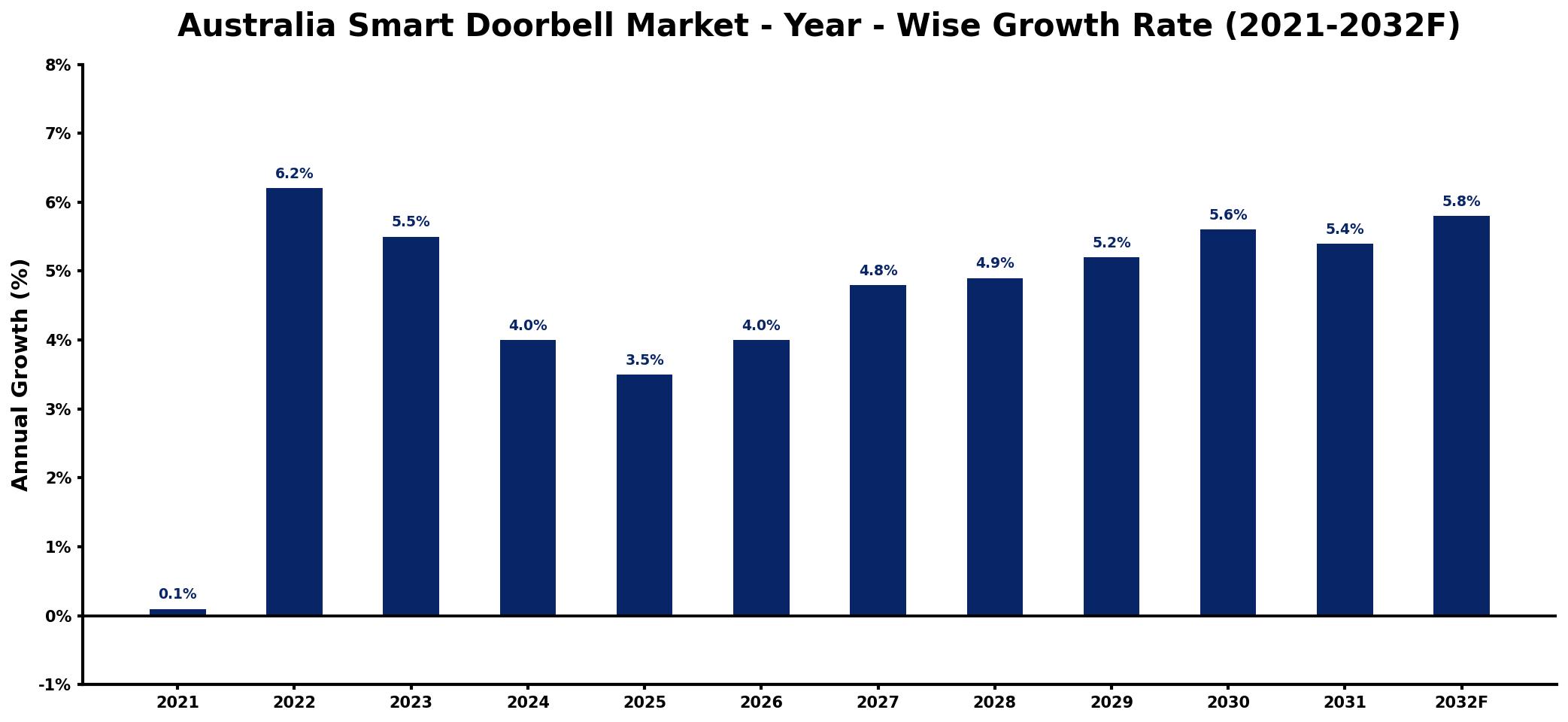
The table below presents the year‑wise growth rates along with the key drivers influencing the market
| Year | Growth Rate | Major Drivers |
| 2021 | 0.1% | Growing interest in home automation |
| 2022 | 6.2% | Increased consumer technology adoption |
| 2023 | 5.5% | Rise in home security investments |
| 2024 | 4.0% | Expansion of connected device market |
| 2025 | 3.5% | Surging demand for remote monitoring |
| 2026 | 4.0% | Advancements in wireless technology |
| 2027 | 4.8% | Increased focus on home safety |
| 2028 | 4.9% | Growing popularity of DIY solutions |
| 2029 | 5.2% | Rising awareness of personal security |
| 2030 | 5.6% | rising export shipment volumes |
| 2031 | 5.4% | Investment in residential security solutions |
| 2032 | 5.8% | Emergence of new technology integrations |
Note: Market size estimations and growth projections presented in this report are based on 6Wresearch's proprietary forecasting methodology, utilizing the latest available industry data, government publications, and primary research inputs.
Australia Smart Doorbell Market Synopsis
In Australia, the demand for smart doorbells has accelerated as consumers prioritize security and convenience in their homes. With advanced features such as real-time video streaming and two-way audio communication, these devices enable homeowners to monitor their front doors from virtually anywhere. The awareness of the importance of home safety has prompted many Australians to invest in smart doorbells as a first line of defense against potential threats.
Moreover, the integration of smart doorbells into existing home automation systems is becoming increasingly prevalent. This trend is not just about surveillance; it is about creating a cohesive ecosystem that enhances overall home management. As consumers continue to adopt smart technologies, the appeal of smart doorbells is expected to grow, making them a staple in contemporary Australian households.
Australia Smart Doorbell Market Key Takeaways
- The smart doorbell market is evolving with the integration of advanced surveillance and communication features.
- Growing consumer inclination towards smart home solutions is a major driver of market expansion.
- Privacy concerns regarding data security remain a significant challenge for market adoption.
- Government policies that emphasize home security and connectivity play a crucial role in shaping market dynamics.
- The market is poised for continued growth with projected revenues reaching USD 409 Million by 2032.
Evaluation of Restraints in Australia Smart Doorbell Market
Despite the promising growth potential, the Australia Smart Doorbell Market faces notable constraints that could impede its full expansion. Privacy concerns remain at the forefront, as consumers are increasingly wary of how their data is utilized and stored. Many potential customers fear that smart doorbells may expose them to security risks rather than mitigate them. Furthermore, challenges related to interoperability with existing home security systems create barriers for consumers looking to upgrade without facing compatibility issues. Addressing these issues is essential for fostering broader market acceptance and integration.
Australia Smart Doorbell Market Trends
Current trends indicate a growing emphasis on user-friendly interfaces and aesthetic designs in smart doorbell products, aimed at appealing to the tech-savvy yet design-conscious Australian homeowner. Additionally, the incorporation of artificial intelligence features, such as motion detection and facial recognition, is becoming more common, significantly enhancing the functionality of these devices. The market is also witnessing a rise in demand for products that can seamlessly connect with other smart home devices, which is shaping future innovations.
Australia Smart Doorbell Market Opportunities
The smart doorbell market presents several lucrative opportunities for growth and investment. As more homeowners adopt smart home technology, manufacturers have the chance to diversify their offerings and create bundled packages that include smart doorbells, cameras, and additional security features. Moreover, educational campaigns focused on the advantages of smart doorbells can help alleviate consumer concerns regarding privacy and security, paving the way for broader acceptance. Innovative design and integration with popular smart home ecosystems could also yield significant market opportunities.
Government Initiatives in the Australia Smart Doorbell Market
Government policies in Australia are increasingly supportive of smart technology adoption in both residential and commercial spaces. Regulatory frameworks that prioritize cybersecurity and data protection are vital for encouraging consumer trust in smart doorbell technologies. Additionally, initiatives such as the Smart Cities and Suburbs Program foster innovation in home security solutions, creating a conducive environment for market growth. These policies and programs serve to not only enhance safety but also to promote a technologically advanced society.
Future Insights of the Australia Smart Doorbell Market
Looking ahead to the period from 2026 to 2032, the Australia Smart Doorbell Market is expected to witness significant advancements driven by technology and consumer demand. As smart home solutions become more mainstream, we anticipate a shift towards more sophisticated features, such as enhanced AI capabilities and deeper integration with other smart home devices. Furthermore, as privacy regulations evolve, manufacturers will need to adapt their offerings to align with consumer expectations, ensuring both security and functionality remain paramount.
Australia Smart Doorbell Market Latest Developments (2025 - 2026)
Recent developments in the Australia Smart Doorbell Market indicate a growing trend towards integrating smart home devices with personal assistance technologies. Innovations focusing on user experience, such as voice-activated functionalities and mobile app enhancements, are making these products more appealing. Additionally, industry players are increasingly collaborating with cybersecurity experts to bolster the security features of smart doorbells, aiming to alleviate consumer apprehensions regarding privacy and data protection.
Australia Smart Doorbell Market - Key Attractiveness of the Report
- 10 Years of Market Numbers
- Historical Data Starting from 2022 to 2025
- Base Year: 2025
- Forecast Data until 2032
- Key Performance Indicators Impacting the Market
- Major Upcoming Developments and Projects
Key Highlights of the Report:
- Australia Smart Doorbell Market Outlook
- Market Size of Australia Smart Doorbell Market, 2025
- Forecast of Australia Smart Doorbell Market, 2032
- Historical Data and Forecast of Australia Smart Doorbell Revenues & Volume for the Period 2022-2032F
- Australia Smart Doorbell Market Trend Evolution
- Australia Smart Doorbell Market Drivers and Challenges
- Australia Smart Doorbell Price Trends
- Australia Smart Doorbell Porter's Five Forces
- Australia Smart Doorbell Industry Life Cycle
- Historical Data and Forecast of Australia Smart Doorbell Market Revenues & Volume By Product Type for the Period 2022-2032F
- Historical Data and Forecast of Australia Smart Doorbell Market Revenues & Volume By Wired Doorbell for the Period 2022-2032F
- Historical Data and Forecast of Australia Smart Doorbell Market Revenues & Volume By Wireless Doorbell for the Period 2022-2032F
- Historical Data and Forecast of Australia Smart Doorbell Market Revenues & Volume By Distribution Channel for the Period 2022-2032F
- Historical Data and Forecast of Australia Smart Doorbell Market Revenues & Volume By Online for the Period 2022-2032F
- Historical Data and Forecast of Australia Smart Doorbell Market Revenues & Volume By Offline for the Period 2022-2032F
- Historical Data and Forecast of Australia Smart Doorbell Market Revenues & Volume By End User for the Period 2022-2032F
- Historical Data and Forecast of Australia Smart Doorbell Market Revenues & Volume By Residential for the Period 2022-2032F
- Historical Data and Forecast of Australia Smart Doorbell Market Revenues & Volume By Commercial for the Period 2022-2032F
- Australia Smart Doorbell Import Export Trade Statistics
- Market Opportunity Assessment By Product Type
- Market Opportunity Assessment By Distribution Channel
- Market Opportunity Assessment By End User
- Australia Smart Doorbell Top Companies Market Share
- Australia Smart Doorbell Competitive Benchmarking By Technical and Operational Parameters
- Australia Smart Doorbell Company Profiles
- Australia Smart Doorbell Key Strategic Recommendations






































