Australia Smart Water Management Market Size & Growth Rate (2026-2032)
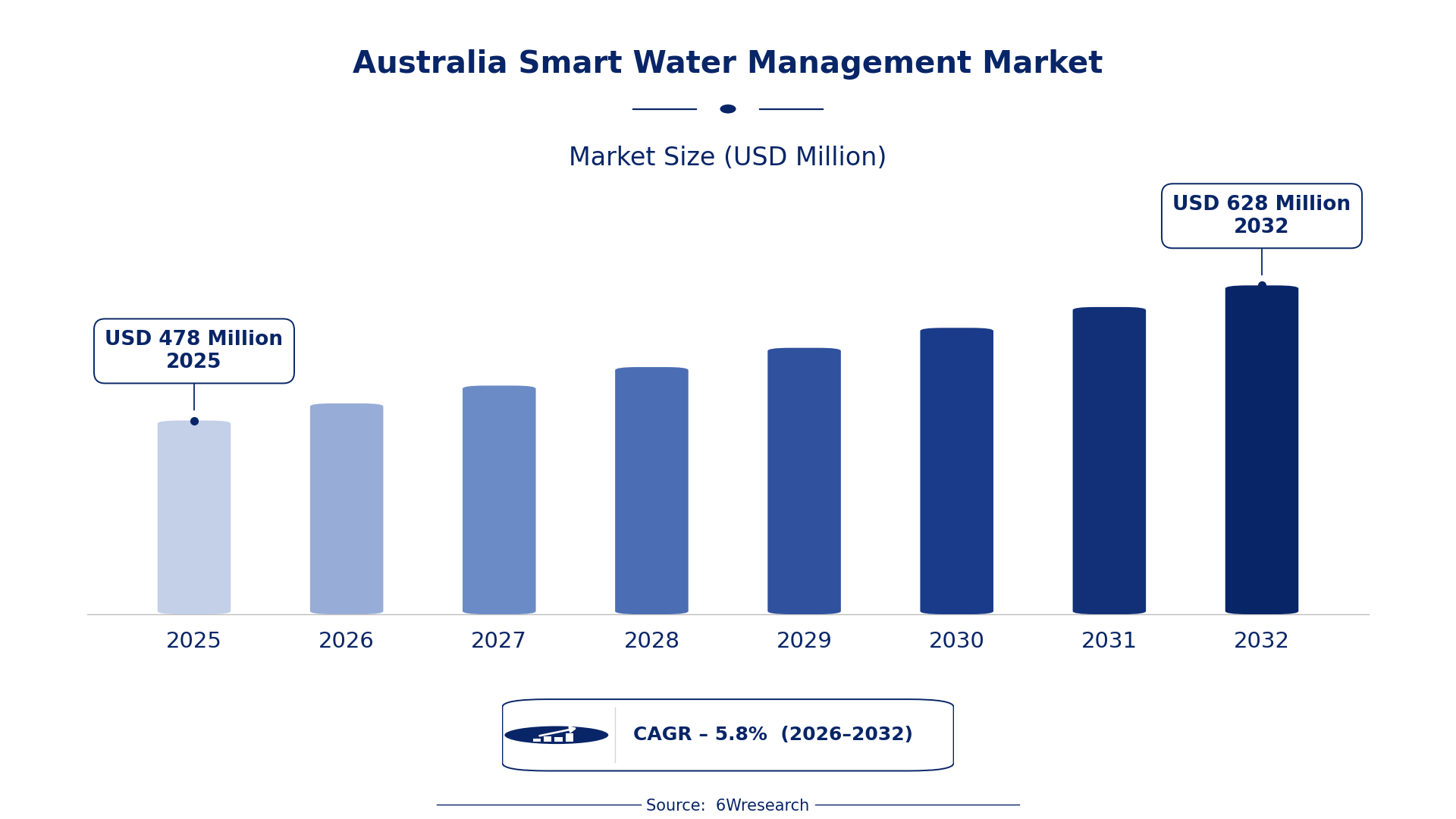
The Australia Smart Water Management Market was estimated at USD 478 Million in 2025 and is projected to reach USD 628 Million by 2032, growing at a CAGR of 5.8% from 2026 to 2032.
Australia Smart Water Management Market Synopsis
The pressing issue of water scarcity is the primary force driving the Australia Smart Water Management Market today. As the nation grapples with climate variability and increasing demand for water, the implementation of advanced technologies becomes critical to ensure efficient resource management.
Smart water management solutions are gaining traction across various sectors, particularly in agriculture and municipal utilities. These technologies, including IoT devices and data analytics platforms, are not just enhancing operational efficiency; they are also playing a vital role in promoting sustainable water practices in a country where every drop counts.
Australia Smart Water Management Market Year-wise Growth Rate and Key Drivers
This graph illustrates the annual growth rates of the Australia Smart Water Management Market from 2021 to 2032, highlighting a steady upward trajectory and projected expansion over the forecast period.
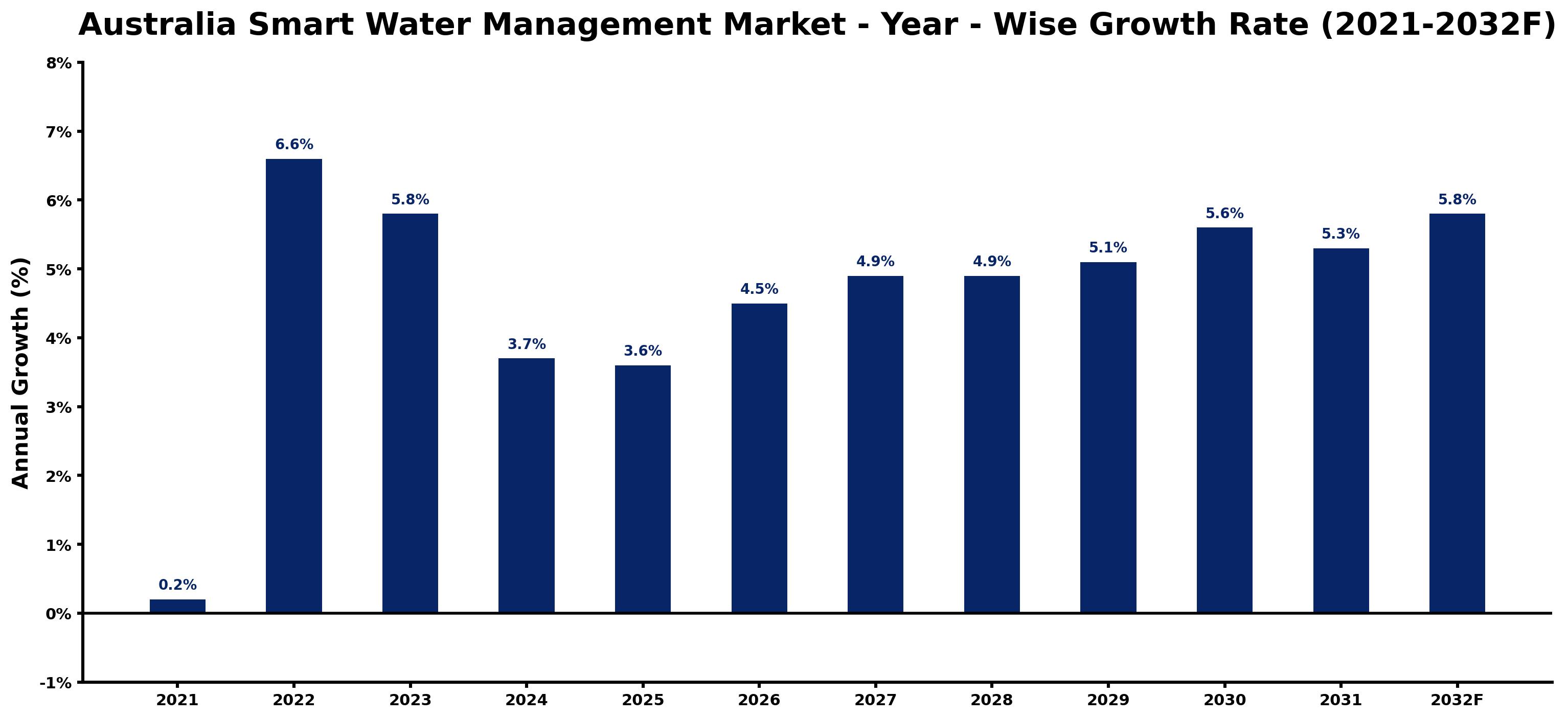
The table below presents the year‑wise growth rates along with the key drivers influencing the market
| Year | Growth Rate | Major Drivers |
| 2021 | 0.2% | Increased drought conditions boosting water efficiency investments. |
| 2022 | 6.6% | State funding for advanced water recycling projects. |
| 2023 | 5.8% | Adoption of IoT solutions for smart water monitoring. |
| 2024 | 3.7% | National framework promoting sustainable water management practices. |
| 2025 | 3.6% | Urbanization leading to greater demand for water technologies. |
| 2026 | 4.5% | Collaboration with universities for innovative water solutions. |
| 2027 | 4.9% | Rise in environmental awareness driving smart usage adoption. |
| 2028 | 4.9% | Government incentives for smart metering implementation. |
| 2029 | 5.1% | Increased focus on protecting water sources from pollution. |
| 2030 | 5.6% | Partnerships with tech firms enhancing smart management systems. |
| 2031 | 5.3% | Legislation mandating water efficiency in new developments. |
| 2032 | 5.8% | Growing consumer demand for sustainable water services. |
Note: Market size estimations and growth projections presented in this report are based on 6Wresearch's proprietary forecasting methodology, utilizing the latest available industry data, government publications, and primary research inputs.
Australia Smart Water Management Market Key Takeaways
Below are some of the specific key takeaways from the market, including:
- The adoption of smart technologies is accelerating in response to water scarcity issues.
- Data analytics is increasingly being used to optimize water usage and detect leaks.
- Government policies are aligning with industry needs to promote sustainable water management practices.
- Investment in infrastructure remains a critical focus area for future growth.
- Collaboration between public and private sectors is essential for innovation in water management solutions.
Evaluation of Restraints in Australia Smart Water Management Market
While the market is on an upward trajectory, several restraints hinder its full potential. Chief among these is the high upfront cost associated with implementing smart technologies. Water utilities and industries are often caught in a bind, needing to invest in modern infrastructure to effectively manage resources while also facing budget constraints. This balancing act poses a significant challenge, as the capital needed for technology adoption can be daunting, particularly for smaller entities.
on top of that, the integration of new technologies into existing systems requires careful planning and execution. Without proper alignment of goals and clear communication among stakeholders, the transition can be inefficient and lead to wasted resources. Addressing these challenges is crucial for unlocking the market’s full potential.
Australia Smart Water Management Market Trends
A notable trend in the Australia Smart Water Management Market is the increasing use of artificial intelligence and machine learning. These technologies enhance predictive analytics, allowing for more proactive water management strategies. Real-time data monitoring is becoming standard, which helps stakeholders make informed decisions.
on top of that, the focus on sustainability is reshaping market dynamics. Companies are not only seeking to conserve water but also to engage in practices that promote environmental stewardship. This shift is reflected in the growing number of partnerships between tech firms and water utilities, aimed at developing innovative solutions.
Australia Smart Water Management Market Opportunities
The future is bright for the Australia Smart Water Management Market, with numerous opportunities for growth. The increasing awareness of climate change impacts is propelling investments in smart technologies that enhance water efficiency. Agricultural sectors, in particular, are ripe for technological adoption, as farmers seek to maximize yields while minimizing water use.
Additionally, government incentives for sustainable practices are encouraging companies to explore innovative solutions. Public-private partnerships present another avenue for investment and collaboration, further driving advancements in smart water management systems.
Government Initiatives in the Australia Smart Water Management Market
The Australian government is actively shaping the Smart Water Management Market through various initiatives aimed at addressing the pressing issues of water scarcity and climate change. Policies focused on encouraging the adoption of technology-driven solutions are critical to achieving efficient water use and conservation. As these initiatives unfold, they underscore the government's commitment to fostering a sustainable future.
- A national digital infrastructure upgrade programme now in its rollout phase aims to enhance data collection for better water management.
- A regulatory framework introduced in 2025 mandating billing transparency is currently being implemented to improve consumer awareness.
- A public-private initiative focusing on smart irrigation technologies is planned to launch in 2026, aimed at supporting agricultural sectors.
- Recent legislation promoting smart water meters was passed in early 2025, encouraging broader adoption among utilities.
- Current discussions are underway for a state-level initiative that incentivizes water recycling and reuse projects.
Future Insights of the Australia Smart Water Management Market
Looking ahead, the Australia Smart Water Management Market is set to evolve significantly between 2026 and 2032. As technology continues to advance, the integration of AI and IoT will become even more prevalent, enabling more precise water management solutions. The emphasis on sustainability will drive demand for innovative approaches, encouraging stakeholders to invest in smarter infrastructure.
Expect to see increased collaboration between technology providers and water utilities, paving the way for groundbreaking solutions. As regulatory frameworks continue to evolve, companies that adapt to these changes will find themselves at the forefront of the market, equipped to tackle the challenges of tomorrow.
Australia Smart Water Management Market Latest Developments
In the past year, the Australia Smart Water Management Market has witnessed several noteworthy developments. Innovations in technology and increased governmental focus on sustainability have spurred activity across the sector. As entities seek to enhance their water management capabilities, the drive toward smarter solutions is more pronounced than ever.
- A major technology vendor launched an advanced leak detection system in early 2025, aimed at minimizing water wastage for municipal utilities.
- An initiative that began in mid-2025 and remains underway focuses on deploying smart meters across urban areas to improve water usage transparency.
- A rollout expected to begin in the second half of 2026 will introduce AI-driven analytics platforms for agricultural water management.
- A collaborative project between several states, initiated in Q1 2025, focuses on developing a centralized water management dashboard to monitor usage in real-time.
Australia Smart Water Management Market - Key Attractiveness of the Report
- 10 Years of Market Numbers
- Historical Data Starting from 2022 to 2025
- Base Year: 2025
- Forecast Data until 2032
- Key Performance Indicators Impacting the Market
- Major Upcoming Developments and Projects
Key Highlights of the Report:
- Australia Smart Water Management Market Outlook
- Market Size of Australia Smart Water Management Market, 2025
- Forecast of Australia Smart Water Management Market, 2032
- Historical Data and Forecast of Australia Smart Water Management Revenues & Volume for the Period 2022-2032F
- Australia Smart Water Management Market Trend Evolution
- Australia Smart Water Management Market Drivers and Challenges
- Australia Smart Water Management Price Trends
- Australia Smart Water Management Porter's Five Forces
- Australia Smart Water Management Industry Life Cycle
- Historical Data and Forecast of Australia Smart Water Management Market Revenues & Volume By Offering for the Period 2022-2032F
- Historical Data and Forecast of Australia Smart Water Management Market Revenues & Volume By Water Meters for the Period 2022-2032F
- Historical Data and Forecast of Australia Smart Water Management Market Revenues & Volume By Solutions for the Period 2022-2032F
- Historical Data and Forecast of Australia Smart Water Management Market Revenues & Volume By Services for the Period 2022-2032F
- Historical Data and Forecast of Australia Smart Water Management Market Revenues & Volume By Water Meters for the Period 2022-2032F
- Historical Data and Forecast of Australia Smart Water Management Market Revenues & Volume By AMR Meters for the Period 2022-2032F
- Historical Data and Forecast of Australia Smart Water Management Market Revenues & Volume By AMI Meters for the Period 2022-2032F
- Historical Data and Forecast of Australia Smart Water Management Market Revenues & Volume By Solutions for the Period 2022-2032F
- Historical Data and Forecast of Australia Smart Water Management Market Revenues & Volume By Enterprise Asset Management for the Period 2022-2032F
- Historical Data and Forecast of Australia Smart Water Management Market Revenues & Volume By Analytics and data management for the Period 2022-2032F
- Historical Data and Forecast of Australia Smart Water Management Market Revenues & Volume By Security for the Period 2022-2032F
- Historical Data and Forecast of Australia Smart Water Management Market Revenues & Volume By Smart irrigation management for the Period 2022-2032F
- Historical Data and Forecast of Australia Smart Water Management Market Revenues & Volume By Advanced pressure management for the Period 2022-2032F
- Historical Data and Forecast of Australia Smart Water Management Market Revenues & Volume By Mobile workforce management for the Period 2022-2032F
- Historical Data and Forecast of Australia Smart Water Management Market Revenues & Volume By Network management for the Period 2022-2032F
- Historical Data and Forecast of Australia Smart Water Management Market Revenues & Volume By Customer information system and billing for the Period 2022-2032F
- Historical Data and Forecast of Australia Smart Water Management Market Revenues & Volume By Service for the Period 2022-2032F
- Historical Data and Forecast of Australia Smart Water Management Market Revenues & Volume By Professional Services for the Period 2022-2032F
- Historical Data and Forecast of Australia Smart Water Management Market Revenues & Volume By Managed Services for the Period 2022-2032F
- Historical Data and Forecast of Australia Smart Water Management Market Revenues & Volume By End User for the Period 2022-2032F
- Historical Data and Forecast of Australia Smart Water Management Market Revenues & Volume By Commercial and industrial for the Period 2022-2032F
- Historical Data and Forecast of Australia Smart Water Management Market Revenues & Volume By Residential for the Period 2022-2032F
- Australia Smart Water Management Import Export Trade Statistics
- Market Opportunity Assessment By Offering
- Market Opportunity Assessment By Water Meters
- Market Opportunity Assessment By Solutions
- Market Opportunity Assessment By Service
- Market Opportunity Assessment By End User
- Australia Smart Water Management Top Companies Market Share
- Australia Smart Water Management Competitive Benchmarking By Technical and Operational Parameters
- Australia Smart Water Management Company Profiles
- Australia Smart Water Management Key Strategic Recommendations






































