Australia Soap and detergents Market Summary
The australia soap and detergents market was estimated at USD 99 Million in 2025 and is projected to reach USD 116 Million by 2032, growing at a CAGR of 2.3% from 2026 to 2032.
Australia Soap and detergents Market Year-wise Growth Rate and Key Drivers
This graph highlights how the Australia Soap and detergents Market has steadily grown over the past five years, supported by major growth factors.
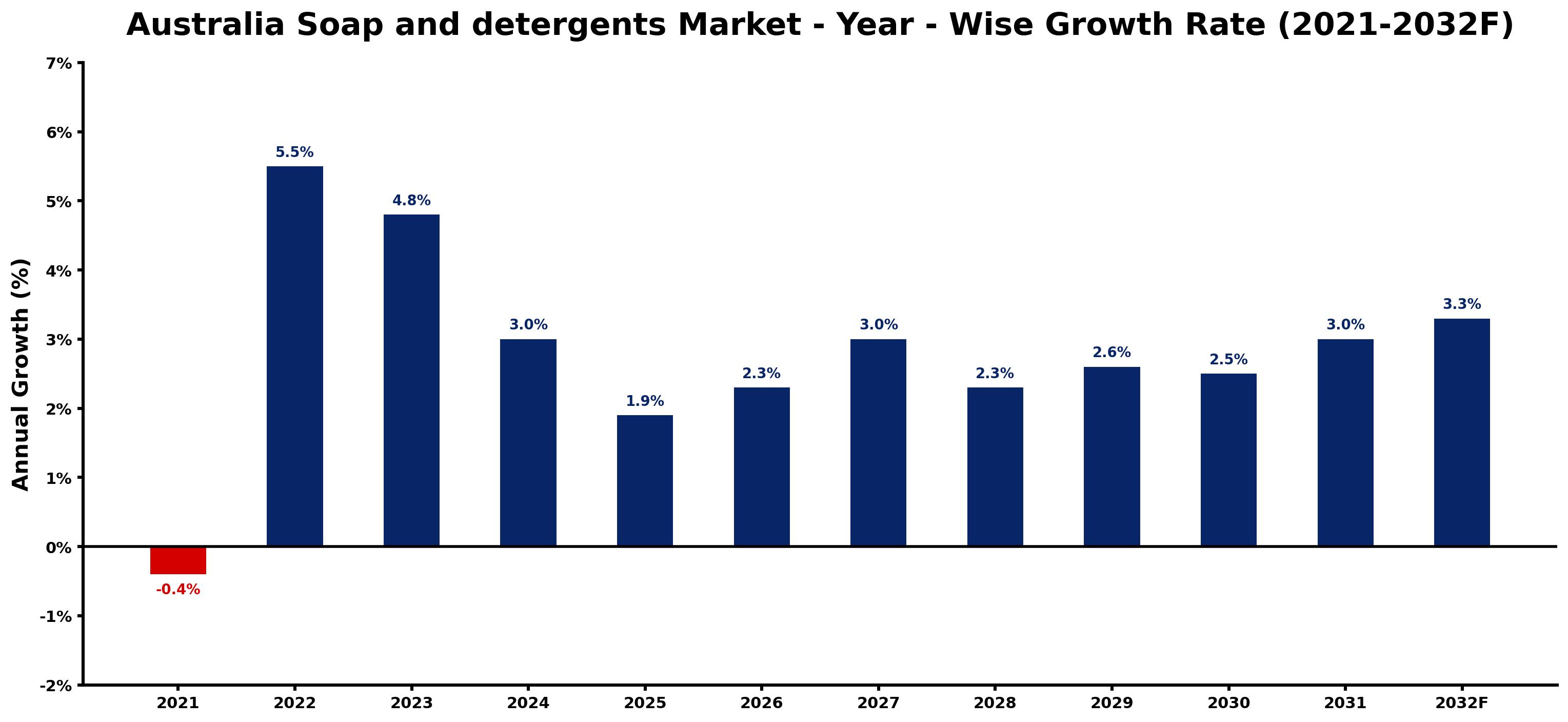
The table below presents the year wise growth rates along with the key drivers influencing the market
| Year | Growth Rate | Major Drivers |
| 2021 | -0.4% | Heightened environmental regulations led to increased production costs, impacting pricing and consumer demand for cleaning products. |
| 2022 | 5.5% | Consumer preference shifted towards natural ingredients, driving product innovation across brands. |
| 2023 | 4.8% | Widespread awareness of plastic pollution prompted significant changes in packaging strategies. |
| 2024 | 3.0% | Major retailers started prioritizing sustainable suppliers in their product selection processes. |
| 2025 | 1.9% | Emerging e-commerce platforms enhanced accessibility to niche soap and detergent brands. |
| 2026 | 2.3% | Health-conscious consumers increasingly turned to chemical-free alternatives for daily use. |
| 2027 | 3.0% | Local artisans began thriving, showcasing handcrafted soaps at community markets and fairs. |
| 2028 | 2.3% | Technological advancements in production boosted efficiency and reduced overall manufacturing costs. |
| 2029 | 2.6% | Collaborations between brands and environmental NGOs raised awareness on sustainable practices. |
| 2030 | 2.5% | Consumer insights indicated strong preference for refillable and reusable product options. |
| 2031 | 3.0% | Multi-national brands faced pressure to meet higher sustainability standards from consumers. |
| 2032 | 3.3% | Regional production capabilities expanded, reducing reliance on imported soap and detergent products. |
Note - Market size estimations and growth projections presented in this report are based on 6Wresearch's advanced forecasting approach, validated with industry datasets as of June 2026.
Australia Soap and detergents Market Synopsis
The Australia Soap and detergents Market is projected to reach 2.3% and witness significant growth during the forecast period (2026-2032). This market is characterized by evolving consumer preferences, a heightened focus on hygiene, and an increasing shift toward sustainable and eco-friendly products. As consumers become more environmentally conscious, the demand for natural and effective cleaning solutions is anticipated to drive market expansion.
Australia Soap and detergents Market Growth Drivers
Several factors contribute to the growth of the Australia Soap and detergents Market. Rising awareness surrounding hygiene and cleanliness is a primary driver, as consumers prioritize personal and household health more than ever. This trend has been accelerated by public health campaigns and personal experiences during recent health crises.
- Increased focus on health and wellness has prompted consumers to seek products tailored to specific needs, such as hypoallergenic or eco-friendly formulations that minimize environmental impact.
- Product innovation plays a crucial role, with manufacturers constantly reformulating existing products to enhance their effectiveness while simultaneously addressing sustainability concerns.
- The trend towards concentrated and multifunctional products has gained traction, appealing to modern consumers who value convenience and efficacy in their cleaning solutions.
- Digitalization and e-commerce have transformed the purchasing landscape, allowing consumers easy access to a wider range of products, thus driving market growth.
- Government regulations promoting sustainable practices are pushing manufacturers to adapt and innovate, fueling further growth in the market.
Australia Soap and detergents Market Challenges and Restraints
Despite its promising prospects, the Australia Soap and detergents Market faces notable challenges. Increasing consumer awareness regarding environmental sustainability is one of the most pressing issues.
- As demand for eco-friendly products rises, manufacturers must invest in research and development to reformulate existing products, which can lead to increased production costs.
- The market is also affected by the fluctuating prices of raw materials, which can create pricing pressures and impact profit margins.
- Navigating the regulatory landscape can be complex, as compliance with evolving government policies regarding sustainable practices may pose challenges for manufacturers.
- The proliferation of private label brands in the market may intensify competition by offering similar products at lower prices, potentially eroding market share for established brands.
- Consumer loyalty can be fleeting in this market, with the possibility of customers switching to newer brands that offer more innovative or sustainable options.
Australia Soap and detergents Market Government Investment and Initiatives
The Australian government has initiated several policies aimed at promoting sustainability within the soap and detergents market. These initiatives focus on enhancing product safety and environmental responsibility.
- Regulatory bodies, including the Australia Competition and Consumer Commission (ACCC), monitor compliance with industry standards, ensuring that manufacturers meet safety and labeling requirements.
- Government campaigns encouraging the use of eco-friendly formulations aim to reduce the environmental impact of cleaning products, fostering innovation among manufacturers.
- Public funding and support programs for research and development initiatives help businesses transition to more sustainable practices and product lines.
- The government also promotes responsible packaging practices, which seek to minimize plastic waste associated with soap and detergent products.
- Through various public awareness campaigns, consumers are being educated about the importance of making informed choices when it comes to cleaning products, further driving the market towards sustainability.
Australia Soap and detergents Market Latest Developments (May 2025 - June 2026)
The Australia Soap and detergents Market has witnessed several developments from May 2025 to June 2026, reflecting the industry's ongoing adaptation to consumer needs and regulatory changes. During this period, there has been a marked increase in the availability of environmentally friendly products, with manufacturers responding to consumer demand for sustainable options.
- Innovation in product formulations has led to the introduction of biodegradable soaps and detergents that align with eco-conscious consumer preferences.
- The market has observed a rise in the use of alternative packaging materials, as companies seek to minimize plastic usage and enhance recyclability.
- There is a growing trend towards direct-to-consumer sales channels, which have gained popularity due to the convenience they offer, particularly in the wake of shifts in consumer purchasing behavior.
- Consumer education initiatives continue to gain traction, empowering shoppers to make informed choices regarding the environmental impact of their cleaning products.
- Overall, these developments indicate a responsive and evolving market landscape that aims to meet the dual demands of efficiency and sustainability.
Australia Soap and detergents Market - Key Attractiveness of the Report
- 10 Years of Market Numbers
- Historical Data Starting from 2022 to 2025
- Base Year: 2025
- Forecast Data until 2032
- Key Performance Indicators Impacting the Market
- Major Upcoming Developments and Projects
Key Highlights of the Report:
- Australia Soap and detergents Market Outlook
- Market Size of Australia Soap and detergents Market, 2025
- Forecast of Australia Soap and detergents Market, 2032
- Historical Data and Forecast of Australia Soap and detergents Revenues & Volume for the Period 2022-2032F
- Australia Soap and detergents Market Trend Evolution
- Australia Soap and detergents Market Drivers and Challenges
- Australia Soap and detergents Price Trends
- Australia Soap and detergents Porter's Five Forces
- Australia Soap and detergents Industry Life Cycle
- Historical Data and Forecast of Australia Soap and detergents Market Revenues & Volume By Product for the Period 2022-2032F
- Historical Data and Forecast of Australia Soap and detergents Market Revenues & Volume By Household detergents for the Period 2022-2032F
- Historical Data and Forecast of Australia Soap and detergents Market Revenues & Volume By Industrial soaps & detergents for the Period 2022-2032F
- Historical Data and Forecast of Australia Soap and detergents Market Revenues & Volume By Household soaps for the Period 2022-2032F
- Historical Data and Forecast of Australia Soap and detergents Market Revenues & Volume By Others for the Period 2022-2032F
- Historical Data and Forecast of Australia Soap and detergents Market Revenues & Volume By Applications for the Period 2022-2032F
- Historical Data and Forecast of Australia Soap and detergents Market Revenues & Volume By Homecare Detergents for the Period 2022-2032F
- Historical Data and Forecast of Australia Soap and detergents Market Revenues & Volume By Industrial Soap and Detergent for the Period 2022-2032F
- Historical Data and Forecast of Australia Soap and detergents Market Revenues & Volume By Homecare Soaps for the Period 2022-2032F
- Historical Data and Forecast of Australia Soap and detergents Market Revenues & Volume By Others for the Period 2022-2032F
- Australia Soap and detergents Import Export Trade Statistics
- Market Opportunity Assessment By Product
- Market Opportunity Assessment By Applications
- Australia Soap and detergents Top Companies Market Share
- Australia Soap and detergents Competitive Benchmarking By Technical and Operational Parameters
- Australia Soap and detergents Company Profiles
- Australia Soap and detergents Key Strategic Recommendations






































