Australia Special Occasions Clothes Market Summary
The australia special occasions clothes market was estimated at USD 104 Million in 2025 and is projected to reach USD 122 Million by 2032, growing at a CAGR of 3.0% from 2026 to 2032.
Australia Special Occasions Clothes Market Year-wise Growth Rate and Key Drivers
This graph highlights how the Australia Special Occasions Clothes Market has steadily grown over the past five years, supported by major growth factors.
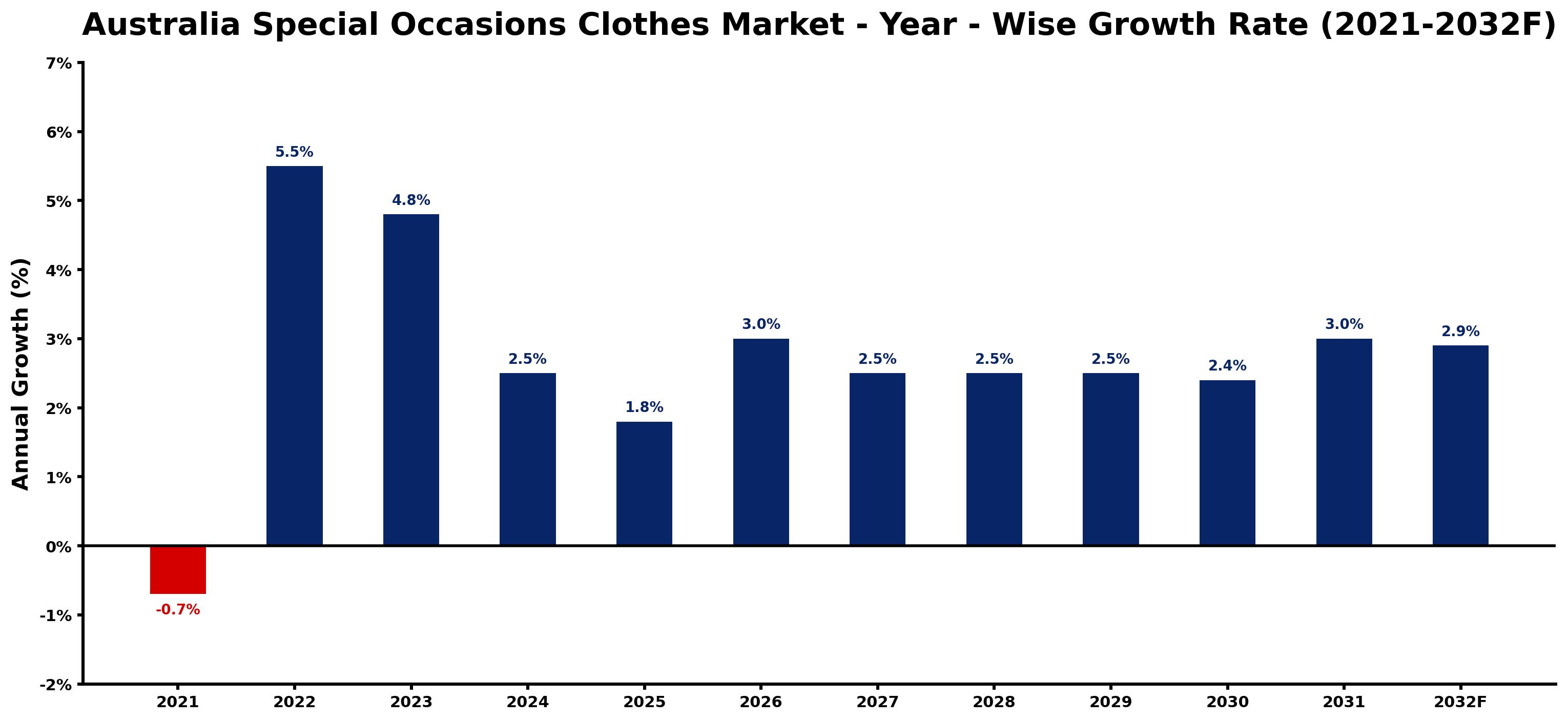
The table below presents the year wise growth rates along with the key drivers influencing the market
| Year | Growth Rate | Major Drivers |
| 2021 | -0.7% | Heightened economic uncertainty led to reduced discretionary spending on special occasion apparel among Australian consumers. |
| 2022 | 5.5% | Local designers capitalized on unique Australian fashion trends for special events. |
| 2023 | 4.8% | Sustainable materials began attracting environmentally conscious consumers in clothing choices. |
| 2024 | 2.5% | Online shopping platforms expanded offerings for niche special occasion clothing markets. |
| 2025 | 1.8% | Social media influencers played a pivotal role in shaping fashion trends for events. |
| 2026 | 3.0% | Cultural celebrations inspired diverse clothing lines tailored to multicultural Australian demographics. |
| 2027 | 2.5% | Corporate partnerships with fashion brands enhanced visibility and accessibility of collections. |
| 2028 | 2.5% | Increased disposable income led to greater spending on premium special occasion garments. |
| 2029 | 2.5% | Technological innovations facilitated personalized shopping experiences for special clothing needs. |
| 2030 | 2.4% | Seasonal fashion events showcased emerging trends, attracting attention from international buyers. |
| 2031 | 3.0% | Consumer preferences shifted towards mix-and-match styles for greater outfit versatility. |
| 2032 | 2.9% | Collaborations between fashion houses and local artists introduced unique, limited-edition collections. |
Note - Market size estimations and growth projections presented in this report are based on 6Wresearch's advanced forecasting approach, validated with industry datasets as of June 2026.
Australia Special Occasions Clothes Market Synopsis
The Australia Special Occasions Clothes Market is projected to reach 3.0% and witness significant growth during the forecast period (2026-2032). This market encompasses a broad spectrum of attire designed for celebrations of various cultural and social significance, including weddings, formal events, and festive gatherings. As the Australian population continues to embrace diverse cultural practices, the demand for stylish and elegant special occasion clothing is anticipated to rise, driven by individual expression and the importance placed on dressing appropriately for significant life events.
Australia Special Occasions Clothes Market Growth Drivers
Several factors contribute to the robust growth of the Australia Special Occasions Clothes Market. These include:
- Affluent Consumer Base: Australia boasts a wealthy demographic that appreciates high-quality fashion, particularly for special occasions, which stimulates market demand.
- Cultural Diversity: The multicultural fabric of Australian society drives a variety of style preferences, resulting in a demand for diverse clothing options that cater to different cultural celebrations.
- Social Media Influence: The pervasive impact of social media platforms encourages consumers to seek unique and trendsetting outfits, driving market growth as consumers often aim to emulate styles seen online.
- Emphasis on Fashion: Australians place a significant emphasis on fashion and the image they present at events, leading to a higher propensity to invest in quality special occasion clothing.
- Growing Celebration Trends: The increasing trend towards celebrating milestones, not only traditional events like weddings but also personal achievements and parties, fuels demand for stylish clothing.
Australia Special Occasions Clothes Market Challenges and Restraints
Despite the favorable growth conditions, the Australia Special Occasions Clothes Market faces several challenges:
- Rapidly Changing Trends: The fast-paced nature of fashion trends necessitates adaptability from retailers and designers to remain relevant, complicating inventory management.
- E-Commerce Competition: The rise of online shopping adds pressure on physical retailers to enhance the in-store experience while also competing with e-commerce platforms offering convenience and variety.
- Sustainability Concerns: Increasing consumer awareness about ethical and sustainable fashion practices poses a challenge for manufacturers to adopt responsible production methods.
- Consumer Preferences: The influence of celebrity culture and social media means consumer tastes can shift rapidly, making it essential for retailers to stay ahead of these changes.
- Market Saturation: The abundance of options can overwhelm consumers and lead to indecision, creating additional challenges for retailers in differentiating their offerings.
Australia Special Occasions Clothes Market Government Investment and Initiatives
The Australian government recognizes the importance of the apparel sector, particularly regarding special occasions attire. Initiatives aimed at supporting growth in this market include:
- Financial Support for SMEs: The government offers grants and financial aid to small and medium-sized enterprises in the fashion industry, facilitating their development and competitiveness.
- Promotion of Local Products: Initiatives to promote Australia-made clothing encourage local production and consumption, enhancing the market's sustainability and economic footprint.
- Skill Development Programs: The government invests in training and skill development for designers and craftsmen, ensuring a skilled workforce capable of meeting evolving market trends.
- Support for Sustainable Practices: Policies that encourage ethical manufacturing processes and sustainable practices within the fashion industry are increasingly being prioritized.
- Industry Collaboration: The government fosters collaboration between various stakeholders in the fashion ecosystem, enhancing innovation and promoting best practices in the sector.
Australia Special Occasions Clothes Market Latest Developments (May 2025 - June 2026)
Recent developments in the Australia Special Occasions Clothes Market reflect a dynamic move towards adaptation in response to changing consumer behaviors and preferences. The ongoing influence of social media continues to shape trends, prompting retailers to enhance their online presence and engage with customers through digital platforms. Additionally, there is an increased focus on sustainable fashion, with many brands reevaluating their supply chains to incorporate more eco-friendly practices. Collaborations between designers and local artisans are gaining momentum, creating unique offerings that reflect cultural heritage. Furthermore, competitive strategies are evolving, with retailers enhancing the in-store experience to attract customers away from online shopping.
Australia Special Occasions Clothes Market - Key Attractiveness of the Report
- 10 Years of Market Numbers
- Historical Data Starting from 2022 to 2025
- Base Year: 2025
- Forecast Data until 2032
- Key Performance Indicators Impacting the Market
- Major Upcoming Developments and Projects
Key Highlights of the Report:
- Australia Special Occasions Clothes Market Outlook
- Market Size of Australia Special Occasions Clothes Market, 2025
- Forecast of Australia Special Occasions Clothes Market, 2032
- Historical Data and Forecast of Australia Special Occasions Clothes Revenues & Volume for the Period 2022-2032F
- Australia Special Occasions Clothes Market Trend Evolution
- Australia Special Occasions Clothes Market Drivers and Challenges
- Australia Special Occasions Clothes Price Trends
- Australia Special Occasions Clothes Porter's Five Forces
- Australia Special Occasions Clothes Industry Life Cycle
- Historical Data and Forecast of Australia Special Occasions Clothes Market Revenues & Volume By Product Type for the Period 2022-2032F
- Historical Data and Forecast of Australia Special Occasions Clothes Market Revenues & Volume By Gown for the Period 2022-2032F
- Historical Data and Forecast of Australia Special Occasions Clothes Market Revenues & Volume By Suit/Tuxedo for the Period 2022-2032F
- Historical Data and Forecast of Australia Special Occasions Clothes Market Revenues & Volume By Traditional Wear for the Period 2022-2032F
- Historical Data and Forecast of Australia Special Occasions Clothes Market Revenues & Volume By Gender for the Period 2022-2032F
- Historical Data and Forecast of Australia Special Occasions Clothes Market Revenues & Volume By Male for the Period 2022-2032F
- Historical Data and Forecast of Australia Special Occasions Clothes Market Revenues & Volume By Female for the Period 2022-2032F
- Historical Data and Forecast of Australia Special Occasions Clothes Market Revenues & Volume By Distribution Channel for the Period 2022-2032F
- Historical Data and Forecast of Australia Special Occasions Clothes Market Revenues & Volume By Online for the Period 2022-2032F
- Historical Data and Forecast of Australia Special Occasions Clothes Market Revenues & Volume By Offline for the Period 2022-2032F
- Australia Special Occasions Clothes Import Export Trade Statistics
- Market Opportunity Assessment By Product Type
- Market Opportunity Assessment By Gender
- Market Opportunity Assessment By Distribution Channel
- Australia Special Occasions Clothes Top Companies Market Share
- Australia Special Occasions Clothes Competitive Benchmarking By Technical and Operational Parameters
- Australia Special Occasions Clothes Company Profiles
- Australia Special Occasions Clothes Key Strategic Recommendations






































