Australia Sugar Centrifuge Market Size, Share & Growth Rate
The Australia Sugar Centrifuge Market was estimated at USD 184 Million in 2025 and is projected to reach USD 216 Million by 2032, growing at a CAGR of 2.3% from 2026 to 2032. This growth trajectory is primarily driven by the modernization and expansion of sugar refineries to meet rising demand for refined sugar products. As manufacturers prioritize high-efficiency centrifuge systems, investments in advanced technologies are expected to rise, enhancing overall productivity and sustainability in sugar processing.
Australia Sugar Centrifuge Market Year-wise Growth Rate and Key Drivers
This graph highlights how the Australia Sugar Centrifuge Market has steadily grown over the years, supported by major growth factors.
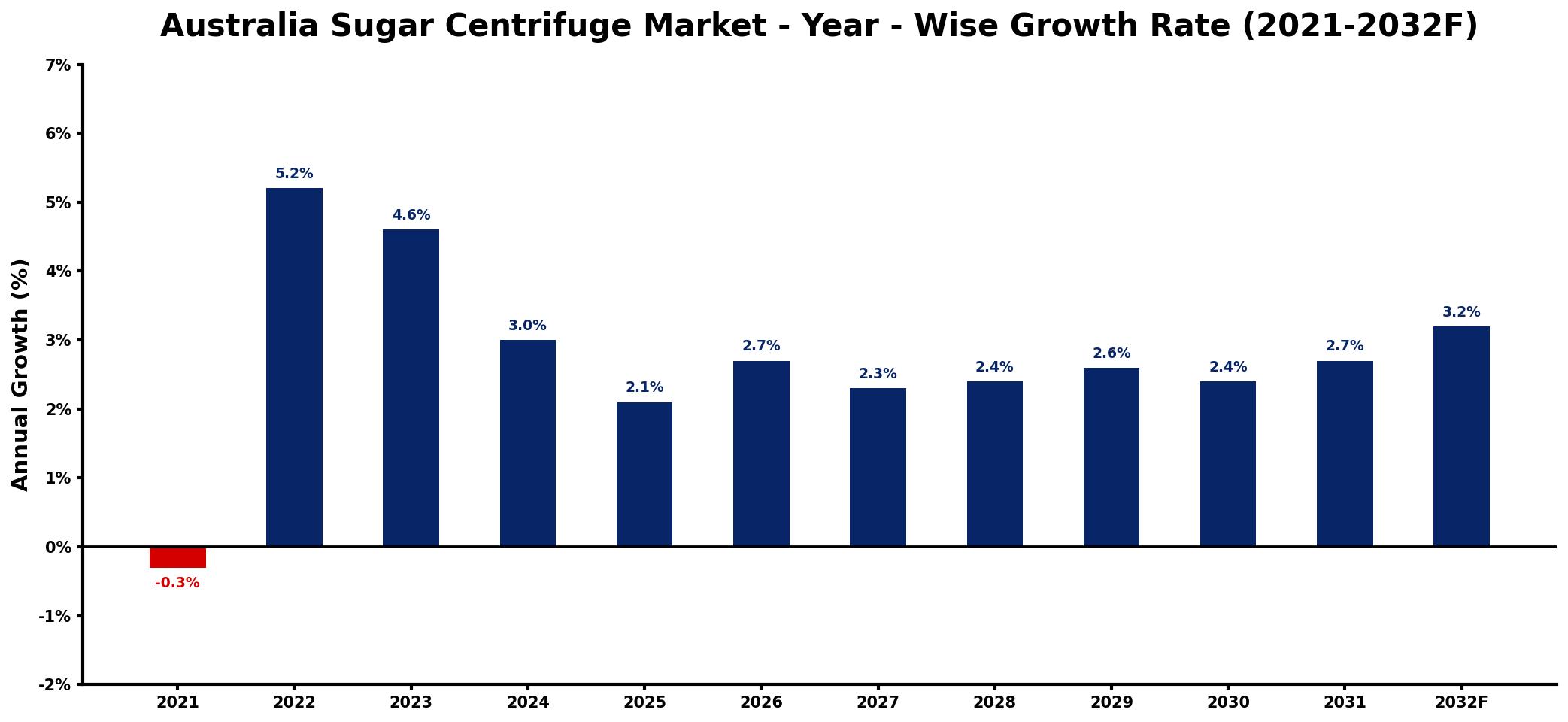
The table below presents the year‑wise growth rates along with the key drivers influencing the market
| Year | Growth Rate | Major Drivers |
| 2021 | -0.3% | Lower industrial production demand observed |
| 2022 | 5.2% | Rising investments in processing technology |
| 2023 | 4.6% | Increased focus on operational efficiency |
| 2024 | 3.0% | Expansion of food processing sector |
| 2025 | 2.1% | Growing demand for renewable energy |
| 2026 | 2.7% | Advancements in automation technologies |
| 2027 | 2.3% | Surge in export market opportunities |
| 2028 | 2.4% | Development of sustainable production practices |
| 2029 | 2.6% | Rising interest in product innovation |
| 2030 | 2.4% | Strengthening supply chain collaborations |
| 2031 | 2.7% | Increased consumer health consciousness |
| 2032 | 3.2% | Emergence of new market entrants |
Note: Market size estimations and growth projections presented in this report are based on 6Wresearch's proprietary forecasting methodology, utilizing the latest available industry data, government publications, and primary research inputs.
Australia Sugar Centrifuge Market Synopsis
The primary force shaping the Australia Sugar Centrifuge Market is the increasing need for refined sugar products. As consumer preferences evolve, refineries are compelled to adopt cutting-edge centrifuge technologies that not only improve sugar recovery rates but also comply with stringent quality standards. This shift is crucial as the sector navigates both domestic and international market demands.
Furthermore, the blend of traditional sugar production methods with innovative centrifuge designs is forging a more efficient and environmentally sustainable industry. Automation and energy-efficient centrifuges are now essential for sugar mills aiming to streamline operations while minimizing their carbon footprint and ensuring product purity.
Australia Sugar Centrifuge Market Key Takeaways
- The market is significantly influenced by technological advancements in centrifuge design, automation, and energy efficiency.
- Growing consumer demand for high-quality refined sugar products drives investments in centrifuge technologies.
- Government policies supporting modernization efforts bolster market growth through financial incentives and research funding.
- Challenges related to equipment efficiency and maintenance costs pose hurdles for market participants.
- Collaboration among government, industry, and technology providers fosters innovation and best practices in sugar processing.
Evaluation of Restraints in Australia Sugar Centrifuge Market
Despite the promising growth of the Australia Sugar Centrifuge Market, several restraints hinder its full potential. Equipment efficiency remains a critical concern, as many sugar mills grapple with aging infrastructure that can lead to increased maintenance costs and downtime. Additionally, the availability of skilled labor to operate and maintain advanced centrifuge systems is dwindling, impacting operational capabilities. Market consolidation poses another challenge, as fewer players may reduce competitive innovation and limit investment in new technologies.
Australia Sugar Centrifuge Market Trends
Current trends within the Australia Sugar Centrifuge Market highlight a shift towards greater automation and smart technologies. Many refineries are integrating IoT-enabled devices to monitor centrifuge performance in real time, enhancing operational efficiency. Additionally, there is a notable emphasis on sustainability, with companies investing in energy-efficient solutions that not only minimize operational costs but also align with environmental regulations.
Moreover, the adoption of advanced materials and designs is improving the durability and effectiveness of centrifuges. With a focus on reducing water usage and managing waste, these developments are helping the industry become more resilient and responsible amid changing environmental standards.
Australia Sugar Centrifuge Market Opportunities
Significant growth and investment opportunities exist in the realm of innovative centrifuge technologies. As refineries modernize, there is heightened demand for high-performance systems that can process larger volumes while ensuring product quality. Additionally, the move towards sustainable practices opens avenues for developing eco-friendly centrifuge solutions. Collaborations between technology providers and sugar manufacturers can also facilitate the adoption of cutting-edge methods, ensuring competitiveness in the global market.
Government Initiatives in the Australia Sugar Centrifuge Market
The Australian government plays a pivotal role in shaping the sugar centrifuge market through supportive policies and funding initiatives. Financial incentives and subsidies are offered to sugar mills focusing on upgrading and modernizing centrifuge equipment, aimed at enhancing efficiency and product quality. Regulatory frameworks are in place to ensure compliance with safety and environmental standards, further driving investments in technologically advanced centrifuge systems. Additionally, government initiatives support research and development projects that promote sustainable practices within the sugar industry.
Future Insights of the Australia Sugar Centrifuge Market
Looking forward to 2026-2032, the Australia Sugar Centrifuge Market is poised for steady growth, driven by technological innovations and a focus on sustainability. As manufacturers continue to modernize facilities to improve efficiency, the demand for advanced centrifuge systems will likely escalate. Additionally, evolving consumer preferences for high-quality sugar products will necessitate further investments in centrifuge technology, ensuring compliance with stringent quality standards. Overall, the market is expected to thrive as stakeholders embrace modernization and efficiency, ultimately positioning themselves competitively in the global landscape.
Australia Sugar Centrifuge Market Latest Developments (2025 - 2026)
Recent developments in the Australia Sugar Centrifuge Market indicate a shift toward greater integration of digital technologies within processing facilities. Many refineries are exploring automation solutions to streamline operations and enhance production efficiency. Additionally, there is a growing interest in collaborative projects between technology providers and sugar manufacturers aimed at developing innovative centrifuge systems that prioritize both performance and sustainability. As the market adapts to changing consumer demands, advancements in waste management and energy recovery solutions are also emerging as focal points in strategic planning.
Australia Sugar Centrifuge Market - Key Attractiveness of the Report
- 10 Years of Market Numbers
- Historical Data Starting from 2022 to 2025
- Base Year: 2025
- Forecast Data until 2032
- Key Performance Indicators Impacting the Market
- Major Upcoming Developments and Projects
Key Highlights of the Report:
- Australia Sugar Centrifuge Market Outlook
- Market Size of Australia Sugar Centrifuge Market, 2025
- Forecast of Australia Sugar Centrifuge Market, 2032
- Historical Data and Forecast of Australia Sugar Centrifuge Revenues & Volume for the Period 2022-2032F
- Australia Sugar Centrifuge Market Trend Evolution
- Australia Sugar Centrifuge Market Drivers and Challenges
- Australia Sugar Centrifuge Price Trends
- Australia Sugar Centrifuge Porter's Five Forces
- Australia Sugar Centrifuge Industry Life Cycle
- Historical Data and Forecast of Australia Sugar Centrifuge Market Revenues & Volume By Product for the Period 2022-2032F
- Historical Data and Forecast of Australia Sugar Centrifuge Market Revenues & Volume By Batch Type Centrifugal Machines for the Period 2022-2032F
- Historical Data and Forecast of Australia Sugar Centrifuge Market Revenues & Volume By Continuous Centrifugal Machines for the Period 2022-2032F
- Historical Data and Forecast of Australia Sugar Centrifuge Market Revenues & Volume By End Users for the Period 2022-2032F
- Historical Data and Forecast of Australia Sugar Centrifuge Market Revenues & Volume By Cane Processing for the Period 2022-2032F
- Historical Data and Forecast of Australia Sugar Centrifuge Market Revenues & Volume By Beet Processing for the Period 2022-2032F
- Historical Data and Forecast of Australia Sugar Centrifuge Market Revenues & Volume By Other Applications for the Period 2022-2032F
- Australia Sugar Centrifuge Import Export Trade Statistics
- Market Opportunity Assessment By Product
- Market Opportunity Assessment By End Users
- Australia Sugar Centrifuge Top Companies Market Share
- Australia Sugar Centrifuge Competitive Benchmarking By Technical and Operational Parameters
- Australia Sugar Centrifuge Company Profiles
- Australia Sugar Centrifuge Key Strategic Recommendations






































