Australia Sugar Refinery Machinery and Equipment Market Summary
The australia sugar refinery machinery and equipment market was estimated at USD 211 Million in 2025 and is projected to reach USD 249 Million by 2032, growing at a CAGR of 3.0% from 2026 to 2032.
Australia Sugar Refinery Machinery and Equipment Market Year-wise Growth Rate and Key Drivers
This graph highlights how the Australia Sugar Refinery Machinery and Equipment Market has steadily grown over the past five years, supported by major growth factors.
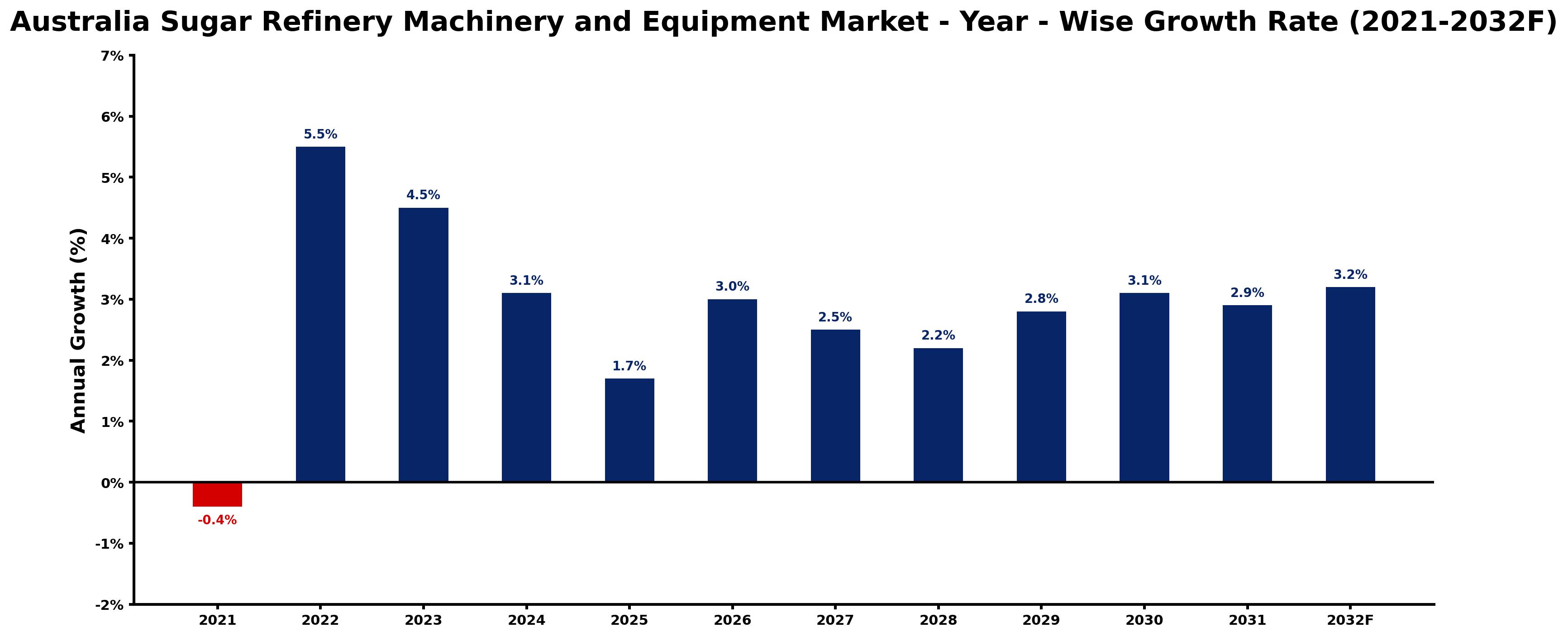
The table below presents the year wise growth rates along with the key drivers influencing the market
| Year | Growth Rate | Major Drivers |
| 2021 | -0.4% | Decreased export demand due to tighter international trade restrictions adversely impacted local machinery sales. |
| 2022 | 5.5% | Rising global sugar prices prompted local manufacturers to upgrade their machinery. |
| 2023 | 4.5% | Sustainability concerns pushed refiners toward energy-efficient production processes. |
| 2024 | 3.1% | Technological innovations started reshaping production lines for enhanced efficiency. |
| 2025 | 1.7% | A shift towards automation improved labor costs and operational efficiency significantly. |
| 2026 | 3.0% | Australian sugar exports increased, encouraging local market players to expand capacity. |
| 2027 | 2.5% | Supply chain resilience became critical, driving investments in robust machinery. |
| 2028 | 2.2% | Competitive pressures urged refiners to adopt smart technology solutions to stay relevant. |
| 2029 | 2.8% | Emerging markets expressed growing interest in Australian sugar, boosting refinery demand. |
| 2030 | 3.1% | Integration of IoT devices in machinery enhanced operational oversight and efficiency. |
| 2031 | 2.9% | Collaborative ventures between manufacturers and tech firms introduced innovative designs. |
| 2032 | 3.2% | The need for modernization aligned with industry 4.0 trends, fueling further growth. |
Note - Market size estimations and growth projections presented in this report are based on 6Wresearch's advanced forecasting approach, validated with industry datasets as of June 2026.
Australia Sugar Refinery Machinery and Equipment Market Synopsis
The Australia Sugar Refinery Machinery and Equipment Market is projected to reach 3.0% and witness significant growth during the forecast period (2026-2032). This market is crucial for the comprehensive sugar processing framework in Australia, which includes purification, crystallization, and packaging of refined sugar products. The machinery facilitates the production of high-quality sugar that meets the needs of both industrial applications and consumer markets. With the rising demand for various types of sugars—including white, specialty, and organic varieties—there is an ongoing emphasis on enhancing and expanding the capabilities of sugar refineries across the nation.
Australia Sugar Refinery Machinery and Equipment Market Growth Drivers
Several key factors are propelling the growth of the Australia Sugar Refinery Machinery and Equipment Market. Foremost, the escalating demand for refined sugar products and their by-products, particularly molasses and ethanol, is motivating refineries to invest in advanced machinery. This investment is vital for optimizing production processes, lowering costs, and enhancing product quality. Additionally, technological advancements are revolutionizing the refining sector, showcasing innovations like filtration systems, crystallizers, and vacuum pans designed to meet modern production demands.
Moreover, the adoption of automation and digitalization solutions is proving beneficial for operational efficiency and product traceability. Refineries are increasingly seeking to integrate these technologies to enhance production workflows, align with sustainability goals, and address quality assurance challenges in sugar processing. Collectively, these driving forces are underscoring the significance of reliable and efficient machinery in the Australian sugar industry.
Australia Sugar Refinery Machinery and Equipment Market Challenges and Restraints
While the Australia Sugar Refinery Machinery and Equipment Market presents numerous growth opportunities, it also faces several challenges. Globalization remains a significant factor, as Australian sugar producers encounter intensified international competition. This necessitates not only superior product quality but also compliance with stringent regulatory standards. The complexities of trade dynamics and shifting market demands further complicate the operational landscape for sugar refineries.
Moreover, sustainability concerns are at the forefront, prompting sugar refineries to seek more energy-efficient and environmentally friendly solutions. The pressure to reduce waste and improve overall environmental performance can strain operational budgets, particularly for smaller refineries with limited resources. As the market shifts towards more innovative processing technologies, refineries must balance modernization efforts with the practicalities of cost and compliance, which adds another layer of challenge to this evolving sector.
Australia Sugar Refinery Machinery and Equipment Market Government Investment and Initiatives
The landscape of the Australia Sugar Refinery Machinery and Equipment Market is significantly shaped by government policies designed to bolster the sugar processing industry. These policies focus on ensuring product quality, promoting sustainability, and facilitating industry advancements. The Australian government has implemented various financial incentives, grants, and technical assistance programs aimed at encouraging sugar refineries to invest in cutting-edge machinery and equipment. Such investments are expected to enhance processing efficiency, improve yield rates, and guarantee compliance with food safety standards.
Regulatory frameworks establish critical standards and specifications for sugar refinery machinery, thereby ensuring adherence to hygiene, safety, and environmental regulations. Furthermore, initiatives are underway to promote the adoption of energy-efficient technologies and waste management solutions, aligning industry goals with broader national sustainability targets. Collaborative efforts among government agencies, industry stakeholders, and technology providers are crucial for addressing the challenges faced and fostering a sustainable growth trajectory in the sugar refining sector.
Australia Sugar Refinery Machinery and Equipment Market Latest Developments (May 2025 - June 2026)
In the period between May 2025 and June 2026, the Australia Sugar Refinery Machinery and Equipment Market has seen substantial developments indicative of its dynamic nature. Trends suggest a marked shift towards automation, with numerous refineries investing in smart technologies that integrate data analytics for improved decision-making. This movement highlights a broader industry push towards digital transformation, with refineries seeking not only operational efficiencies but also enhanced product traceability.
Additionally, advancements in sustainability practices have gained traction, with many refineries adopting eco-friendly technologies aimed at reducing their carbon footprint. The focus on waste reduction strategies and energy efficiency has become paramount, fueled by both economic imperatives and regulatory pressures. Moreover, the market remains responsive to changing consumer preferences, reflecting a growing inclination towards organic and specialty sugars, which further drives innovations in refining processes.
Australia Sugar Refinery Machinery and Equipment Market - Key Attractiveness of the Report
- 10 Years of Market Numbers
- Historical Data Starting from 2022 to 2025
- Base Year: 2025
- Forecast Data until 2032
- Key Performance Indicators Impacting the Market
- Major Upcoming Developments and Projects
Key Highlights of the Report:
- Australia Sugar Refinery Machinery and Equipment Market Outlook
- Market Size of Australia Sugar Refinery Machinery and Equipment Market, 2025
- Forecast of Australia Sugar Refinery Machinery and Equipment Market, 2032
- Historical Data and Forecast of Australia Sugar Refinery Machinery and Equipment Revenues & Volume for the Period 2022-2032F
- Australia Sugar Refinery Machinery and Equipment Market Trend Evolution
- Australia Sugar Refinery Machinery and Equipment Market Drivers and Challenges
- Australia Sugar Refinery Machinery and Equipment Price Trends
- Australia Sugar Refinery Machinery and Equipment Porter's Five Forces
- Australia Sugar Refinery Machinery and Equipment Industry Life Cycle
- Historical Data and Forecast of Australia Sugar Refinery Machinery and Equipment Market Revenues & Volume By Refineries Type for the Period 2022-2032F
- Historical Data and Forecast of Australia Sugar Refinery Machinery and Equipment Market Revenues & Volume By Front End Refineries for the Period 2022-2032F
- Historical Data and Forecast of Australia Sugar Refinery Machinery and Equipment Market Revenues & Volume By Back End Refineries for the Period 2022-2032F
- Historical Data and Forecast of Australia Sugar Refinery Machinery and Equipment Market Revenues & Volume By Machinery and Equipment Type for the Period 2022-2032F
- Historical Data and Forecast of Australia Sugar Refinery Machinery and Equipment Market Revenues & Volume By Cane Handling Equipment for the Period 2022-2032F
- Historical Data and Forecast of Australia Sugar Refinery Machinery and Equipment Market Revenues & Volume By Cutting & Grinding Equipment for the Period 2022-2032F
- Historical Data and Forecast of Australia Sugar Refinery Machinery and Equipment Market Revenues & Volume By Processing Equipment for the Period 2022-2032F
- Historical Data and Forecast of Australia Sugar Refinery Machinery and Equipment Market Revenues & Volume By Packaging Equipment for the Period 2022-2032F
- Australia Sugar Refinery Machinery and Equipment Import Export Trade Statistics
- Market Opportunity Assessment By Refineries Type
- Market Opportunity Assessment By Machinery and Equipment Type
- Australia Sugar Refinery Machinery and Equipment Top Companies Market Share
- Australia Sugar Refinery Machinery and Equipment Competitive Benchmarking By Technical and Operational Parameters
- Australia Sugar Refinery Machinery and Equipment Company Profiles
- Australia Sugar Refinery Machinery and Equipment Key Strategic Recommendations






































