Australia Swimwear Market: Import Trend Analysis
In the Australian swimwear market, the import trend showed a growth rate of 4.53% from 2023 to 2024, with a compound annual growth rate (CAGR) of 10.08% from 2020 to 2024. This indicates a steady import momentum driven by sustained demand for swimwear products, likely influenced by changing consumer preferences or market stability during this period.
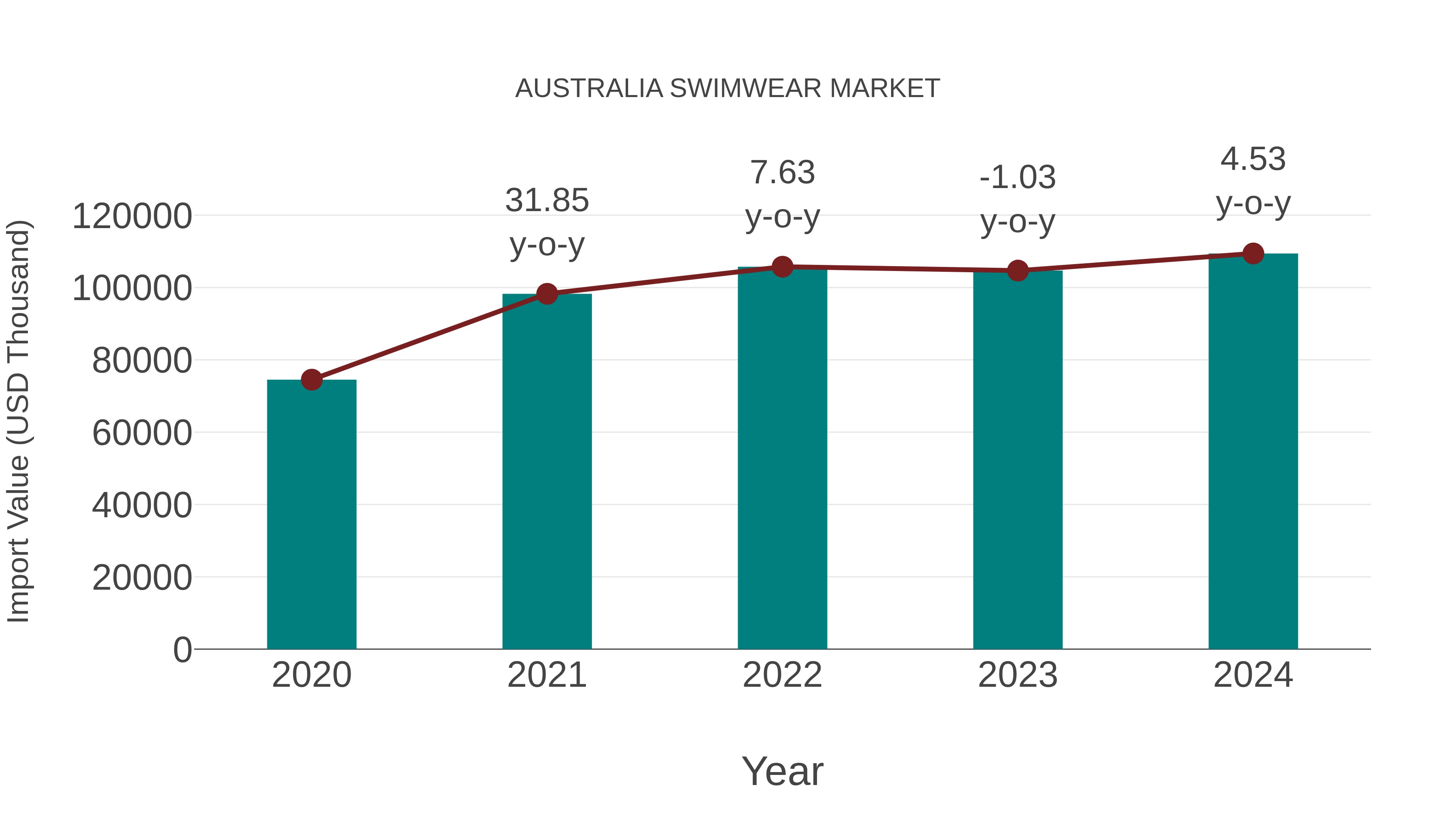
Australia Swimwear Market Growth Rate
According to 6Wresearch internal database and industry insights, the Australia Swimwear Market is growing at a compound annual growth rate (CAGR) of 5.95% during the forecast period (2026-2032).
Topics Covered in the Australia Swimwear Market Report
Australia Swimwear Market report thoroughly covers the market by type and distribution channel. The market report provides an unbiased and detailed analysis of ongoing market trends, opportunities/high growth areas, and market drivers, which would help stakeholders devise and align their market strategies according to the current and future market dynamics.
Australia Swimwear Market Highlights
| Report Name | Australia Swimwear Market |
| Forecast Period | 2026-2032 |
| CAGR | 5.95% |
| Growing Sector | Retail |
Australia Swimwear Market Synopsis
The Australia Swimwear Market is expected to experience steady growth. The market exists as Australians enjoy their beach culture and more people participate in water activities like swimming and surfing and beach tourism. Increasing health knowledge and fitness fads have led people to practice swimming as their primary workout method. The market expands as consumers want stylish swimwear that uses high-quality materials and sustainable components. The development of both online and physical store networks has enhanced product distribution throughout Australia.
Evaluation of Growth Drivers in the Australia Swimwear Market
Below mentioned some growth drivers and their impact on market dynamics:
| Drivers | Primary Segments Affected | Why It Matters |
| Beach Culture and Tourism Growth | Type (Women's Swimwear, Men's Swimwear) | Strong beach tourism drives frequent demand for swimwear products. |
| Increasing Health Awareness | Type (Men's Swimwear, Goggles and Swim Caps) | Consumers are inclined more towards swimming due to increased health trends. |
| Fashion-Oriented Swimwear | Type (Women's Swimwear) | There is a growing demand for new unique and stylish swimwear. |
| Rising Water Sports Participation | Type (Men's Swimwear, Goggles and Swim Caps) | Makes more demand for water sport-specific swimwear and accessories. |
| Online Retail Expansion | Distribution Channel (Online Stores) | Digital platforms increase accessibility and expand consumer reach. |
The Australia Swimwear Market is projected to grow significantly, with a CAGR of 5.95% during the forecast period of 2026-2032. The Australia Swimwear Market operates as people in Australia have a strong relationship with their beaches while more people learn to swim and surf and participate in other water sports activities. The increase in beach tourism together with the rise in outdoor recreational activities creates a situation where consumers buy swimwear products more frequently. People who want to stay healthy through their fitness routines will drive up the need for performance swimwear and swimming accessories. The growing market demand for swimwear that combines fashion with comfort and sustainability drives designers to make new designs of the products. The Australia Swimwear Market experiences continuous growth as online retail platforms and fashion-oriented swimwear companies expand their product availability to customers.
Evaluation of Restraints in the Australia Swimwear Market
Below mentioned are some major restraints and their influence on market dynamics:
| Restraints | Primary Segments Affected | What This Means |
| Seasonal Demand Fluctuations | All Segments | Sales fluctuate as demand rises mainly during summer and tourism seasons |
| High Product Pricing | Type (Women's Swimwear) | Expensive swimwear limits purchases among price-sensitive consumers |
| Competition from Fast Fashion | Type (Men's Swimwear, Women's Swimwear) | Affordable fast-fashion products reduce demand for premium swimwear |
| Environmental Concerns | Type (Swimwear Fabrics) | Rising eco-awareness encourages demand for sustainable swimwear materials |
| Counterfeit Products | All Segments | Fake products sold online reduce consumer trust in branded swimwear |
Australia Swimwear Market Challenges
Seasonal demand fluctuations create challenges for the Australia Swimwear Market, which leads to decreased sales and unstable revenue streams. Also, high pricing of swimwear prevent the adoption of premium items by consumers, while fast-fashion companies that sell cheap alternatives create competitive challenges for the market. Manufacturers face environmental pressure to implement sustainable practices as of public concerns about synthetic materials and textile waste. The increasing trend of eco-conscious consumerism drives higher demand for sustainable swimwear materials, which helps to develop new products and brings sustainable manufacturing practices into the industry.
Australia Swimwear Market Trends
Some major trends contributing to the Australia Swimwear Market Growth are:
- Sustainable Swimwear Materials: There is growing demand among consumers of Australia for eco-friendly swimwear made from recycled fabrics and biodegradable materials.
- Designer and Fashion Swimwear: The consumers are demanding more stylish and designer swimwear collections due to growing fashion trends and social media platform usage.
- Rise of Online Fashion Retail: The online retail platforms are making swimwear more accessible by providing consumers one-click services and competitive pricing.
Investment Opportunities in the Australia Swimwear Market
Here are some investment opportunities in the Australia Swimwear Industry:
- Sustainable Fabric Innovation: The investors can invest more in the making of eco-friendly swimwear materials like recycled nylon and biodegradable textiles.
- Digital Retail Platforms: The expansion of online retail platforms is expected to boost the market growth by providing wide range product offerings and home delivery service to the consumers of Australis.
- Sports and Performance Swimwear: Developing performance-based swimwear designed for athletes and competitive swimmers offers strong growth potential.
Top 5 Leading Players in the Australia Swimwear Market
Here are some top companies contributing to Australia Swimwear Market Share:
1. Seafolly Pty. Limited
| Company Name | Seafolly Pty. Limited |
| Headquarters | Sydney, New South Wales, Australia |
| Established | 1975 |
| Website | Click Here |
Seafolly is one of Australia's most iconic swimwear brands, known for its focus on fashion-forward designs and inclusive fits. The company offers a wide range of bikinis, one-pieces, and beach accessories, maintaining a significant retail presence both domestically and in international markets like the US and Singapore.
2. Speedo Australia
| Company Name | Speedo Australia |
| Headquarters | Sydney, New South Wales, Australia (Global HQ: Nottingham, UK) |
| Established | 1914 |
| Website | Click Here |
Originally founded on Bondi Beach, Speedo is the global benchmark for performance swimwear. While its international headquarters are in the UK, Speedo Australia remains a dominant force in the local market, providing high-technology swimwear for competitive athletes and durable "Endurance" gear for recreational swimmers.
3. Billabong International Limited
| Company Name | Billabong International Limited |
| Headquarters | Burleigh Heads, Queensland, Australia |
| Established | 1973 |
| Website | Click Here |
Billabong is a major global player in the surf and lifestyle category. Founded on the Gold Coast, the brand is celebrated for its durable boardshorts and surf-ready swimwear. It caters primarily to a younger demographic and the "action sports" community, emphasizing effortless, beach-inspired aesthetics.
4. Zimmermann
| Company Name | Zimmermann |
| Headquarters | Sydney, New South Wales, Australia |
| Established | 1991 |
| Website | - |
Zimmermann is a luxury fashion house that redefined the market by fusing high-fashion silhouettes with swimwear. Known for its sophisticated prints and intricate detailing, the brand is a staple in the luxury resort-wear segment and maintains flagship boutiques in major global fashion capitals.
5. Rip Curl
| Company Name | Rip Curl |
| Headquarters | Torquay, Victoria, Australia |
| Established | 1969 |
| Website | Click Here |
Part of the "Big Three" in the surf industry, Rip Curl is a leader in technical swimwear and wetsuit innovation. The brand is highly regarded for its performance-driven products and its "My Bikini" campaign, which targets active women looking for swimwear that stays secure during surfing and other water sports.
Government Regulations Introduced in the Australia Swimwear Market
According to Australian government data, the Australia Swimwear Market develops under three main factors which include textile safety regulations, labeling standards, and environmental sustainability regulations. Regulatory authorities ensure compliance with product safety standards for clothing and swimwear materials. The Australia National Clothing Product Stewardship Scheme along with various other initiatives supports sustainable textile production and recycling initiatives. The existing measures promote responsible manufacturing practices, which improve product safety and drive environmentally friendly swimwear production throughout the nation.
Future Insights of the Australia Swimwear Market
The Australia Swimwear Market demonstrates positive market prospects as the country maintains its beach culture while its tourism sector continues to grow. Future market growth will be supported by the growing demand from consumers who want fashionable swimwear made with sustainable materials. The growing demand for water sports, swimming competitions, and beach vacations will increase market demand. The market will experience future growth as digital retail platforms and new product designs will provide customers with more shopping options.
Market Segmentation Analysis
The report provides a comprehensive analysis of the following market segments:
Men's Swimwear to Dominate the Market – By Product Type
According to Parth, Senior Research analysts at 6Wresearch, the Australian beach culture and busy lifestyle are expected to cause the men's swimwear market to grow a lot. This growth is caused by more people wanting stylish, long-lasting, and performance-focused swimwear. One reason men's swimwear is so popular is that fabrics have gotten better over the years. For example, polyester is light and dries quickly.
Offline stores to Dominate the Market – By Distribution Channel
The offline stores are leading the Australia swimsuit market. In Australia there are well-known department stores, speciality boutiques, and outdoor gear shops. All of these stores help the industry grow. These offline retail platforms, which go along with the growing trend of online shopping, let customers try on clothes and get personalised help.
Key attractiveness of the report
- 10 Years Market Numbers.
- Historical Data Starting from 2022 to 2025.
- Base Year: 2025
- Forecast Data until 2032.
- Key Performance Indicators Impacting the Market.
- Major Upcoming Developments and Projects.
Key Highlights of the Report:
- Australia Swimwear Market Outlook
- Market Size of Australia Swimwear Market, 2025
- Forecast of Australia Swimwear Market, 2032
- Historical Data and Forecast of Australia Swimwear Revenues & Volume for the Period 2022-2032
- Australia Swimwear Market Trend Evolution
- Australia Swimwear Market Drivers and Challenges
- Australia Swimwear Price Trends
- Australia Swimwear Porter's Five Forces
- Australia Swimwear Industry Life Cycle
- Historical Data and Forecast of Australia Swimwear Market Revenues & Volume By Type for the Period 2022-2032
- Historical Data and Forecast of Australia Swimwear Market Revenues & Volume By Women's Swimwear for the Period 2022-2032
- Historical Data and Forecast of Australia Swimwear Market Revenues & Volume By Men's Swimwear for the Period 2022-2032
- Historical Data and Forecast of Australia Swimwear Market Revenues & Volume By Goggles and Swim Caps for the Period 2022-2032
- Historical Data and Forecast of Australia Swimwear Market Revenues & Volume By Distribution Channel for the Period 2022-2032
- Historical Data and Forecast of Australia Swimwear Market Revenues & Volume By Online Stores for the Period 2022-2032
- Historical Data and Forecast of Australia Swimwear Market Revenues & Volume By Offline Stores for the Period 2022-2032
- Australia Swimwear Import Export Trade Statistics
- Market Opportunity Assessment By Type
- Market Opportunity Assessment By Distribution Channel
- Australia Swimwear Top Companies Market Share
- Australia Swimwear Competitive Benchmarking By Technical and Operational Parameters
- Australia Swimwear Company Profiles
- Australia Swimwear Key Strategic Recommendations
Markets Covered
The report provides detailed analysis of the following market segments:
By Type
- Women's Swimwear
- Men's Swimwear
- Goggles and Swim Caps
By Distribution Channel
- Online Stores
- Offline Stores






































