Australia Tax Management Market Size & Growth Rate (2026-2032)
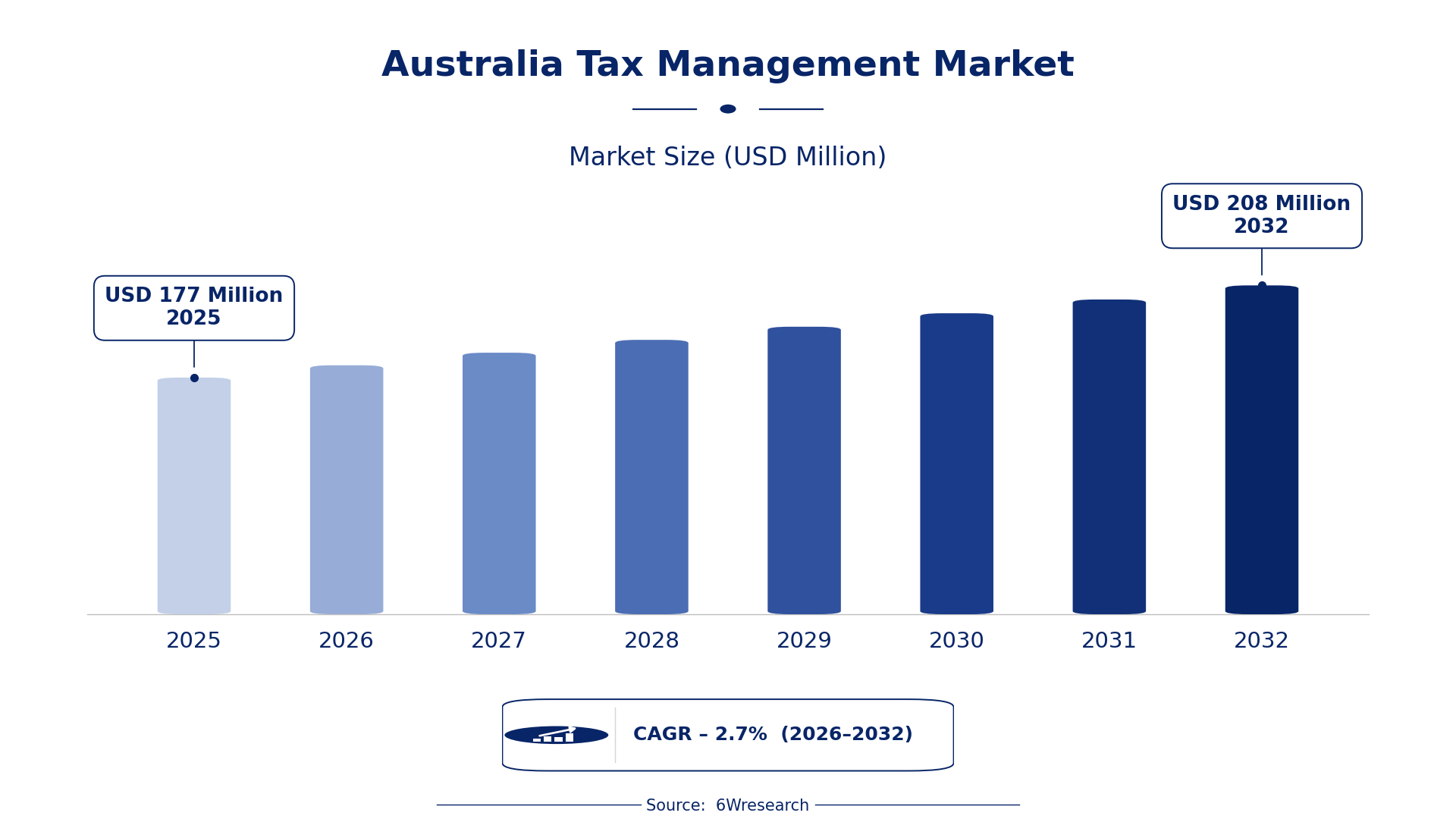
The Australia Tax Management Market was estimated at USD 177 Million in 2025 and is projected to reach USD 208 Million by 2032, growing at a CAGR of 2.7% from 2026 to 2032.
Australia Tax Management Market Synopsis
The Australia Tax Management Market is currently experiencing heightened activity as businesses grapple with increasingly complex tax regulations. Organizations across various sectors are increasingly reliant on advanced tax management solutions to ensure compliance, minimize risks, and enhance operational efficiency. The integration of innovative technologies like automation and AI has become paramount in streamlining tax processes.
As the Australian government continues to refine its tax policies, firms must remain vigilant about compliance requirements. This creates a growing demand for software solutions that offer real-time updates and optimization strategies. The intersection of regulatory changes and technological advancements is reshaping how tax management is approached within the country.
Australia Tax Management Market Year-wise Growth Rate and Key Drivers
This graph illustrates the annual growth rates of the Australia Tax Management Market from 2021 to 2032, highlighting a steady upward trajectory and projected expansion over the forecast period.
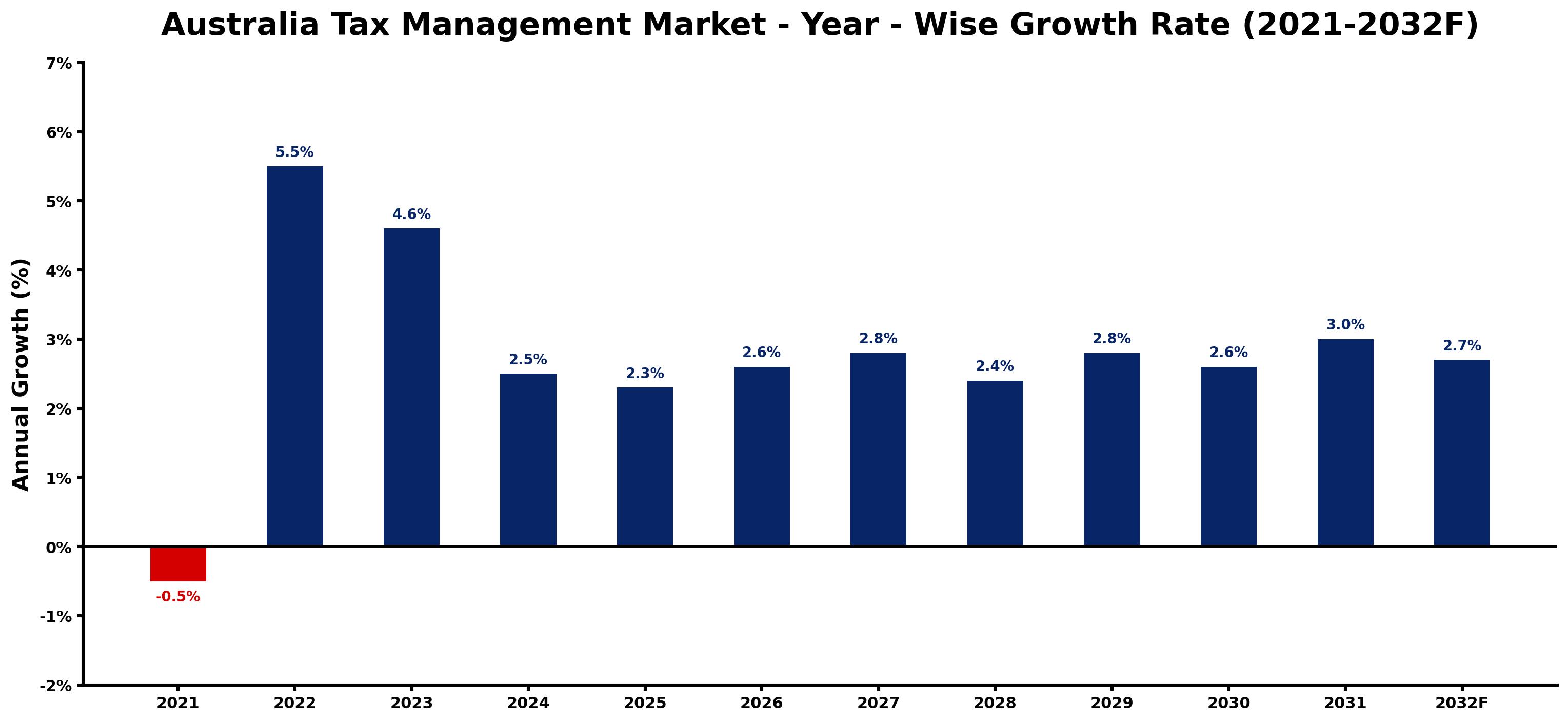
The table below presents the year‑wise growth rates along with the key drivers influencing the market
| Year | Growth Rate | Major Drivers |
| 2021 | -0.5% | ATO's stringent new compliance regulations affecting tax advisors |
| 2022 | 5.5% | Increased digitalization mandates by Australian Taxation Office. |
| 2023 | 4.6% | Implementation of ATO’s new single touch payroll requirements. |
| 2024 | 2.5% | Tax relief initiatives for SMEs during economic recovery. |
| 2025 | 2.3% | Rising compliance needs due to updated taxation legislation. |
| 2026 | 2.6% | Adoption of AI for tax reporting automation. |
| 2027 | 2.8% | Growing interest in tax-efficient investment strategies. |
| 2028 | 2.4% | Integration of ESG considerations into tax planning. |
| 2029 | 2.8% | Support for Australian businesses by ATO grants and resources. |
| 2030 | 2.6% | Increased taxpayer education initiatives by the ATO. |
| 2031 | 3.0% | Rising focus on tax compliance in gig economy sector. |
| 2032 | 2.7% | Emergence of specialized tax software for small businesses. |
Note: Market size estimations and growth projections presented in this report are based on 6Wresearch's proprietary forecasting methodology, utilizing the latest available industry data, government publications, and primary research inputs.
Australia Tax Management Market Key Takeaways
Below are some of the specific key takeaways from the market, including:
- Demand for automation and AI-driven solutions is escalating, aiming to enhance tax accuracy and efficiency.
- Businesses are focusing on real-time updates to stay compliant with evolving tax regulations.
- Ongoing government initiatives are reinforcing the importance of tax transparency and compliance.
- Economic uncertainties are pushing firms to adopt strategic tax planning to mitigate risks.
- The market is projected to grow steadily, driven by an increasing reliance on advanced tax management technologies.
Evaluation of Restraints in Australia Tax Management Market
Several restraints hinder the growth of the Australia Tax Management Market. Chief among these is the constant evolution of tax laws, which presents a challenge for businesses striving to remain compliant. The burden of understanding and implementing changes in tax regulations can overwhelm even established firms. Additionally, the need for ongoing training and resource allocation to adapt to new technologies can stretch budgets thin, particularly for small to medium-sized enterprises. Ultimately, the complexity of compliance and the need for precise tax planning strategies remain significant barriers to market growth.
Australia Tax Management Market Trends
The tax management market in Australia is witnessing a notable shift towards digitalization. Increased adoption of cloud-based tax solutions is enabling organizations to access critical tax data from anywhere, facilitating timely decision-making. on top of that, the rise of AI technologies is automating routine tasks, significantly reducing human error and improving compliance rates. Enhanced analytics capabilities are allowing businesses to forecast tax liabilities more accurately, enabling proactive tax planning. As such, the demand for integrated tax management systems continues to grow.
Australia Tax Management Market Opportunities
Growth opportunities in the Australia Tax Management Market are largely tied to technological advancements and regulatory changes. Companies that invest in innovative tax solutions, particularly those incorporating AI and machine learning, are likely to gain a competitive edge. on top of that, as businesses expand into new markets, the need for sophisticated tax planning becomes critical. This opens avenues for service providers specializing in cross-border tax compliance and advisory services. on top of that, government incentives for businesses adopting tax transparency measures present additional investment opportunities.
Government Initiatives in the Australia Tax Management Market
The Australian government is actively shaping the tax management landscape through various policy initiatives aimed at enhancing compliance and transparency. Recent regulatory updates emphasize the importance of keeping pace with tax obligations, which in turn drives demand for effective tax management solutions. With an eye on economic growth, these policies not only promote compliance but also aim to foster a more efficient tax ecosystem.
- A regulatory framework introduced in 2025 mandates enhanced billing transparency across businesses.
- A national digital infrastructure upgrade program is currently underway to facilitate better access to tax management resources.
- A planned public-private initiative expected to promote the adoption of advanced tax technologies is set to launch in 2026.
- Recently completed initiatives focused on streamlining tax reporting obligations to reduce the compliance burden on small businesses.
- The government is currently exploring incentives to encourage firms to adopt AI-driven tax solutions by 2027.
Future Insights of the Australia Tax Management Market
Looking ahead to 2026-2032, the Australia Tax Management Market is set for steady growth. The trend towards digitalization will not only continue but will also accelerate as businesses seek efficiency and accuracy in their tax practices. Firms that embrace technological advancements will be better positioned to navigate the complexities of compliance. The ongoing reforms in tax policy will further necessitate adaptive strategies, driving demand for sophisticated tax management solutions. Businesses that prioritize strategic tax planning will likely enjoy better financial outcomes as the market evolves.
Australia Tax Management Market Latest Developments
In the past year, the Australia Tax Management Market has seen significant shifts driven by both technological advancements and regulatory changes. The introduction of new compliance standards has prompted businesses to adopt modern tax management solutions, ensuring they remain ahead of the curve. As firms increasingly focus on digital transformation, innovative solutions are rapidly being integrated into existing tax frameworks.
- A leading technology vendor launched an AI-driven tax compliance tool in early 2025, significantly enhancing accuracy in reporting.
- An ongoing initiative began in mid-2025, focusing on educating businesses about the benefits of adopting automated tax solutions.
- A major partnership between tax consultancy firms is expected to formalize by late 2025, aimed at enhancing cross-border tax advisory services.
- Upcoming legislation set for 2026 is anticipated to further simplify tax filing processes for small businesses.
- A rollout of a cloud-based tax management system is planned for mid-2026 to improve accessibility for remote teams.
Australia Tax Management Market - Key Attractiveness of the Report
- 10 Years of Market Numbers
- Historical Data Starting from 2022 to 2025
- Base Year: 2025
- Forecast Data until 2032
- Key Performance Indicators Impacting the Market
- Major Upcoming Developments and Projects
Key Highlights of the Report:
- Australia Tax Management Market Outlook
- Market Size of Australia Tax Management Market, 2025
- Forecast of Australia Tax Management Market, 2032
- Historical Data and Forecast of Australia Tax Management Revenues & Volume for the Period 2022-2032F
- Australia Tax Management Market Trend Evolution
- Australia Tax Management Market Drivers and Challenges
- Australia Tax Management Price Trends
- Australia Tax Management Porter's Five Forces
- Australia Tax Management Industry Life Cycle
- Historical Data and Forecast of Australia Tax Management Market Revenues & Volume By Component for the Period 2022-2032F
- Historical Data and Forecast of Australia Tax Management Market Revenues & Volume By Software for the Period 2022-2032F
- Historical Data and Forecast of Australia Tax Management Market Revenues & Volume By Services for the Period 2022-2032F
- Historical Data and Forecast of Australia Tax Management Market Revenues & Volume By Tax Type for the Period 2022-2032F
- Historical Data and Forecast of Australia Tax Management Market Revenues & Volume By Indirect Tax for the Period 2022-2032F
- Historical Data and Forecast of Australia Tax Management Market Revenues & Volume By Direct Tax for the Period 2022-2032F
- Historical Data and Forecast of Australia Tax Management Market Revenues & Volume By Deployment Mode for the Period 2022-2032F
- Historical Data and Forecast of Australia Tax Management Market Revenues & Volume By Cloud for the Period 2022-2032F
- Historical Data and Forecast of Australia Tax Management Market Revenues & Volume By On-Premises for the Period 2022-2032F
- Historical Data and Forecast of Australia Tax Management Market Revenues & Volume By Organization Size for the Period 2022-2032F
- Historical Data and Forecast of Australia Tax Management Market Revenues & Volume By SMEs and Large Enterprises for the Period 2022-2032F
- Historical Data and Forecast of Australia Tax Management Market Revenues & Volume By Vertical for the Period 2022-2032F
- Historical Data and Forecast of Australia Tax Management Market Revenues & Volume By Banking, Financial Services, and Insurance (BFSI) for the Period 2022-2032F
- Historical Data and Forecast of Australia Tax Management Market Revenues & Volume By Information Technology (IT) and Telecom for the Period 2022-2032F
- Historical Data and Forecast of Australia Tax Management Market Revenues & Volume By Manufacturing for the Period 2022-2032F
- Historical Data and Forecast of Australia Tax Management Market Revenues & Volume By Energy and Utilities for the Period 2022-2032F
- Historical Data and Forecast of Australia Tax Management Market Revenues & Volume By Retail for the Period 2022-2032F
- Historical Data and Forecast of Australia Tax Management Market Revenues & Volume By Healthcare and Life Sciences for the Period 2022-2032F
- Historical Data and Forecast of Australia Tax Management Market Revenues & Volume By Media and Entertainment for the Period 2022-2032F
- Historical Data and Forecast of Australia Tax Management Market Revenues & Volume By Others for the Period 2022-2032F
- Australia Tax Management Import Export Trade Statistics
- Market Opportunity Assessment By Component
- Market Opportunity Assessment By Tax Type
- Market Opportunity Assessment By Deployment Mode
- Market Opportunity Assessment By Organization Size
- Market Opportunity Assessment By Vertical
- Australia Tax Management Top Companies Market Share
- Australia Tax Management Competitive Benchmarking By Technical and Operational Parameters
- Australia Tax Management Company Profiles
- Australia Tax Management Key Strategic Recommendations






































