Australia Tensile Testing Equipment Market Size, Share & Growth Rate
The Australia Tensile Testing Equipment Market was estimated at USD 171 Million in 2025 and is projected to reach USD 202 Million by 2032, growing at a CAGR of 2.4% from 2026 to 2032. This upward trajectory can be attributed to the increasing focus on rigorous quality control processes across various industries such as automotive, aerospace, and manufacturing. As regulatory standards tighten and the use of advanced materials expands, the demand for precise tensile testing solutions is expected to escalate.
Australia Tensile Testing Equipment Market Year-wise Growth Rate and Key Drivers
This graph highlights how the Australia Tensile Testing Equipment Market has steadily grown over the years, supported by major growth factors.
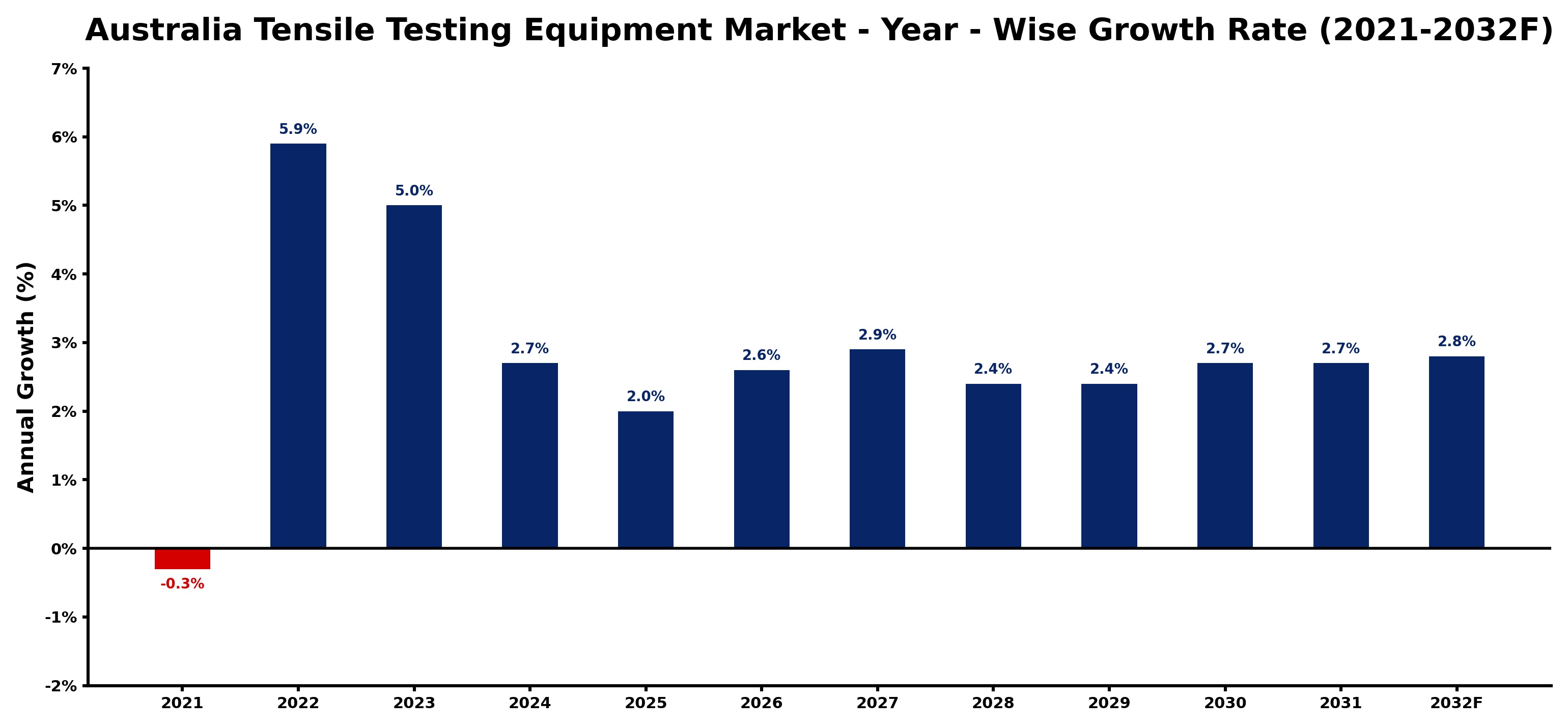
The table below presents the year‑wise growth rates along with the key drivers influencing the market
| Year | Growth Rate | Major Drivers |
| 2021 | -0.3% | Increasing adoption of advanced technologies |
| 2022 | 5.9% | Growing urbanization and commercial development |
| 2023 | 5.0% | Growing urbanization and commercial development |
| 2024 | 2.7% | Increasing industrial infrastructure investments |
| 2025 | 2.0% | Growing urbanization and commercial development |
| 2026 | 2.6% | Increasing industrial automation investments |
| 2027 | 2.9% | Rising electricity demand across industries |
| 2028 | 2.4% | Rising electricity demand across industries |
| 2029 | 2.4% | Expansion of transportation and logistics networks |
| 2030 | 2.7% | Increasing adoption of advanced technologies |
| 2031 | 2.7% | Increasing adoption of advanced technologies |
| 2032 | 2.8% | Increasing industrial automation investments |
Note - Market size estimations and growth projections presented in this report are based on 6Wresearch’s advanced forecasting approach, validated with industry datasets as of June 2026.
Australia Tensile Testing Equipment Market Synopsis
In Australia, the tensile testing equipment market is witnessing a robust surge in demand, propelled by advancements in material science and a heightened emphasis on safety regulations. Industries are increasingly adopting sophisticated testing methodologies to ensure the integrity and performance of materials, particularly those employed in critical applications.
Moreover, the integration of automated testing solutions is reshaping the landscape, offering enhanced efficiency and accuracy. As organizations seek to streamline their testing processes, the reliance on high-precision tensile testing equipment becomes crucial to maintaining competitive advantage.
Australia Tensile Testing Equipment Market Key Takeaways
- Heightened demand driven by quality control in automotive, aerospace, and construction sectors.
- Market expansion is supported by advancements in automated testing technologies and software integration.
- Increased adoption of advanced materials necessitates precise evaluation through tensile testing.
- Regulatory compliance is becoming a critical factor in equipment purchasing decisions.
- Innovation in testing equipment design is essential to address diverse industry requirements.
Evaluation of Restraints in Australia Tensile Testing Equipment Market
Despite the robust growth trajectory, the Australia tensile testing equipment market faces notable restraints. One significant challenge is the necessity for accuracy and precision in testing procedures while catering to a wide array of industry standards. Equipment manufacturers must navigate the complexities of customization, as diverse materials and applications demand specialized solutions. Additionally, maintaining compliance with evolving regulatory frameworks adds to the operational burden, compelling manufacturers to invest in continuous improvements and adaptations to their technologies.
Australia Tensile Testing Equipment Market Trends
The market is witnessing several trends that are reshaping demand. The rise of smart manufacturing practices is driving a shift toward automated and integrated testing systems that offer real-time data analytics. Furthermore, there is a growing emphasis on sustainability, pushing industries to adopt greener materials that require comprehensive tensile testing for performance validation. As digital transformation continues, software capabilities in tensile testing equipment are becoming increasingly sophisticated, enhancing the user experience and data management.
Australia Tensile Testing Equipment Market Opportunities
Significant growth opportunities exist within niche markets, particularly in sectors utilizing advanced composites and alloys. These materials often exhibit unique mechanical properties that necessitate specific testing protocols, creating a demand for tailored solutions. Additionally, as industries pursue more rigorous testing for compliance and performance validation, investments in R&D for innovative testing technologies can yield substantial returns.
Government Initiatives in the Australia Tensile Testing Equipment Market
The Australian government plays a pivotal role in promoting the importance of tensile testing equipment, particularly within high-stakes industries like aerospace and automotive. Policies aimed at enhancing standards compliance and ensuring the reliability of testing methods are frequently introduced. Furthermore, government initiatives often support research and development, fostering partnerships between industry and academia to advance testing technologies. Training and certification programs are also being established to develop a skilled workforce capable of operating advanced tensile testing systems.
Future Insights of the Australia Tensile Testing Equipment Market
Looking forward to the period from 2026 to 2032, the Australia tensile testing equipment market is poised for continued expansion. With ongoing technological innovations and an increasing push for quality assurance, the market will likely see more companies investing in state-of-the-art testing equipment. The growing regulatory landscape and an emphasis on safety standards will further cement the importance of reliable tensile testing solutions, paving the way for sustained growth and diversification in product offerings.
Australia Tensile Testing Equipment Market Latest Developments (May 2025 - June 2026)
Recent months have seen a notable shift in the tensile testing equipment market as companies embrace automation to enhance efficiency. Innovations in software integration are allowing for better data analysis and improved testing protocols. Additionally, there has been an uptick in collaborative efforts between industry and research institutions to develop next-generation testing solutions, fostering an environment of continuous improvement and adaptation to market needs.
Australia Tensile Testing Equipment Market - Key Attractiveness of the Report
- 10 Years of Market Numbers
- Historical Data Starting from 2022 to 2025
- Base Year: 2025
- Forecast Data until 2032
- Key Performance Indicators Impacting the Market
- Major Upcoming Developments and Projects
Key Highlights of the Report:
- Australia Tensile Testing Equipment Market Outlook
- Market Size of Australia Tensile Testing Equipment Market, 2025
- Forecast of Australia Tensile Testing Equipment Market, 2032
- Historical Data and Forecast of Australia Tensile Testing Equipment Revenues & Volume for the Period 2022-2032F
- Australia Tensile Testing Equipment Market Trend Evolution
- Australia Tensile Testing Equipment Market Drivers and Challenges
- Australia Tensile Testing Equipment Price Trends
- Australia Tensile Testing Equipment Porter's Five Forces
- Australia Tensile Testing Equipment Industry Life Cycle
- Historical Data and Forecast of Australia Tensile Testing Equipment Market Revenues & Volume By Equipment Type for the Period 2022-2032F
- Historical Data and Forecast of Australia Tensile Testing Equipment Market Revenues & Volume By Universal Testing Machine for the Period 2022-2032F
- Historical Data and Forecast of Australia Tensile Testing Equipment Market Revenues & Volume By Hydraulic for the Period 2022-2032F
- Historical Data and Forecast of Australia Tensile Testing Equipment Market Revenues & Volume By Electromechanical for the Period 2022-2032F
- Historical Data and Forecast of Australia Tensile Testing Equipment Market Revenues & Volume By Others for the Period 2022-2032F
- Historical Data and Forecast of Australia Tensile Testing Equipment Market Revenues & Volume By End-User Industry for the Period 2022-2032F
- Historical Data and Forecast of Australia Tensile Testing Equipment Market Revenues & Volume By Industrial Manufacturing for the Period 2022-2032F
- Historical Data and Forecast of Australia Tensile Testing Equipment Market Revenues & Volume By Automotive for the Period 2022-2032F
- Historical Data and Forecast of Australia Tensile Testing Equipment Market Revenues & Volume By Construction for the Period 2022-2032F
- Historical Data and Forecast of Australia Tensile Testing Equipment Market Revenues & Volume By Others for the Period 2022-2032F
- Australia Tensile Testing Equipment Import Export Trade Statistics
- Market Opportunity Assessment By Equipment Type
- Market Opportunity Assessment By End-User Industry
- Australia Tensile Testing Equipment Top Companies Market Share
- Australia Tensile Testing Equipment Competitive Benchmarking By Technical and Operational Parameters
- Australia Tensile Testing Equipment Company Profiles
- Australia Tensile Testing Equipment Key Strategic Recommendations






































