Australia Textile Yarn Market: Import Trend Analysis
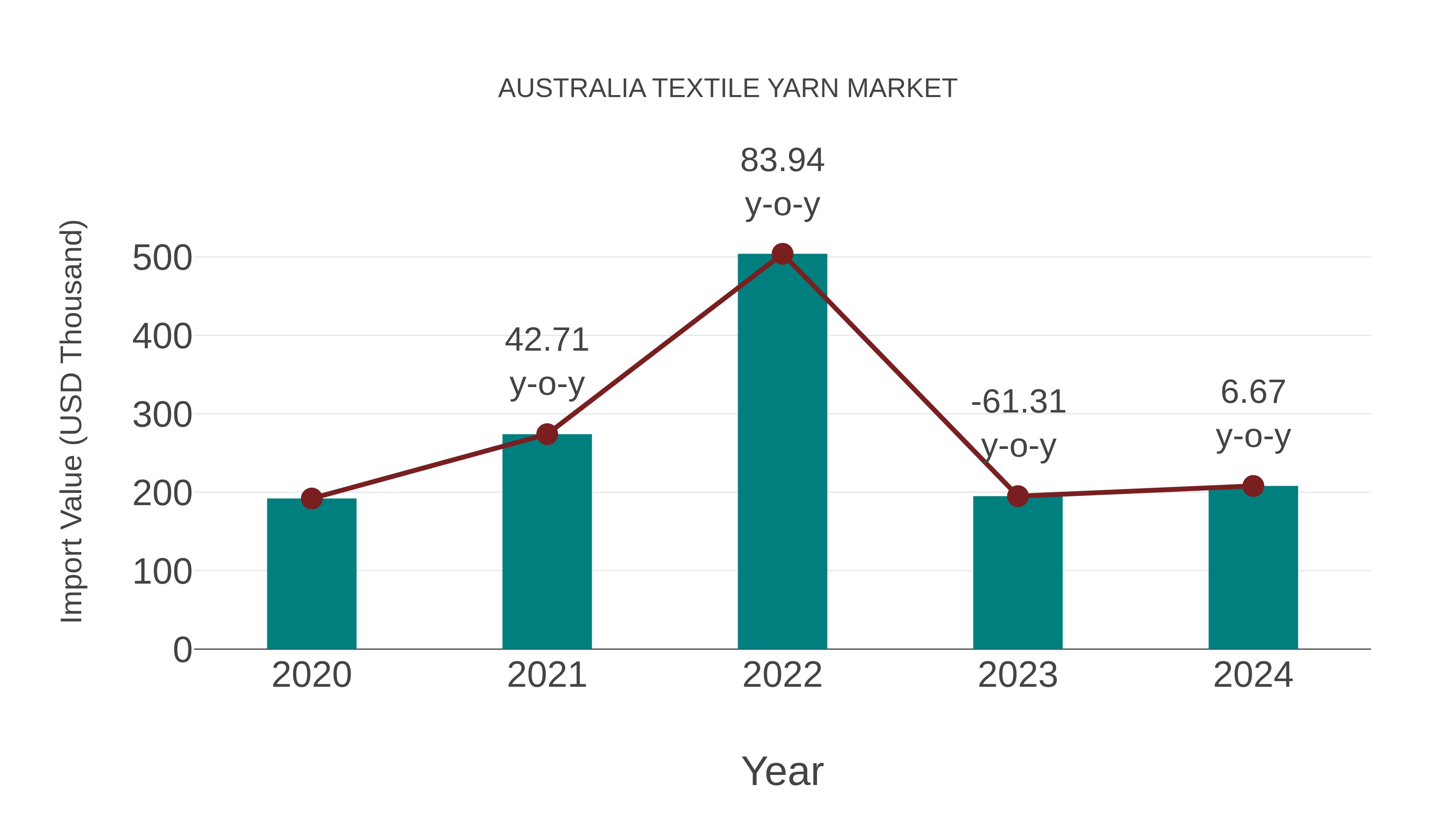
In the Australia textile yarn market, imports experienced a growth rate of 6.67% from 2023 to 2024, with a compound annual growth rate (CAGR) of 2.02% from 2020 to 2024. This import momentum can be attributed to a steady demand shift towards high-quality textile inputs, indicating market stability and sustained interest in foreign yarn sources.
Australia Textile Yarn Market Highlights
| Report Name | Australia Textile Yarn Market |
| Forecast period | 2025-2031 |
| CAGR | 5.8% |
| Growing Sector | Apparel |
Topics Covered in the Australia Textile Yarn Market Report
Australia Textile Yarn Market report thoroughly covers the market By Sources, By Applications, By Artificial Subtype and By Type. The market report provides an unbiased and detailed analysis of the ongoing market trends, opportunities/high growth areas, and market drivers which would help the stakeholders to devise and align their market strategies according to the current and future market dynamics.
Australia Textile Yarn Market Synopsis
According to 6Wresearch, the Australia Textile Yarn Market size is expected to reach a CAGR of 5.8% during the forecast period of 2025-2031. One of the key drivers of this market is the rising demand for textile products in various industries, such as clothing, home furnishings, and industrial textiles. As the Australia economy continues to grow, so does the demand for high-quality and diverse textile products, leading to an increased demand for textile yarn. Moreover, the increasing adoption of advanced technology in the textile industry has also contributed to the growth of this market. With the implementation of automation and digitalization in the production process, manufacturers can now produce a large volume of high-quality yarn at a faster pace. This has not only improved efficiency but also reduced production costs, making it easier for businesses to enter and thrive in the Australia Textile Yarn Market.
However, with the growing demand for sustainable fashion and eco-friendly products, manufacturers are also investing in research and development to produce innovative and environmentally friendly yarn options. Despite its growth prospects, the market also faces some challenges, such as fluctuations in raw material prices and the availability of cheaper alternatives. Additionally, the rise in environmental concerns has led to a shift towards sustainable and eco-friendly textile materials, which may impact the demand for traditional yarn products and these factors have led to major decline in Australia Textile Yarn Market Growth.
Textile Yarn Market in Australia: Leading Players
One of the major players in the Australia textile yarn Industry is BHP, one of the largest mining companies in the world. The company produces a wide range of yarns used for various applications such as apparel, home textiles, and industrial fabrics. Another key player is Nufarm, a leading manufacturer of agricultural and industrial yarns. The company has a strong presence in the Australia market and offers high-quality yarns for various industries. Other prominent players include Ascot Industries, BlueScope Steel, and Trelleborg AB, who offer a diverse range of textile yarn products to cater to the growing demand in the country.
Australia Textile Yarn Industry: Government Initiatives
The Australia government has taken several initiatives to support and promote the growth of the textile yarn industry in the country. One such initiative is the Textile, Clothing, and Footwear Strategic Capability Program (TCFSCP), which aims to strengthen the competitiveness of Australia textile, clothing, and footwear industries through funding and support for innovation, skills development, and market access. The government has also implemented the Textile, Clothing, Footwear and Leather (TCFL) tariff grant scheme to encourage investment in the industry by providing duty refunds on imported textile inputs. In addition, the Australia government has introduced regulations promoting sustainable and ethical practices in the textile yarn industry.
Future Insights of the Market
The future of the Textile Yarn Market in Australia looks promising with a number of factors contributing to its growth. The country growing population and rising disposable income are expected to drive the demand for textile yarn products, particularly in the apparel and home textiles sectors. Additionally, the increasing trend towards sustainable and eco-friendly clothing is likely to boost the demand for organic and ethically sourced yarns in the market. The rise of e-commerce and online retailing in Australia is also expected to have a positive impact on the textile yarn industry, providing opportunities for small and medium-sized businesses to reach a wider market. Technological advancements in manufacturing processes are also helping companies to produce high-quality yarns more efficiently, increasing their competitive advantage. Overall, with government support and consumer demand for sustainable and high-quality products, the Australia Textile Yarn Market is expected to see steady growth in the coming years.
Market Segmentation by Sources
According to Dhaval, Research Manager, 6Wresearch, the Chemical segment is expected to dominate the Australia Textile Yarn Market in terms of revenue and growth rate. This can be attributed to the increasing demand for synthetic yarns such as polyester and nylon, which are widely used in various industries including fashion, home textiles, and technical textiles.
Market Segmentation by Applications
The apparel segment is expected to have the highest growth in the Australia textile yarn market. This can be attributed to the increasing demand for fashionable clothing and a rise in disposable income among consumers. Additionally, advancements in technology have made it easier to produce high-quality synthetic yarns that mimic natural fibers at a lower cost.
Market Segmentation by Type
The natural type segment is expected to grow in the Australian textile yarn market due to increasing consumer demand for eco-friendly and sustainable products. The use of natural fibers, such as cotton, wool, and silk, offers numerous benefits such as biodegradability and renewable resources. In addition, with the growing awareness about ethical sourcing and production processes, consumers are gravitating towards natural fibers, which are seen as more environmentally friendly.
Key Attractiveness of the Report
- 10 Years Market Numbers.
- Historical Data Starting from 2021 to 2024.
- Base Year: 2024
- Forecast Data until 2031.
- Key Performance Indicators Impacting the Market.
- Major Upcoming Developments and Projects.
Key Highlights of the Report:
- Australia Textile Yarn Market Outlook
- Market Size of Australia Textile Yarn Market, 2025
- Forecast of Australia Textile Yarn Market, 2032
- Historical Data and Forecast of Australia Textile Yarn Revenues & Volume for the Period 2022-2032F
- Australia Textile Yarn Market Trend Evolution
- Australia Textile Yarn Market Drivers and Challenges
- Australia Textile Yarn Price Trends
- Australia Textile Yarn Porter's Five Forces
- Australia Textile Yarn Industry Life Cycle
- Historical Data and Forecast of Australia Textile Yarn Market Revenues & Volume By Sources for the Period 2022-2032F
- Historical Data and Forecast of Australia Textile Yarn Market Revenues & Volume By Chemical for the Period 2022-2032F
- Historical Data and Forecast of Australia Textile Yarn Market Revenues & Volume By Animal for the Period 2022-2032F
- Historical Data and Forecast of Australia Textile Yarn Market Revenues & Volume By Plant for the Period 2022-2032F
- Historical Data and Forecast of Australia Textile Yarn Market Revenues & Volume By Others for the Period 2022-2032F
- Historical Data and Forecast of Australia Textile Yarn Market Revenues & Volume By Applications for the Period 2022-2032F
- Historical Data and Forecast of Australia Textile Yarn Market Revenues & Volume By Home Textile for the Period 2022-2032F
- Historical Data and Forecast of Australia Textile Yarn Market Revenues & Volume By Apparel for the Period 2022-2032F
- Historical Data and Forecast of Australia Textile Yarn Market Revenues & Volume By Industrial for the Period 2022-2032F
- Historical Data and Forecast of Australia Textile Yarn Market Revenues & Volume By Artificial Subtype for the Period 2022-2032F
- Historical Data and Forecast of Australia Textile Yarn Market Revenues & Volume By Viscose for the Period 2022-2032F
- Historical Data and Forecast of Australia Textile Yarn Market Revenues & Volume By Polyester for the Period 2022-2032F
- Historical Data and Forecast of Australia Textile Yarn Market Revenues & Volume By Acrylic for the Period 2022-2032F
- Historical Data and Forecast of Australia Textile Yarn Market Revenues & Volume By Nylon for the Period 2022-2032F
- Historical Data and Forecast of Australia Textile Yarn Market Revenues & Volume By Type for the Period 2022-2032F
- Historical Data and Forecast of Australia Textile Yarn Market Revenues & Volume By Artificial for the Period 2022-2032F
- Historical Data and Forecast of Australia Textile Yarn Market Revenues & Volume By Natural Type for the Period 2022-2032F
- Australia Textile Yarn Import Export Trade Statistics
- Market Opportunity Assessment By Sources
- Market Opportunity Assessment By Applications
- Market Opportunity Assessment By Artificial Subtype
- Market Opportunity Assessment By Type
- Australia Textile Yarn Top Companies Market Share
- Australia Textile Yarn Competitive Benchmarking By Technical and Operational Parameters
- Australia Textile Yarn Company Profiles
- Australia Textile Yarn Key Strategic Recommendations
Market Covered
The report offers a comprehensive study of the subsequent market segments:
By Sources
- Chemical
- Animal
- Plant
- Others
By Applications
- Home Textile
- Apparel
- Industrial
By Artificial Subtype
- Viscose
- Polyester
- Acrylic
- Nylon
By Type
- Artificial
- Natural Type






































