Australia Thermoformed Plastic Products Market Size, Share & Growth Rate
The Australia Thermoformed Plastic Products Market was estimated at USD 159 Million in 2025 and is projected to reach USD 187 Million by 2032, growing at a CAGR of 2.3% from 2026 to 2032. This growth trajectory is driven by increased demand from the automotive sector, where thermoformed plastics are becoming essential for lightweight design and improved fuel efficiency. Coupled with advancements in manufacturing technologies and an emphasis on sustainability, the market is well-positioned for robust development in the coming years.
Australia Thermoformed Plastic Products Market Year-wise Growth Rate and Key Drivers
This graph highlights how the Australia Thermoformed Plastic Products Market has steadily grown over the years, supported by major growth factors.
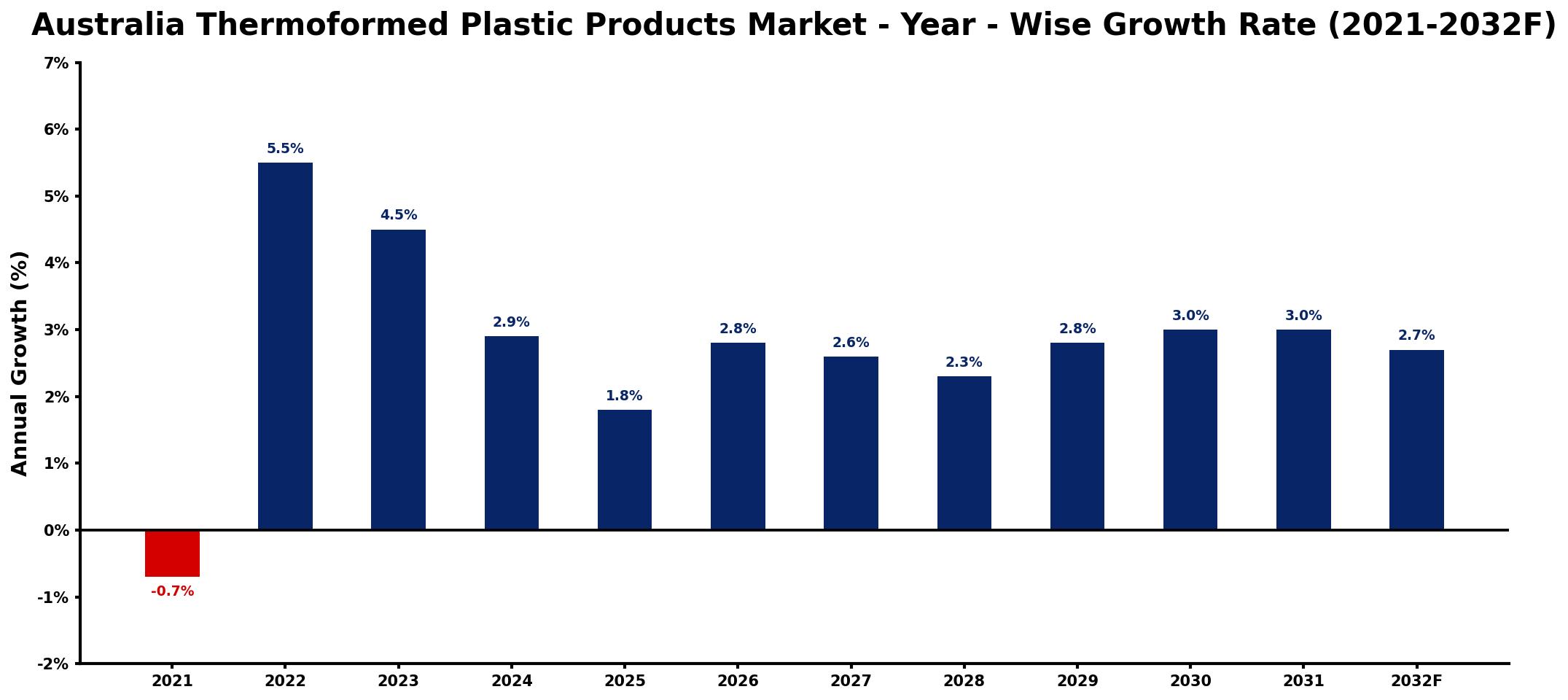
The table below presents the year‑wise growth rates along with the key drivers influencing the market
| Year | Growth Rate | Major Drivers |
| 2021 | -0.7% | decreased demand from manufacturing sector |
| 2022 | 5.5% | increased investments in packaging technology |
| 2023 | 4.5% | growing demand from food industry |
| 2024 | 2.9% | expansion in e-commerce distribution networks |
| 2025 | 1.8% | rising consumer preference for sustainability |
| 2026 | 2.8% | increased adoption in healthcare applications |
| 2027 | 2.6% | growth in automotive component usage |
| 2028 | 2.3% | enhancements in recycling initiatives |
| 2029 | 2.8% | rising demand for custom solutions |
| 2030 | 3.0% | increased domestic production output |
| 2031 | 3.0% | expansion of logistics and warehousing |
| 2032 | 2.7% | increased focus on innovative designs |
Note: Market size estimations and growth projections presented in this report are based on 6Wresearch's proprietary forecasting methodology, utilizing the latest available industry data, government publications, and primary research inputs.
Australia Thermoformed Plastic Products Market Synopsis
The automotive sector stands as the dominant force in the Australia Thermoformed Plastic Products Market, significantly influencing demand across various applications. These materials are integral to modern vehicle design, allowing manufacturers to create lightweight components that enhance performance while offering creative design options.
In parallel, the growing trend of sustainability is reshaping the landscape. Both consumers and manufacturers are increasingly seeking eco-friendly solutions, prompting innovations in materials and production processes that align with environmental stewardship and efficient resource management.
Australia Thermoformed Plastic Products Market Key Takeaways
- The automotive industry remains the largest consumer of thermoformed plastics, driving substantial market growth.
- Advancements in material technology are facilitating the production of lighter, stronger products that meet modern design criteria.
- Government incentives for sustainable practices are pushing companies to adopt greener manufacturing techniques.
- Quality control challenges persist, requiring manufacturers to implement rigorous measures to maintain product standards.
- The demand for innovative packaging solutions across sectors presents untapped opportunities for market expansion.
Evaluation of Restraints in Australia Thermoformed Plastic Products Market
Despite the promising outlook, the Australia Thermoformed Plastic Products Market faces real challenges. Variations in material properties and processing conditions often lead to inconsistencies in quality and dimensional accuracy. This variability can result in defects, complicating production processes and ultimately affecting profitability. As manufacturers strive for efficiency and precision, maintaining stringent quality control measures becomes imperative to ensure market competitiveness.
Australia Thermoformed Plastic Products Market Trends
A notable trend is the shift toward the use of recycled materials in the production of thermoformed products, aligning with consumer demand for sustainability. Moreover, the rise of automation in manufacturing processes is enhancing efficiency and accuracy, enabling companies to meet rising production needs without compromising on quality. Additionally, the customization of products is gaining traction, as clients seek tailored solutions that suit specific application requirements.
Australia Thermoformed Plastic Products Market Opportunities
Opportunities abound in the realm of innovative packaging solutions, particularly within the food service and e-commerce sectors. With consumer expectations rising for sustainable and functional packaging, companies that can integrate eco-friendly practices into their thermoformed products will likely experience significant demand. Furthermore, as the automotive sector continues to evolve, the need for specialized components presents a lucrative avenue for investment and growth.
Government Initiatives in the Australia Thermoformed Plastic Products Market
The Australian government is actively promoting sustainability in the thermoformed plastic products market through various policies. Initiatives focused on extended producer responsibility encourage manufacturers to take accountability for the lifecycle of their products. Additionally, investments in recycling infrastructure aim to manage end-of-life plastic waste effectively, supporting a transition towards a circular economy while fostering innovation in sustainable materials.
Future Insights of the Australia Thermoformed Plastic Products Market
Looking ahead to 2026-2032, the Australia Thermoformed Plastic Products Market is set to evolve significantly. The integration of advanced manufacturing technologies will likely drive down costs and enhance production capabilities, making it feasible for companies to innovate continuously. A growing emphasis on sustainable practices will further encourage investment in eco-friendly materials, ensuring that the market remains aligned with global sustainability goals. Overall, the future holds promise for players willing to adapt and innovate.
Australia Thermoformed Plastic Products Market Latest Developments (2025 - 2026)
Recent industry developments indicate a strong push towards automation and smart manufacturing processes in the thermoformed plastics sector. Companies are increasingly investing in advanced technologies that enhance production efficiency and reduce waste. Furthermore, collaborative efforts among manufacturers, regulators, and environmental organizations are gaining momentum, aiming to establish best practices that promote sustainability and streamline recycling efforts in the industry.
Australia Thermoformed Plastic Products Market - Key Attractiveness of the Report
- 10 Years of Market Numbers
- Historical Data Starting from 2022 to 2025
- Base Year: 2025
- Forecast Data until 2032
- Key Performance Indicators Impacting the Market
- Major Upcoming Developments and Projects
Key Highlights of the Report:
- Australia Thermoformed Plastic Products Market Outlook
- Market Size of Australia Thermoformed Plastic Products Market, 2025
- Forecast of Australia Thermoformed Plastic Products Market, 2032
- Historical Data and Forecast of Australia Thermoformed Plastic Products Revenues & Volume for the Period 2022-2032F
- Australia Thermoformed Plastic Products Market Trend Evolution
- Australia Thermoformed Plastic Products Market Drivers and Challenges
- Australia Thermoformed Plastic Products Price Trends
- Australia Thermoformed Plastic Products Porter's Five Forces
- Australia Thermoformed Plastic Products Industry Life Cycle
- Historical Data and Forecast of Australia Thermoformed Plastic Products Market Revenues & Volume By Product for the Period 2022-2032F
- Historical Data and Forecast of Australia Thermoformed Plastic Products Market Revenues & Volume By Polymethyl Methacrylate (PMMA) for the Period 2022-2032F
- Historical Data and Forecast of Australia Thermoformed Plastic Products Market Revenues & Volume By Bio-degradable polymers for the Period 2022-2032F
- Historical Data and Forecast of Australia Thermoformed Plastic Products Market Revenues & Volume By Polyethylene (PE) for the Period 2022-2032F
- Historical Data and Forecast of Australia Thermoformed Plastic Products Market Revenues & Volume By Acrylonitrile Butadiene Styrene (ABS) for the Period 2022-2032F
- Historical Data and Forecast of Australia Thermoformed Plastic Products Market Revenues & Volume By Poly Vinyl Chloride (PVC) for the Period 2022-2032F
- Historical Data and Forecast of Australia Thermoformed Plastic Products Market Revenues & Volume By High Impact Polystyrene (HIPS) for the Period 2022-2032F
- Historical Data and Forecast of Australia Thermoformed Plastic Products Market Revenues & Volume By Polystyrene (PS) for the Period 2022-2032F
- Historical Data and Forecast of Australia Polymethyl Methacrylate (PMMA) Thermoformed Plastic Products Market Revenues & Volume By Polypropylene (PP) for the Period 2022-2032F
- Historical Data and Forecast of Australia Thermoformed Plastic Products Market Revenues & Volume By Process for the Period 2022-2032F
- Historical Data and Forecast of Australia Thermoformed Plastic Products Market Revenues & Volume By Plug Assist Forming for the Period 2022-2032F
- Historical Data and Forecast of Australia Thermoformed Plastic Products Market Revenues & Volume By Thick Gauge Thermoforming for the Period 2022-2032F
- Historical Data and Forecast of Australia Thermoformed Plastic Products Market Revenues & Volume By Thin Gauge Thermoforming for the Period 2022-2032F
- Historical Data and Forecast of Australia Thermoformed Plastic Products Market Revenues & Volume By Vacuum Snapback for the Period 2022-2032F
- Historical Data and Forecast of Australia Thermoformed Plastic Products Market Revenues & Volume By Application for the Period 2022-2032F
- Historical Data and Forecast of Australia Thermoformed Plastic Products Market Revenues & Volume By Healthcare & Medical for the Period 2022-2032F
- Historical Data and Forecast of Australia Thermoformed Plastic Products Market Revenues & Volume By Food Packaging for the Period 2022-2032F
- Historical Data and Forecast of Australia Thermoformed Plastic Products Market Revenues & Volume By Electrical & Electronics for the Period 2022-2032F
- Historical Data and Forecast of Australia Thermoformed Plastic Products Market Revenues & Volume By Automotive for the Period 2022-2032F
- Historical Data and Forecast of Australia Thermoformed Plastic Products Market Revenues & Volume By Construction for the Period 2022-2032F
- Historical Data and Forecast of Australia Thermoformed Plastic Products Market Revenues & Volume By Consumer Goods & Appliances for the Period 2022-2032F
- Australia Thermoformed Plastic Products Import Export Trade Statistics
- Market Opportunity Assessment By Product
- Market Opportunity Assessment By Process
- Market Opportunity Assessment By Application
- Australia Thermoformed Plastic Products Top Companies Market Share
- Australia Thermoformed Plastic Products Competitive Benchmarking By Technical and Operational Parameters
- Australia Thermoformed Plastic Products Company Profiles
- Australia Thermoformed Plastic Products Key Strategic Recommendations






































