Australia Tobacco and Tobacco Products Market Summary
The australia tobacco and tobacco products market was estimated at USD 166 Million in 2025 and is projected to reach USD 195 Million by 2032, growing at a CAGR of 2.9% from 2026 to 2032.
Australia Tobacco and Tobacco Products Market Year-wise Growth Rate and Key Drivers
This graph highlights how the Australia Tobacco and Tobacco Products Market has steadily grown over the past five years, supported by major growth factors.
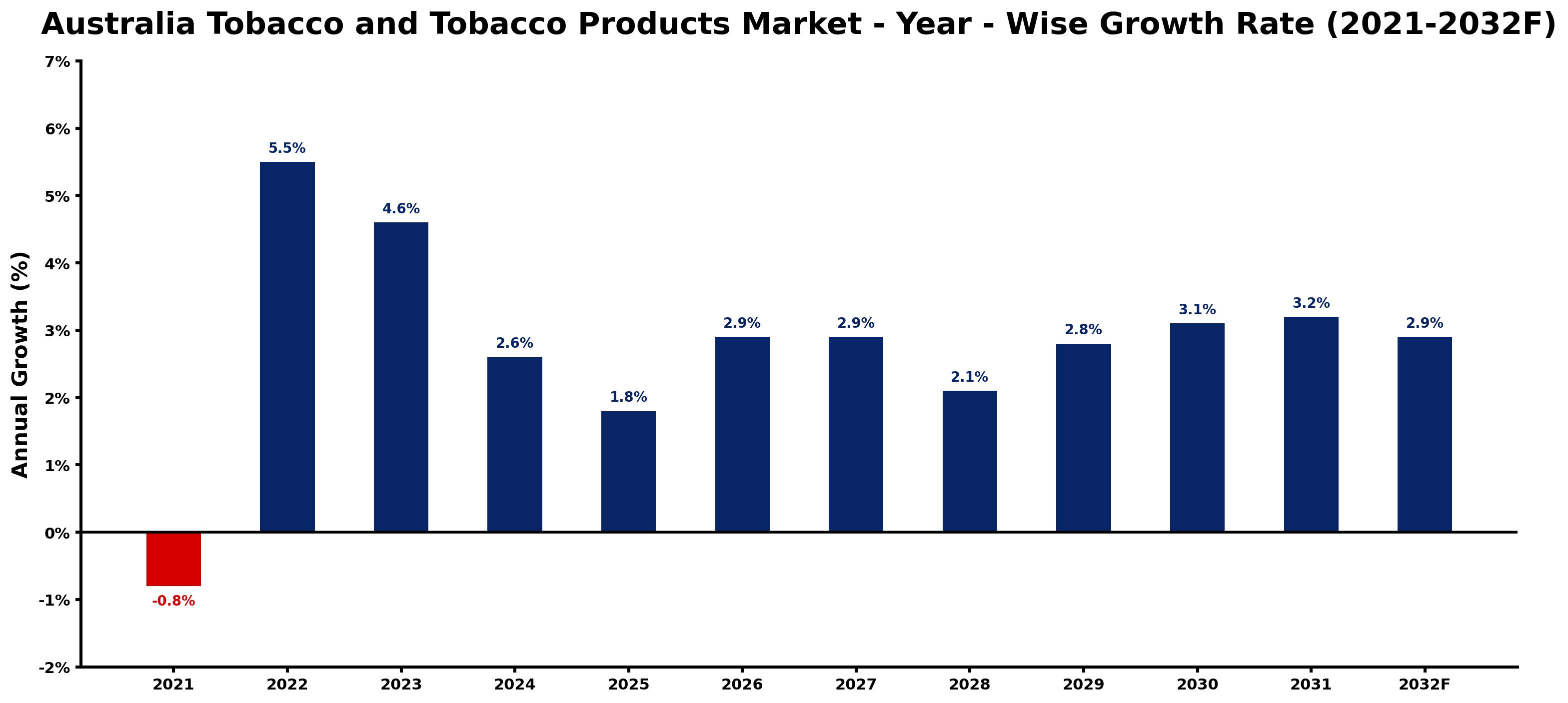
The table below presents the year wise growth rates along with the key drivers influencing the market
| Year | Growth Rate | Major Drivers |
| 2021 | -0.8% | Health awareness campaigns significantly reduced tobacco consumption, leading to a decline in overall sales volume. |
| 2022 | 5.5% | Health-conscious Australians showed rising interest in alternatives to traditional tobacco products. |
| 2023 | 4.6% | Innovations in vaping technologies attracted younger demographics, reshaping market dynamics gradually. |
| 2024 | 2.6% | Increased focus on sustainability influenced manufacturers to explore eco-friendly tobacco sourcing. |
| 2025 | 1.8% | Consumer education campaigns enhanced awareness of risks associated with tobacco use and alternatives. |
| 2026 | 2.9% | E-commerce platforms expanded, allowing tobacco products to reach consumers more conveniently. |
| 2027 | 2.9% | Market saturation prompted brands to diversify product lines to maintain competitive advantage. |
| 2028 | 2.1% | Collaborations between tobacco companies and tech firms sparked interest in personalized smoking experiences. |
| 2029 | 2.8% | Youth culture embraced new smoking alternatives, distancing from traditional tobacco perceptions. |
| 2030 | 3.1% | Public health initiatives continued to challenge traditional tobacco, pushing for reduced consumption rates. |
| 2031 | 3.2% | Shifting cultural attitudes led to increased stigma around smoking, affecting consumer choices significantly. |
| 2032 | 2.9% | Emerging markets within Australia identified new opportunities for niche tobacco products and services. |
Note - Market size estimations and growth projections presented in this report are based on 6Wresearch's advanced forecasting approach, validated with industry datasets as of June 2026.
Australia Tobacco and Tobacco Products Market Synopsis
The Australia Tobacco and Tobacco Products Market is projected to reach 2.9% and witness significant growth during the forecast period (2026-2032). This market is subject to stringent regulations, yet it remains substantial due to the persistent consumer demand for tobacco-related products. Shifting preferences among consumers, heightened health awareness campaigns, and government-led regulatory initiatives are instrumental in shaping the current market landscape.
Australia Tobacco and Tobacco Products Market Growth Drivers
Several factors are influencing the trajectory of the Australia Tobacco and Tobacco Products Market. Government regulations, notably stringent advertising restrictions and plain packaging laws, are fundamental drivers of change.
- The regulatory environment has a significant impact on sales channels, affecting how products are marketed and sold.
- Health awareness campaigns have led to a general decline in smoking rates, although this has increased interest in alternative products.
- Changing consumer preferences are shifting towards less harmful alternatives such as e-cigarettes and heated tobacco products.
- Government taxation policies contribute to changing consumption patterns, with higher taxes often leading to reduced demand for traditional cigarettes.
- The rise in health-consciousness among consumers has led to an increased market presence of smokeless tobacco products.
Australia Tobacco and Tobacco Products Market Challenges and Restraints
While the Australia Tobacco and Tobacco Products Market presents ample opportunities, several critical challenges hinder its growth. The extensive regulatory framework poses direct obstacles for traditional tobacco product sales.
- Increased public health campaigns aimed at reducing smoking prevalence have created a negative perception of tobacco products among the general population.
- Regulatory bodies continuously update restrictions, affecting product availability and market access.
- Changing social attitudes towards smoking have contributed to declining acceptance of tobacco consumption in public spaces.
- The emergence of alternative products has resulted in a competitive landscape that traditional tobacco brands must navigate cautiously.
- Compliance with evolving regulations requires substantial financial investment from tobacco companies, affecting profitability.
Australia Tobacco and Tobacco Products Market Government Investment and Initiatives
Government policy plays an integral role in shaping the Australia Tobacco and Tobacco Products Market, primarily aimed at reducing smoking rates and associated health risks.
- Public spending on smoking cessation programs encourages individuals to quit, thereby impacting overall tobacco consumption rates.
- Investment in health awareness campaigns has heightened public knowledge of tobacco-related health risks.
- Regulatory measures such as comprehensive advertising bans and plain packaging laws are part of ongoing government initiatives.
- Government taxation policies are strategically used to deter consumption through increased prices on tobacco products.
- Collaboration between government agencies and health organizations promotes research and development of less harmful alternatives to smoking.
Australia Tobacco and Tobacco Products Market Latest Developments (May 2025 - June 2026)
Recent industry developments between May 2025 and June 2026 indicate a continued evolution in the Australia Tobacco and Tobacco Products Market. The trend towards reduced-risk products continues to gain traction, influencing consumer preferences.
- Regulatory updates are anticipated to further reinforce limitations on tobacco advertising and product displays in retail settings.
- Public health initiatives are expected to expand, aiming for aggressive reductions in smoking rates across various demographics.
- Emerging trends suggest an increasing focus on the development of innovative nicotine delivery systems.
- The market is likely to see heightened interactions between public health authorities and the tobacco industry regarding compliance and health impacts.
- Additionally, efforts to integrate harm reduction strategies into public health policy are gaining momentum, presenting new opportunities for market participants.
Australia Tobacco and Tobacco Products Market - Key Attractiveness of the Report
- 10 Years of Market Numbers
- Historical Data Starting from 2022 to 2025
- Base Year: 2025
- Forecast Data until 2032
- Key Performance Indicators Impacting the Market
- Major Upcoming Developments and Projects
Key Highlights of the Report:
- Australia Tobacco and Tobacco Products Market Outlook
- Market Size of Australia Tobacco and Tobacco Products Market, 2025
- Forecast of Australia Tobacco and Tobacco Products Market, 2032
- Historical Data and Forecast of Australia Tobacco and Tobacco Products Revenues & Volume for the Period 2022-2032F
- Australia Tobacco and Tobacco Products Market Trend Evolution
- Australia Tobacco and Tobacco Products Market Drivers and Challenges
- Australia Tobacco and Tobacco Products Price Trends
- Australia Tobacco and Tobacco Products Porter's Five Forces
- Australia Tobacco and Tobacco Products Industry Life Cycle
- Historical Data and Forecast of Australia Tobacco and Tobacco Products Market Revenues & Volume By Type for the Period 2022-2032F
- Historical Data and Forecast of Australia Tobacco and Tobacco Products Market Revenues & Volume By Oriental for the Period 2022-2032F
- Historical Data and Forecast of Australia Tobacco and Tobacco Products Market Revenues & Volume By Flue Cured for the Period 2022-2032F
- Historical Data and Forecast of Australia Tobacco and Tobacco Products Market Revenues & Volume By Burley for the Period 2022-2032F
- Historical Data and Forecast of Australia Tobacco and Tobacco Products Market Revenues & Volume By Applications for the Period 2022-2032F
- Historical Data and Forecast of Australia Tobacco and Tobacco Products Market Revenues & Volume By Cigarette? for the Period 2022-2032F
- Historical Data and Forecast of Australia Tobacco and Tobacco Products Market Revenues & Volume By Cigars for the Period 2022-2032F
- Australia Tobacco and Tobacco Products Import Export Trade Statistics
- Market Opportunity Assessment By Type
- Market Opportunity Assessment By Applications
- Australia Tobacco and Tobacco Products Top Companies Market Share
- Australia Tobacco and Tobacco Products Competitive Benchmarking By Technical and Operational Parameters
- Australia Tobacco and Tobacco Products Company Profiles
- Australia Tobacco and Tobacco Products Key Strategic Recommendations






































