Australia Tokenization Market Size & Growth Rate (2026-2032)
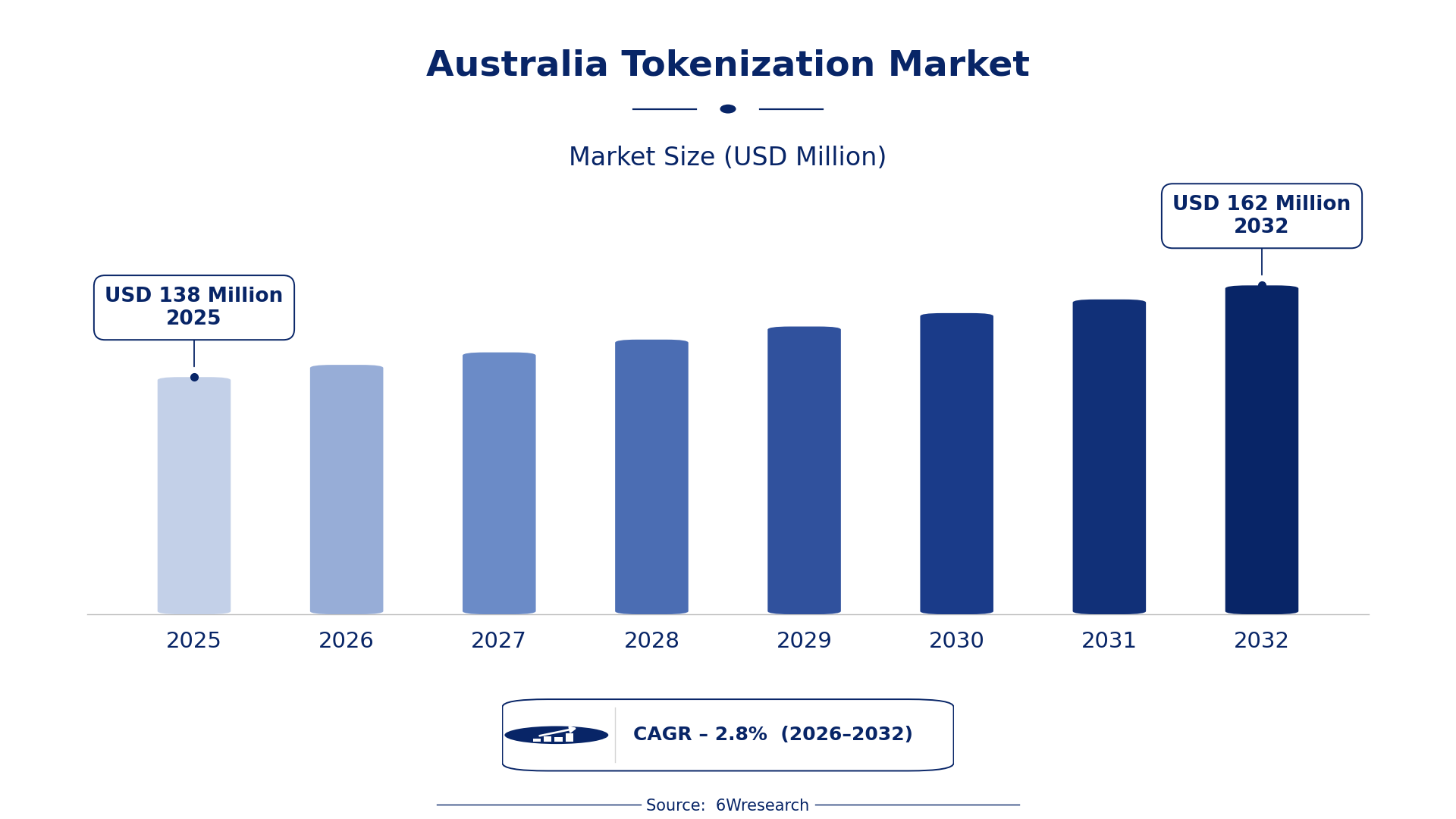
The Australia Tokenization Market was estimated at USD 138 Million in 2025 and is projected to reach USD 162 Million by 2032, growing at a CAGR of 2.8% from 2026 to 2032.
Australia Tokenization Market Synopsis
The Australia Tokenization Market is currently witnessing a surge in adoption, primarily driven by advancements in digital payment solutions and blockchain technology. This growing momentum indicates a shifting consumer preference towards secure financial transactions, paving the way for tokenization's expansion.
As businesses increasingly prioritize data security and compliance with regulatory frameworks, the future outlook for tokenization in Australia remains optimistic. The ongoing integration of tokenization into various sectors like finance and healthcare demonstrates a broader trend towards digital transformation that cannot be overlooked.
Australia Tokenization Market Year-wise Growth Rate and Key Drivers
This graph illustrates the annual growth rates of the Australia Tokenization Market from 2021 to 2032, highlighting a steady upward trajectory and projected expansion over the forecast period.
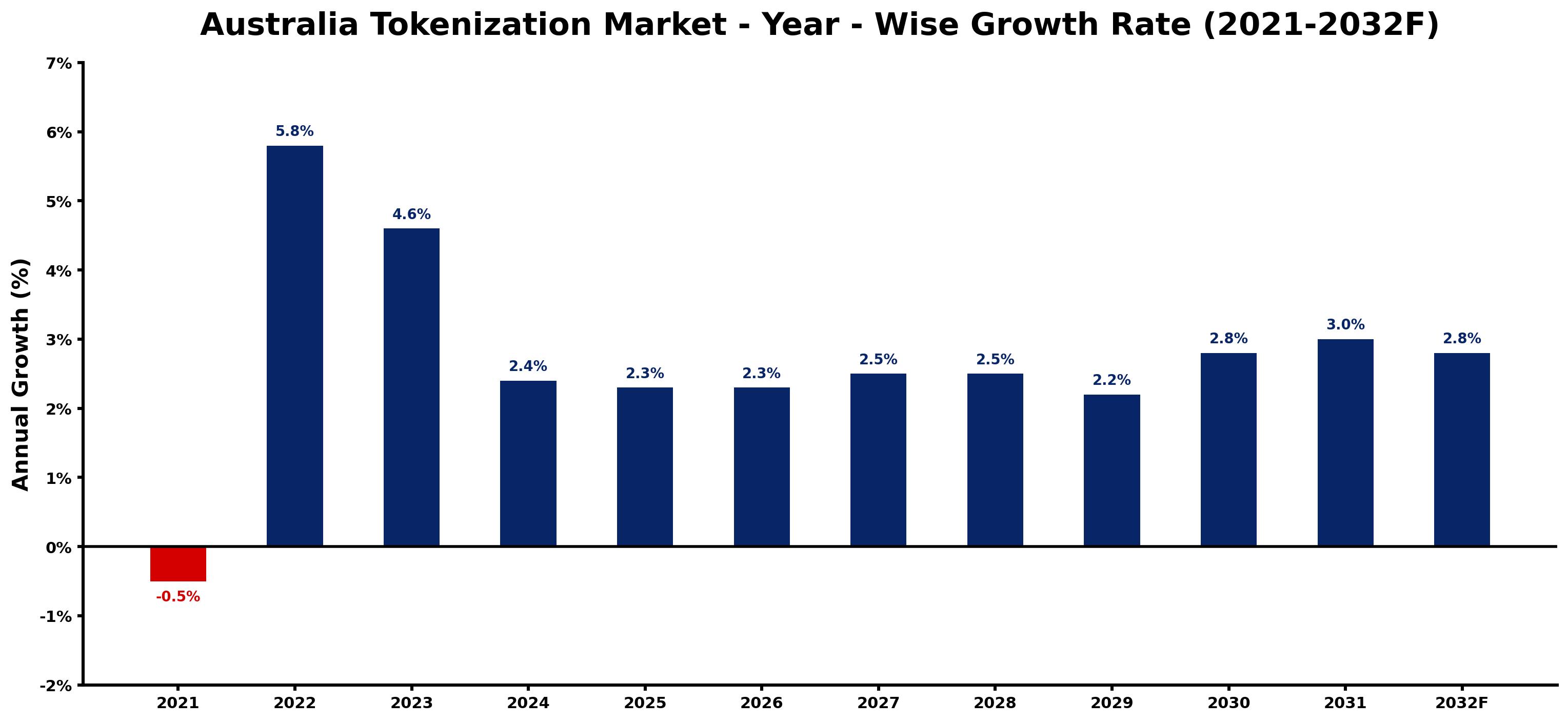
The table below presents the year‑wise growth rates along with the key drivers influencing the market
| Year | Growth Rate | Major Drivers |
| 2021 | -0.5% | Regulatory uncertainty from Australian Securities and Investments Commission. |
| 2022 | 5.8% | Australian government's digital currency initiative boosts adoption |
| 2023 | 4.6% | Increased demand for secure online transactions in retail |
| 2024 | 2.4% | Financial services embracing blockchain for asset tokenization |
| 2025 | 2.3% | Growing interest in NFTs within Australian creative industries |
| 2026 | 2.3% | Regulatory support from ASIC for tokenized assets |
| 2027 | 2.5% | Rise in local startups offering tokenization solutions |
| 2028 | 2.5% | Corporate investments in tokenization for supply chain transparency |
| 2029 | 2.2% | Small businesses adopting tokenization for loyalty programs |
| 2030 | 2.8% | Emerging fintech partnerships enhancing tokenization services |
| 2031 | 3.0% | Public awareness campaigns on benefits of tokenization |
| 2032 | 2.8% | Evolving consumer preferences for digital asset management |
Note: Market size estimations and growth projections presented in this report are based on 6Wresearch's proprietary forecasting methodology, utilizing the latest available industry data, government publications, and primary research inputs.
Australia Tokenization Market Key Takeaways
Below are some of the specific key takeaways from the market, including:
- The increasing reliance on digital payment methods is significantly fueling market growth.
- Tokenization technology is becoming essential for businesses looking to enhance security and streamline transactions.
- Regulatory frameworks are evolving, offering clearer guidelines for token issuers and investors.
- Consumer trust is a critical factor that can impact the market's expansion and adoption rates.
- The rise of e-commerce and mobile payments is accelerating the demand for secure tokenization solutions.
Evaluation of Restraints in Australia Tokenization Market
Despite positive market indicators, several constraints impede the growth of the tokenization market in Australia. One pressing issue is the complexity of regulatory compliance, which often requires businesses to invest considerable resources to align their tokenization strategies with existing laws. In addition, ensuring robust cybersecurity while implementing tokenization solutions can present significant technical challenges. Consumers also exhibit skepticism regarding the safety of tokenized assets, which can deter broader adoption and trust.
Australia Tokenization Market Trends
Emerging trends in the Australia Tokenization Market illustrate a shift towards the integration of tokenization in various sectors. The rise of decentralized finance (DeFi) applications is pushing businesses to adopt tokenization for more transparent and secure transactions. on top of that, the growing intersection of blockchain technology with artificial intelligence is fostering innovative solutions that enhance the tokenization process.
Another notable trend is the increasing collaboration between fintech companies and traditional financial institutions. These partnerships are facilitating the development of more advanced tokenization solutions, enabling businesses to offer better security measures while streamlining payment processes.
Australia Tokenization Market Opportunities
There are substantial opportunities for growth in the tokenization market, particularly in sectors such as healthcare and retail. The healthcare industry can benefit from tokenization by ensuring patient data privacy while streamlining billing and insurance claims processes. Retailers can leverage tokenization to improve payment security and enhance customer trust in online transactions.
Investment in research and development, particularly around blockchain technology, offers additional growth avenues. As businesses continue to seek innovative ways to secure transactions, the demand for advanced tokenization solutions will likely increase.
Government Initiatives in the Australia Tokenization Market
The Australian government is actively shaping the tokenization market through various regulatory initiatives aimed at fostering a secure and transparent environment for digital transactions. These policies emphasize the need for compliance with anti-money laundering (AML) and know your customer (KYC) regulations while promoting innovation in digital finance.
- A regulatory framework introduced in 2025 mandates clear guidelines for token issuers and exchanges to ensure AML compliance.
- A national digital infrastructure upgrade program is currently underway to enhance the technological landscape necessary for secure token transactions.
- In 2023, the government launched an initiative focused on educating businesses about the benefits and compliance requirements of tokenization.
- A public-private partnership is planned for 2026 to develop a centralized digital asset registry, promoting transparency in token transactions.
Future Insights of the Australia Tokenization Market
Looking ahead to 2026-2032, the Australia Tokenization Market is expected to evolve significantly. Driven by continuous technological advancements and increasing consumer awareness, the market is likely to see broader adoption across multiple sectors. on top of that, as regulatory frameworks become more defined, businesses will feel more confident implementing tokenization solutions, reducing associated risks.
The integration of tokenization into everyday financial transactions will not only enhance security but also improve operational efficiency. As organizations adapt to these changes, they will unlock new revenue streams and foster deeper customer relationships.
Australia Tokenization Market Latest Developments
Recent developments in the Australia Tokenization Market indicate a dynamic shift toward broader implementation of tokenization solutions across various industries. Over the past year, there have been notable advancements in both technology and regulatory frameworks, indicating a growing recognition of the value that tokenization brings.
- A leading technology vendor launched a new tokenization platform in Q1 2025, designed to enhance transaction security for online retailers.
- An ongoing initiative by a consortium of banks began in mid-2025 to develop a cross-institutional tokenization framework, aimed at improving transaction efficiencies.
- By late 2025, a major healthcare provider is expected to implement a tokenization solution to protect sensitive patient data.
- A planned rollout of a tokenization awareness campaign is set to begin in early 2026, targeting small and medium-sized enterprises across Australia.
Australia Tokenization Market - Key Attractiveness of the Report
- 10 Years of Market Numbers
- Historical Data Starting from 2022 to 2025
- Base Year: 2025
- Forecast Data until 2032
- Key Performance Indicators Impacting the Market
- Major Upcoming Developments and Projects
Key Highlights of the Report:
- Australia Tokenization Market Outlook
- Market Size of Australia Tokenization Market, 2025
- Forecast of Australia Tokenization Market, 2032
- Historical Data and Forecast of Australia Tokenization Revenues & Volume for the Period 2022-2032F
- Australia Tokenization Market Trend Evolution
- Australia Tokenization Market Drivers and Challenges
- Australia Tokenization Price Trends
- Australia Tokenization Porter's Five Forces
- Australia Tokenization Industry Life Cycle
- Historical Data and Forecast of Australia Tokenization Market Revenues & Volume By Application Area for the Period 2022-2032F
- Historical Data and Forecast of Australia Tokenization Market Revenues & Volume By Payment Security for the Period 2022-2032F
- Historical Data and Forecast of Australia Tokenization Market Revenues & Volume By User Authentication for the Period 2022-2032F
- Historical Data and Forecast of Australia Tokenization Market Revenues & Volume By Compliance Management for the Period 2022-2032F
- Historical Data and Forecast of Australia Tokenization Market Revenues & Volume By Vertical for the Period 2022-2032F
- Historical Data and Forecast of Australia Tokenization Market Revenues & Volume By Banking, Financial Services, and Insurance for the Period 2022-2032F
- Historical Data and Forecast of Australia Tokenization Market Revenues & Volume By Healthcare for the Period 2022-2032F
- Historical Data and Forecast of Australia Tokenization Market Revenues & Volume By IT and ITeS for the Period 2022-2032F
- Historical Data and Forecast of Australia Tokenization Market Revenues & Volume By Government for the Period 2022-2032F
- Historical Data and Forecast of Australia Tokenization Market Revenues & Volume By Retail & eCommerce for the Period 2022-2032F
- Historical Data and Forecast of Australia Tokenization Market Revenues & Volume By Energy & Utilities for the Period 2022-2032F
- Historical Data and Forecast of Australia Tokenization Market Revenues & Volume By Other Verticals for the Period 2022-2032F
- Historical Data and Forecast of Australia Tokenization Market Revenues & Volume By Component for the Period 2022-2032F
- Historical Data and Forecast of Australia Tokenization Market Revenues & Volume By Solutions for the Period 2022-2032F
- Historical Data and Forecast of Australia Tokenization Market Revenues & Volume By Services for the Period 2022-2032F
- Historical Data and Forecast of Australia Tokenization Market Revenues & Volume By Deployment Mode for the Period 2022-2032F
- Historical Data and Forecast of Australia Tokenization Market Revenues & Volume By Cloud for the Period 2022-2032F
- Historical Data and Forecast of Australia Tokenization Market Revenues & Volume By On-premises for the Period 2022-2032F
- Historical Data and Forecast of Australia Tokenization Market Revenues & Volume By Organization Size for the Period 2022-2032F
- Historical Data and Forecast of Australia Tokenization Market Revenues & Volume By Large Enterprises for the Period 2022-2032F
- Historical Data and Forecast of Australia Tokenization Market Revenues & Volume By SMEs for the Period 2022-2032F
- Australia Tokenization Import Export Trade Statistics
- Market Opportunity Assessment By Application Area
- Market Opportunity Assessment By Vertical
- Market Opportunity Assessment By Component
- Market Opportunity Assessment By Deployment Mode
- Market Opportunity Assessment By Organization Size
- Australia Tokenization Top Companies Market Share
- Australia Tokenization Competitive Benchmarking By Technical and Operational Parameters
- Australia Tokenization Company Profiles
- Australia Tokenization Key Strategic Recommendations






































