Australia Transformers and Auto Transformers Market Summary
The australia transformers and auto transformers market was estimated at USD 191 Million in 2025 and is projected to reach USD 224 Million by 2032, growing at a CAGR of 2.9% from 2026 to 2032.
Australia Transformers and Auto Transformers Market Year-wise Growth Rate and Key Drivers
This graph highlights how the Australia Transformers and Auto Transformers Market has steadily grown over the past five years, supported by major growth factors.
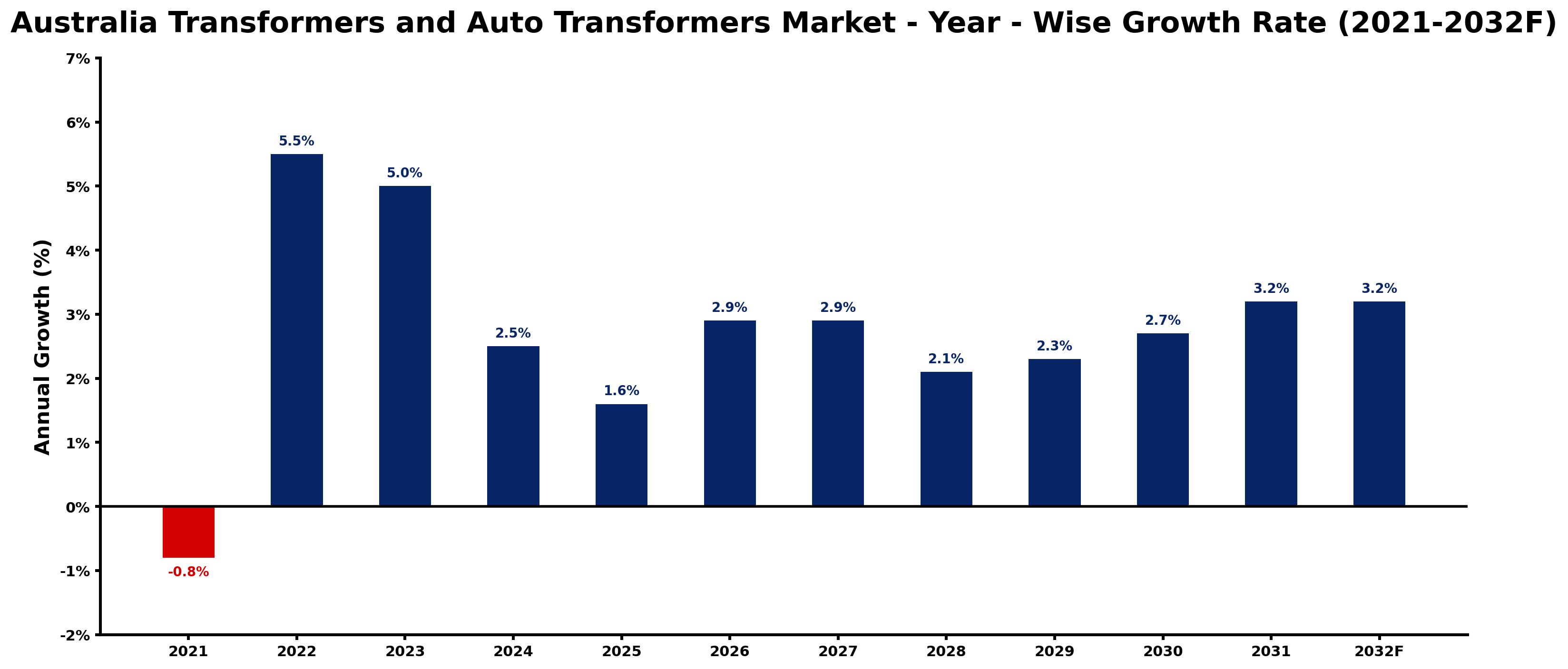
The table below presents the year wise growth rates along with the key drivers influencing the market
| Year | Growth Rate | Major Drivers |
| 2021 | -0.8% | Supply chain disruptions hindered production capabilities, causing delays and impacting customer orders in the transformer sector. |
| 2022 | 5.5% | Technological shifts in energy efficiency compelled manufacturers to innovate transformer designs. |
| 2023 | 5.0% | Local production capabilities addressed supply chain vulnerabilities observed during the pandemic. |
| 2024 | 2.5% | Increased urbanization trends intensified the need for enhanced electrical infrastructure investments. |
| 2025 | 1.6% | Data center expansions highlighted the importance of robust power systems and transformers. |
| 2026 | 2.9% | Emerging renewable energy projects necessitated adaptive transformer technologies for integration. |
| 2027 | 2.9% | The shift to electric vehicles prompted new standards in transformer efficiency and performance. |
| 2028 | 2.1% | Aging electrical grids required modernization efforts, fueling demand for advanced auto transformers. |
| 2029 | 2.3% | Rural electrification initiatives aimed at improving infrastructure across remote Australian areas. |
| 2030 | 2.7% | Corporate sustainability goals influenced procurement strategies, prioritizing eco-friendly transformer solutions. |
| 2031 | 3.2% | Industry collaborations emerged to enhance knowledge sharing and improve transformer technologies. |
| 2032 | 3.2% | Innovative financing models supported the expansion of smart grid solutions across urban centers. |
Note - Market size estimations and growth projections presented in this report are based on 6Wresearch's advanced forecasting approach, validated with industry datasets as of June 2026.
Australia Transformers and Auto Transformers Market Synopsis
The Australia Transformers and Auto Transformers Market is projected to reach 2.9% and witness significant growth during the forecast period (2026-2032). The market is characterized by a diverse range of applications that include power distribution, voltage regulation, and electrical isolation. Factors such as ongoing grid expansion projects, the push for industrial automation, and the integration of renewable energy sources are key drivers of demand in this evolving market landscape.
Australia Transformers and Auto Transformers Market Growth Drivers
The growth of the Australia Transformers and Auto Transformers Market is primarily driven by several interconnected factors:
- Infrastructure Development: The ongoing urbanization and industrialization in Australia necessitate the enhancement of power distribution networks, pushing the demand for transformers and auto transformers.
- Renewable Energy Integration: As Australia transitions towards renewable energy sources, the need for effective voltage regulation and reliable power distribution systems becomes increasingly critical.
- Smart Grid Initiatives: The government's focus on modernizing the electrical grid with smart technologies requires advanced transformer solutions to manage energy efficiently.
- Industrial Automation: Advancements in industrial automation demand reliable power supply systems, where transformers play a pivotal role in ensuring optimal performance and efficiency.
- Rising Energy Efficiency Standards: With a growing emphasis on minimizing energy losses, there is a heightened demand for energy-efficient transformer solutions that meet stringent performance criteria.
Australia Transformers and Auto Transformers Market Challenges and Restraints
Despite positive growth prospects, the Australia Transformers and Auto Transformers Market faces several challenges:
- Energy Efficiency Optimization: Balancing energy efficiency with performance is a major obstacle, as stakeholders seek transformers that minimize losses while maintaining affordability.
- Regulatory Compliance: Adhering to an evolving landscape of safety and efficiency regulations can impose additional costs and operational challenges for manufacturers.
- Technological Advancements: Keeping pace with rapid technological changes in transformer design and manufacturing can strain resources and require significant investment.
- Supply Chain Disruptions: Global supply chain uncertainties can impact the availability of critical components, potentially delaying project timelines and increasing costs.
- Market Competition: The competitive landscape necessitates continuous innovation and improvement, placing pressure on companies to differentiate their products effectively.
Australia Transformers and Auto Transformers Market Government Investment and Initiatives
The Australian government plays a significant role in shaping the landscape of the transformers and auto transformers market through various investment initiatives and policy frameworks:
- Infrastructure Spending: The government has committed to substantial investments in infrastructure development, which directly supports the demand for advanced energy solutions, including transformers.
- Renewable Energy Targets: Policies aimed at increasing renewable energy generation necessitate the adoption of efficient transformer technology to ensure grid stability and reliability.
- Regulatory Frameworks: The establishment of safety standards and energy efficiency regulations helps to promote consumer confidence and market competitiveness.
- Public-Private Partnerships: Collaborative efforts between the government and private sector stakeholders aim to drive innovation and address the technological needs of the power distribution system.
- Incentives for Sustainability: Government initiatives that encourage energy conservation and efficiency are expected to spur demand for next-generation transformers that align with sustainability goals.
Australia Transformers and Auto Transformers Market Latest Developments (May 2025 - June 2026)
Recent developments in the Australia Transformers and Auto Transformers Market highlight significant industry shifts and trends:
- The ongoing integration of smart technologies into transformer systems is being prioritized to enhance grid management and reliability.
- With increased focus on sustainability, manufacturers are innovating to develop transformer solutions that meet new energy efficiency standards.
- Government support for renewable energy projects is catalyzing advancements in transformer technology, particularly for wind and solar energy applications.
- Research and development initiatives are ramping up, with a focus on improving transformer designs to enhance performance and reduce energy losses.
- The industry is witnessing increased collaboration between utility companies and tech firms to deploy smart grid solutions that include modern transformer systems.
Australia Transformers and Auto Transformers Market - Key Attractiveness of the Report
- 10 Years of Market Numbers
- Historical Data Starting from 2022 to 2025
- Base Year: 2025
- Forecast Data until 2032
- Key Performance Indicators Impacting the Market
- Major Upcoming Developments and Projects
Key Highlights of the Report:
- Australia Transformers and Auto Transformers Market Outlook
- Market Size of Australia Transformers and Auto Transformers Market, 2025
- Forecast of Australia Transformers and Auto Transformers Market, 2032
- Historical Data and Forecast of Australia Transformers and Auto Transformers Revenues & Volume for the Period 2022-2032F
- Australia Transformers and Auto Transformers Market Trend Evolution
- Australia Transformers and Auto Transformers Market Drivers and Challenges
- Australia Transformers and Auto Transformers Price Trends
- Australia Transformers and Auto Transformers Porter's Five Forces
- Australia Transformers and Auto Transformers Industry Life Cycle
- Historical Data and Forecast of Australia Transformers and Auto Transformers Market Revenues & Volume By Type for the Period 2022-2032F
- Historical Data and Forecast of Australia Transformers and Auto Transformers Market Revenues & Volume By Step-up Transformer for the Period 2022-2032F
- Historical Data and Forecast of Australia Transformers and Auto Transformers Market Revenues & Volume By Step-down Transformer for the Period 2022-2032F
- Historical Data and Forecast of Australia Transformers and Auto Transformers Market Revenues & Volume By Others for the Period 2022-2032F
- Historical Data and Forecast of Australia Transformers and Auto Transformers Market Revenues & Volume By End-Users for the Period 2022-2032F
- Historical Data and Forecast of Australia Transformers and Auto Transformers Market Revenues & Volume By Power Applications for the Period 2022-2032F
- Historical Data and Forecast of Australia Transformers and Auto Transformers Market Revenues & Volume By Audio Applications for the Period 2022-2032F
- Historical Data and Forecast of Australia Transformers and Auto Transformers Market Revenues & Volume By Railway Applications for the Period 2022-2032F
- Australia Transformers and Auto Transformers Import Export Trade Statistics
- Market Opportunity Assessment By Type
- Market Opportunity Assessment By End-Users
- Australia Transformers and Auto Transformers Top Companies Market Share
- Australia Transformers and Auto Transformers Competitive Benchmarking By Technical and Operational Parameters
- Australia Transformers and Auto Transformers Company Profiles
- Australia Transformers and Auto Transformers Key Strategic Recommendations






































