Australia Truck / Lorry Trailers Market Summary
The australia truck / lorry trailers market was estimated at USD 171 Million in 2025 and is projected to reach USD 233 Million by 2032, growing at a CAGR of 4.9% from 2026 to 2032.
Australia Truck / Lorry Trailers Market Year-wise Growth Rate and Key Drivers
This graph highlights how the Australia Truck / Lorry Trailers Market has steadily grown over the past five years, supported by major growth factors.
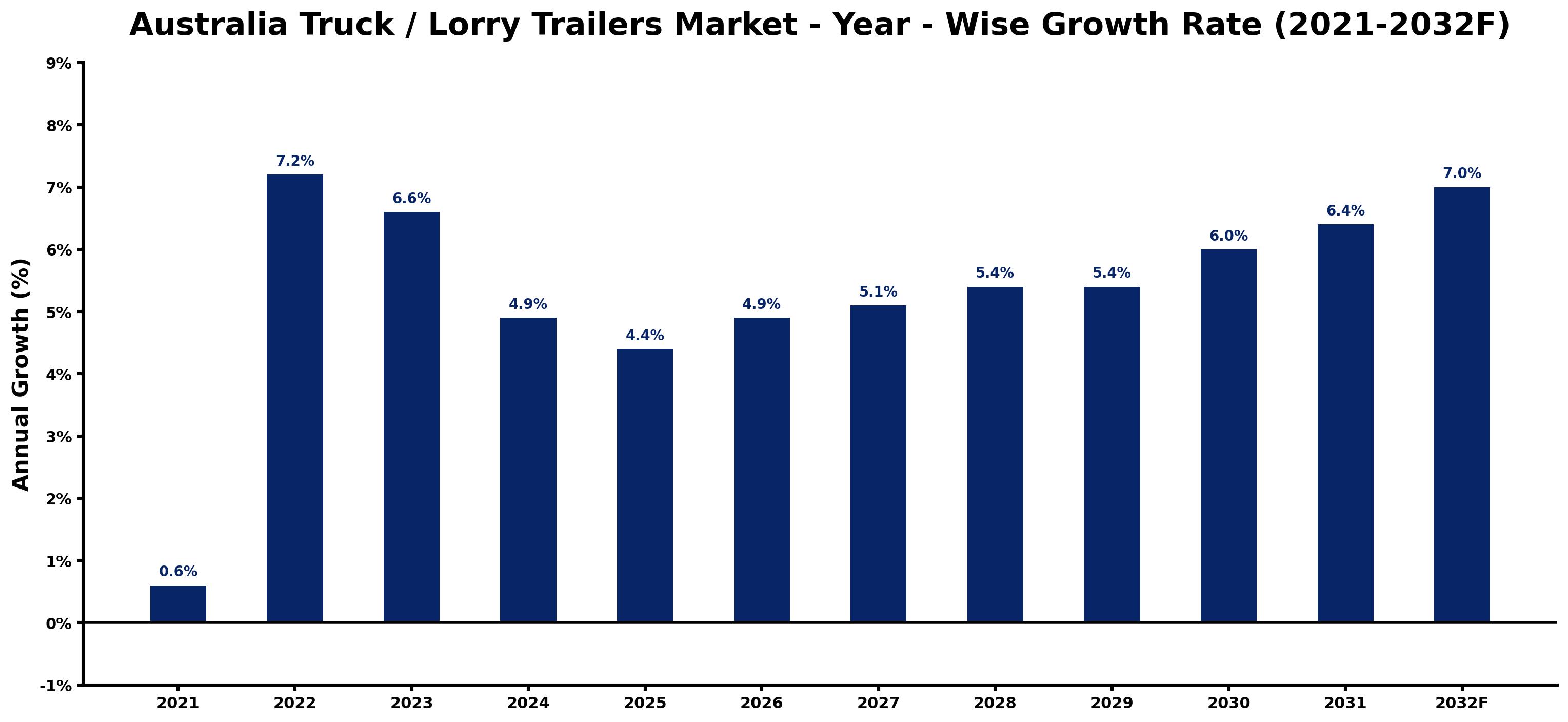
The table below presents the year wise growth rates along with the key drivers influencing the market
| Year | Growth Rate | Major Drivers |
| 2021 | 0.6% | Post-pandemic supply chain recovery started revitalizing commercial transport segments across Australia. |
| 2022 | 7.2% | Rising e-commerce trends heightened the need for efficient freight transport solutions nationwide. |
| 2023 | 6.6% | Increased focus on sustainability led to innovative trailer designs with eco-friendly materials. |
| 2024 | 4.9% | Urbanization trends necessitated enhanced logistics capabilities in densely populated metropolitan areas. |
| 2025 | 4.4% | Technological integration within logistics systems improved operational efficiencies in trailer management. |
| 2026 | 4.9% | Fleet modernization initiatives encouraged companies to invest in advanced trailer technologies. |
| 2027 | 5.1% | Infrastructure projects expanded, particularly in regional areas, driving trailer demand for construction. |
| 2028 | 5.4% | Changing consumer behaviors shifted freight needs, emphasizing adaptability in trailer designs and features. |
| 2029 | 5.4% | Cost pressures prompted logistics firms to optimize their fleets with multifunctional trailer options. |
| 2030 | 6.0% | Collaborative logistics models emerged, reshaping trailer utilization in shared transport networks. |
| 2031 | 6.4% | Increased export activities stimulated demand for specialized trailers in international shipping. |
| 2032 | 7.0% | Rising fuel prices encouraged investments in energy-efficient trailer technologies across sectors. |
Note - Market size estimations and growth projections presented in this report are based on 6Wresearch's advanced forecasting approach, validated with industry datasets as of June 2026.
Australia Truck / Lorry Trailers Market Synopsis
The Australia Truck / Lorry Trailers Market is projected to reach 4.9% and witness significant growth during the forecast period (2026-2032). This sector plays a vital role in the country's transportation and logistics network, addressing the varying demands for cargo transport across Australia's extensive and diverse geography. With a strong focus on innovation and sustainability, the market is expected to evolve to meet the shifting needs of businesses and environmental standards.
Australia Truck / Lorry Trailers Market Growth Drivers
The growth of the Australia Truck / Lorry Trailers Market is primarily driven by several key factors. Firstly, the expansion of the e-commerce sector significantly increases the demand for efficient freight transportation solutions. An increase in online retail activity necessitates a robust logistics framework that relies heavily on reliable trailer solutions. Secondly, advancements in trailer design, such as the use of lightweight materials and aerodynamic shapes, contribute to improved fuel efficiency and operational performance, making them more appealing to logistics providers.
- The Australian government's focus on infrastructure development enhances road networks, thereby facilitating better logistics operations that support the truck lorry trailers market.
- Increased public awareness and demand for sustainability push manufacturers towards eco-friendly trailer designs that minimize carbon emissions, aligning with global environmental goals.
- Technological advancements, such as the integration of telematics and real-time tracking systems, improve operational efficiency and enhance the attractiveness of modern trailers.
- A growing population and urbanization trends contribute to increased freight demand, requiring more robust transportation solutions to meet the needs of various industries.
- Investment in freight rail and intermodal transport services promotes synergy between road and rail transport, further stimulating the truck lorry trailers market.
Australia Truck / Lorry Trailers Market Challenges and Restraints
Despite its growth, the Australia Truck / Lorry Trailers Market faces several challenges that could impede progression. One significant constraint is related to infrastructure limitations, which can affect the efficiency of transportation networks. Road congestion and regulatory hurdles can slow down the movement of goods, impacting trailer demand.
- The competition among manufacturers intensifies, necessitating continuous innovation and improvement in trailer design and features to remain competitive.
- Compliance with stringent government regulations regarding vehicle standards and emissions can pose challenges for manufacturers in terms of costs and production timelines.
- Economic fluctuations may affect transportation budgets, leading businesses to reduce spending on new trailers or delay replacements, thereby impacting market demand.
- Concerns regarding fuel efficiency and environmental impact are increasingly demanding for manufacturers to adopt more sustainable practices, which may require significant investment.
- The rise of alternative transport modes, such as rail and shipping, may divert some demand away from truck lorry trailers, influencing sales strategies across the sector.
Australia Truck / Lorry Trailers Market Trends and Opportunities
Emerging trends within the Australia Truck / Lorry Trailers Market indicate substantial opportunities for growth. Innovations focusing on smart technologies, including automation and connectivity, are at the forefront as increasingly automated logistics operations demand advanced trailer features. Logistics service providers are increasingly looking for smart trailers that offer real-time insights into cargo status and vehicle performance.
- The trend towards electrification of transport solutions presents opportunities for manufacturers to develop electric or hybrid trailers, aligning with sustainability goals.
- Consumer preference for quicker delivery times drives demand for specialized trailers designed for specific cargo types, such as refrigerated trailers for temperature-sensitive goods.
- Collaboration between manufacturers and tech firms is becoming prevalent, fostering the development of innovative, integrated transport solutions that enhance overall efficiency.
- The need for increased fleet viability and reduced operational costs propels investment in fuel-efficient trailer technology and durable materials.
- Shifts in trade policies and international relations may lead to new logistics pathways, further emphasizing the importance of adaptable trailer designs capable of meeting evolving market demands.
Australia Truck / Lorry Trailers Market Government Investment and Initiatives
The government plays a crucial role in shaping the Australia Truck / Lorry Trailers Market through various policies and initiatives aimed at enhancing road safety and environmental compliance. Recent developments include increased public spending on infrastructure, which directly benefits the logistics and transportation sectors by improving road conditions and connectivity.
- Regulatory frameworks are established to ensure safety standards for vehicle design and trailer construction, promoting a safer transportation network.
- Initiatives aimed at reducing carbon emissions from the transport sector encourage the adoption of cleaner technologies and practices among trailer manufacturers.
- Incentives for research and development support innovation in trailer design, particularly focusing on lightweight materials and fuel efficiency technologies.
- Government programs aimed at enhancing logistics efficiency through public-private partnerships provide further investment opportunities for the trailer market.
- Collaborations between federal and state governments foster integrated transport planning, which can enhance the delivery capabilities of logistics services relying on truck lorry trailers.
Australia Truck / Lorry Trailers Market Latest Developments (May 2025 - June 2026)
The period between May 2025 and June 2026 has seen several notable developments in the Australia Truck / Lorry Trailers Market. Industry players are increasingly focusing on technological enhancements, with a significant push towards automation and connectivity, aiming to optimize transport operations.
- Innovative research in materials science has led to the introduction of more durable and lightweight trailer components, improving efficiency and load capacities.
- In response to regulatory pressures, there is a clear trend toward the incorporation of green technologies and practices in trailer production, reflecting broader sustainability goals.
- The competitive landscape has prompted many businesses to explore strategic partnerships and collaborations to enhance product offerings and service capabilities.
- Ongoing discussions surrounding freight and transport policies indicate a growing commitment to modernize infrastructure and promote efficient logistics practices.
- Investment in digital solutions continues to rise, with increased implementation of tracking systems and smart technologies enhancing operational transparency and performance.
Australia Truck / Lorry Trailers Market - Key Attractiveness of the Report
- 10 Years of Market Numbers
- Historical Data Starting from 2022 to 2025
- Base Year: 2025
- Forecast Data until 2032
- Key Performance Indicators Impacting the Market
- Major Upcoming Developments and Projects
Key Highlights of the Report:
- Australia Truck / Lorry Trailers Market Outlook
- Market Size of Australia Truck / Lorry Trailers Market, 2025
- Forecast of Australia Truck / Lorry Trailers Market, 2032
- Historical Data and Forecast of Australia Truck / Lorry Trailers Revenues & Volume for the Period 2022-2032F
- Australia Truck / Lorry Trailers Market Trend Evolution
- Australia Truck / Lorry Trailers Market Drivers and Challenges
- Australia Truck / Lorry Trailers Price Trends
- Australia Truck / Lorry Trailers Porter's Five Forces
- Australia Truck / Lorry Trailers Industry Life Cycle
- Historical Data and Forecast of Australia Truck / Lorry Trailers Market Revenues & Volume By Types for the Period 2022-2032F
- Historical Data and Forecast of Australia Truck / Lorry Trailers Market Revenues & Volume By Articulated Dump Trucks for the Period 2022-2032F
- Historical Data and Forecast of Australia Truck / Lorry Trailers Market Revenues & Volume By Electric Dump Trucks for the Period 2022-2032F
- Historical Data and Forecast of Australia Truck / Lorry Trailers Market Revenues & Volume By Mechanical Dump Trucks for the Period 2022-2032F
- Historical Data and Forecast of Australia Truck / Lorry Trailers Market Revenues & Volume By Applications for the Period 2022-2032F
- Historical Data and Forecast of Australia Truck / Lorry Trailers Market Revenues & Volume By Mining Industry for the Period 2022-2032F
- Historical Data and Forecast of Australia Truck / Lorry Trailers Market Revenues & Volume By Achitechive for the Period 2022-2032F
- Historical Data and Forecast of Australia Truck / Lorry Trailers Market Revenues & Volume By Municipal Services for the Period 2022-2032F
- Historical Data and Forecast of Australia Truck / Lorry Trailers Market Revenues & Volume By Other for the Period 2022-2032F
- Australia Truck / Lorry Trailers Import Export Trade Statistics
- Market Opportunity Assessment By Types
- Market Opportunity Assessment By Applications
- Australia Truck / Lorry Trailers Top Companies Market Share
- Australia Truck / Lorry Trailers Competitive Benchmarking By Technical and Operational Parameters
- Australia Truck / Lorry Trailers Company Profiles
- Australia Truck / Lorry Trailers Key Strategic Recommendations






































