Australia Tung Oil Market Size, Share & Growth Rate
The Australia Tung Oil Market was estimated at USD 88 Million in 2025 and is projected to reach USD 103 Million by 2032, growing at a CAGR of 2.3% from 2026 to 2032. This growth trajectory is primarily driven by a rising consumer preference for eco-friendly and sustainable materials, especially in the woodworking and coatings industries. Additionally, as awareness about the advantages of natural products gains momentum, the versatility of tung oil continues to bolster its appeal across various applications.
Australia Tung Oil Market Year-wise Growth Rate and Key Drivers
This graph highlights how the Australia Tung Oil Market has steadily grown over the years, supported by major growth factors.
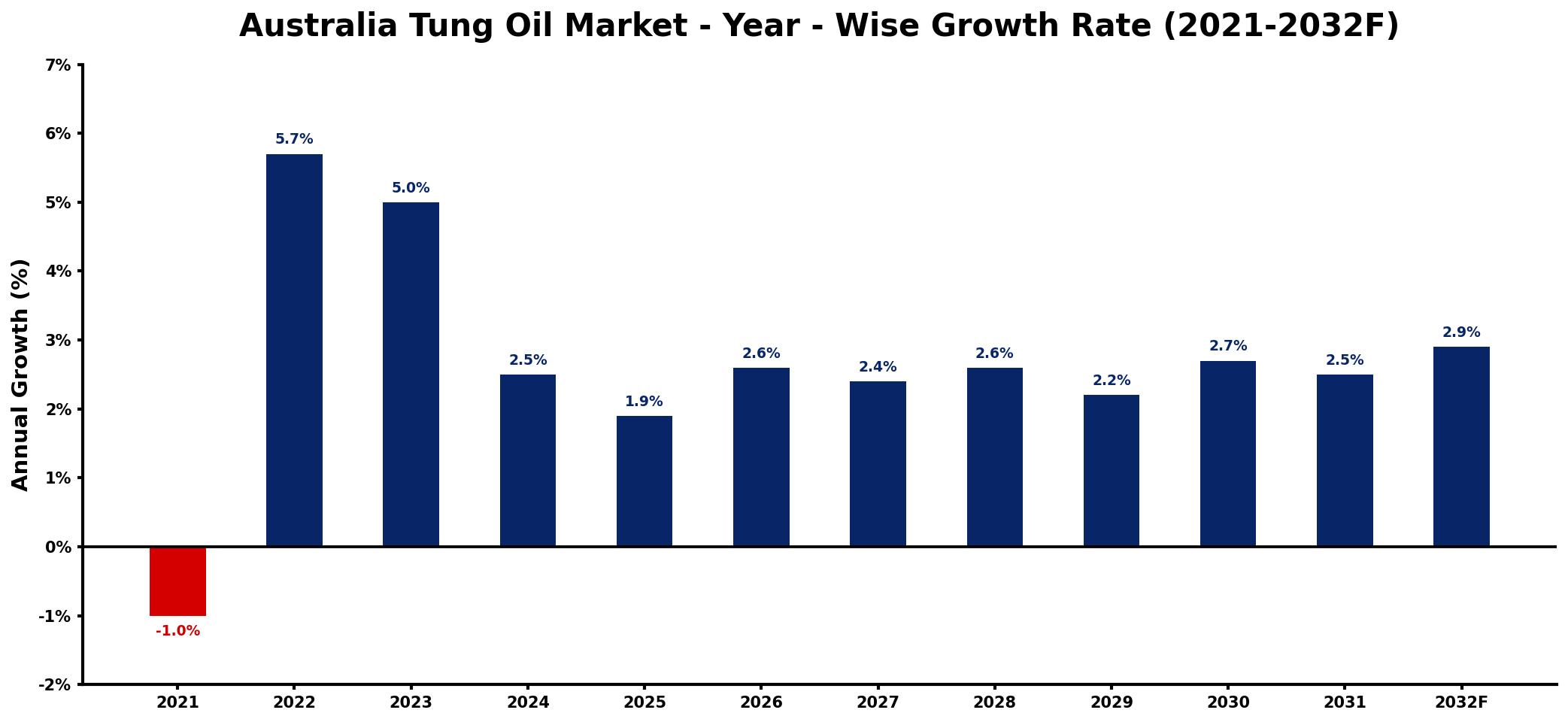
The table below presents the year‑wise growth rates along with the key drivers influencing the market
| Year | Growth Rate | Major Drivers |
| 2021 | -1.0% | decreased interest in natural solutions |
| 2022 | 5.7% | rising demand for sustainable products |
| 2023 | 5.0% | increased investment in eco-friendly alternatives |
| 2024 | 2.5% | growing popularity of green coatings |
| 2025 | 1.9% | expansion in organic farming practices |
| 2026 | 2.6% | surge in home improvement projects |
| 2027 | 2.4% | increased focus on renewable resources |
| 2028 | 2.6% | expanding healthcare application demand |
| 2029 | 2.2% | rising popularity of artisanal products |
| 2030 | 2.7% | expansion of international trade networks |
| 2031 | 2.5% | increased applications in construction sector |
| 2032 | 2.9% | growing innovation in product formulations |
Note: Market size estimations and growth projections presented in this report are based on 6Wresearch's proprietary forecasting methodology, utilizing the latest available industry data, government publications, and primary research inputs.
Australia Tung Oil Market Synopsis
A significant aspect of the Australia tung oil market is its burgeoning application in the woodworking sector, where it is valued for its outstanding water resistance and drying properties. As wood finishing standards evolve to prioritize sustainability, the demand for tung oil as a natural alternative to synthetic finishes is increasingly being recognized.
Moreover, the cosmetics and pharmaceutical industries are exploring the natural properties of tung oil for their formulations, further driving market demand. This trend aligns with a larger movement towards green practices, influencing both consumer choices and regulatory frameworks.
Australia Tung Oil Market Key Takeaways
- The market is expanding due to heightened demand for sustainable and eco-friendly materials.
- Tung oils natural durability makes it a preferred choice in the woodworking and coatings sectors.
- The cosmetics industry is increasingly incorporating tung oil, bolstering its overall market footprint.
- Government policies promoting sustainable forestry are fostering a conducive environment for market growth.
- Despite challenges, the market is positioned for steady growth driven by innovation and consumer awareness.
Evaluation of Restraints in Australia Tung Oil Market
While the Australia tung oil market showcases promising growth potential, it faces notable restraints. The limited availability of raw materials is a significant concern, as tung oil production is contingent on specific tree species that can be vulnerable to environmental threats like diseases and climate change. Additionally, market volatility due to fluctuating supply and competition from alternative oils adds complexity to stability and pricing strategies, posing challenges for stakeholders in the industry.
Australia Tung Oil Market Trends
Current trends in the Australia tung oil market illustrate a clear shift towards natural and biodegradable ingredients, especially in the paint and coatings industry. As manufacturers respond to consumer demand for sustainability, innovations in extraction and processing techniques are emerging, enhancing the oil's properties. Additionally, the trend towards green building practices is accelerating the development and adoption of tung oil-based products.
Australia Tung Oil Market Opportunities
The market presents numerous opportunities for growth and investment, particularly in product development and diversification. Companies can leverage the growing interest in sustainable materials by creating innovative formulations that highlight the natural benefits of tung oil. Furthermore, expanding distribution channels into emerging sectors such as eco-friendly cosmetics could significantly enhance market penetration.
Government Initiatives in the Australia Tung Oil Market
The Australian government plays a crucial role in supporting the tung oil market through various initiatives aimed at promoting sustainable forestry practices. Regulations designed to prevent deforestation and protect biodiversity, alongside certification programs for environmentally friendly products, foster responsible harvesting and extraction of tung oil. Additionally, subsidies for reforestation efforts reflect the government's commitment to maintaining ecological balance while encouraging market growth.
Future Insights of the Australia Tung Oil Market
Looking ahead to the 2026-2032 period, the Australia tung oil market is poised for steady expansion fueled by ongoing innovation and a strong shift towards green alternatives. As industries continue to embrace sustainability, the demand for natural products like tung oil will likely grow. Advances in agricultural practices and supply chain management may also mitigate current challenges related to raw material availability, positioning the market for long-term success.
Australia Tung Oil Market Latest Developments (2025 - 2026)
In recent months, the Australia tung oil market has experienced a notable increase in interest from various industries seeking to incorporate sustainable practices into their operations. This has led to heightened collaboration among researchers, producers, and businesses focused on exploring the diverse applications of tung oil. Additionally, new innovations aimed at improving extraction efficiency and product quality are being introduced, setting the stage for enhanced market competitiveness.
Australia Tung Oil Market - Key Attractiveness of the Report
- 10 Years of Market Numbers
- Historical Data Starting from 2022 to 2025
- Base Year: 2025
- Forecast Data until 2032
- Key Performance Indicators Impacting the Market
- Major Upcoming Developments and Projects
Key Highlights of the Report:
- Australia Tung Oil Market Outlook
- Market Size of Australia Tung Oil Market, 2025
- Forecast of Australia Tung Oil Market, 2032
- Historical Data and Forecast of Australia Tung Oil Revenues & Volume for the Period 2022-2032F
- Australia Tung Oil Market Trend Evolution
- Australia Tung Oil Market Drivers and Challenges
- Australia Tung Oil Price Trends
- Australia Tung Oil Porter's Five Forces
- Australia Tung Oil Industry Life Cycle
- Historical Data and Forecast of Australia Tung Oil Market Revenues & Volume By Product Type for the Period 2022-2032F
- Historical Data and Forecast of Australia Tung Oil Market Revenues & Volume By Raw Tung Oil for the Period 2022-2032F
- Historical Data and Forecast of Australia Tung Oil Market Revenues & Volume By Boiled Tung Oil for the Period 2022-2032F
- Historical Data and Forecast of Australia Tung Oil Market Revenues & Volume By Application for the Period 2022-2032F
- Historical Data and Forecast of Australia Tung Oil Market Revenues & Volume By Wood Finishing for the Period 2022-2032F
- Historical Data and Forecast of Australia Tung Oil Market Revenues & Volume By Food and Beverage for the Period 2022-2032F
- Historical Data and Forecast of Australia Tung Oil Market Revenues & Volume By Medicines for the Period 2022-2032F
- Historical Data and Forecast of Australia Tung Oil Market Revenues & Volume By Others for the Period 2022-2032F
- Australia Tung Oil Import Export Trade Statistics
- Market Opportunity Assessment By Product Type
- Market Opportunity Assessment By Application
- Australia Tung Oil Top Companies Market Share
- Australia Tung Oil Competitive Benchmarking By Technical and Operational Parameters
- Australia Tung Oil Company Profiles
- Australia Tung Oil Key Strategic Recommendations






































