Australia Unified Communication and Collaboration (UCC) Market Size, Share & Growth Rate
The Australia Unified Communication and Collaboration (UCC) Market was estimated at USD 109 Million in 2025 and is projected to reach USD 127 Million by 2032, growing at a CAGR of 2.2% from 2026 to 2032. This trajectory is bolstered by the increasing prevalence of remote work as companies seek to maintain operational efficiency. Digital transformation initiatives, combined with a robust demand for integrated communication tools, are propelling organizations of all sizes to adopt UCC solutions, ensuring effective collaboration among dispersed teams.
Australia Unified Communication and Collaboration (UCC) Market Year-wise Growth Rate and Key Drivers
This graph highlights how the Australia Unified Communication and Collaboration (UCC) Market has steadily grown over the years, supported by major growth factors.
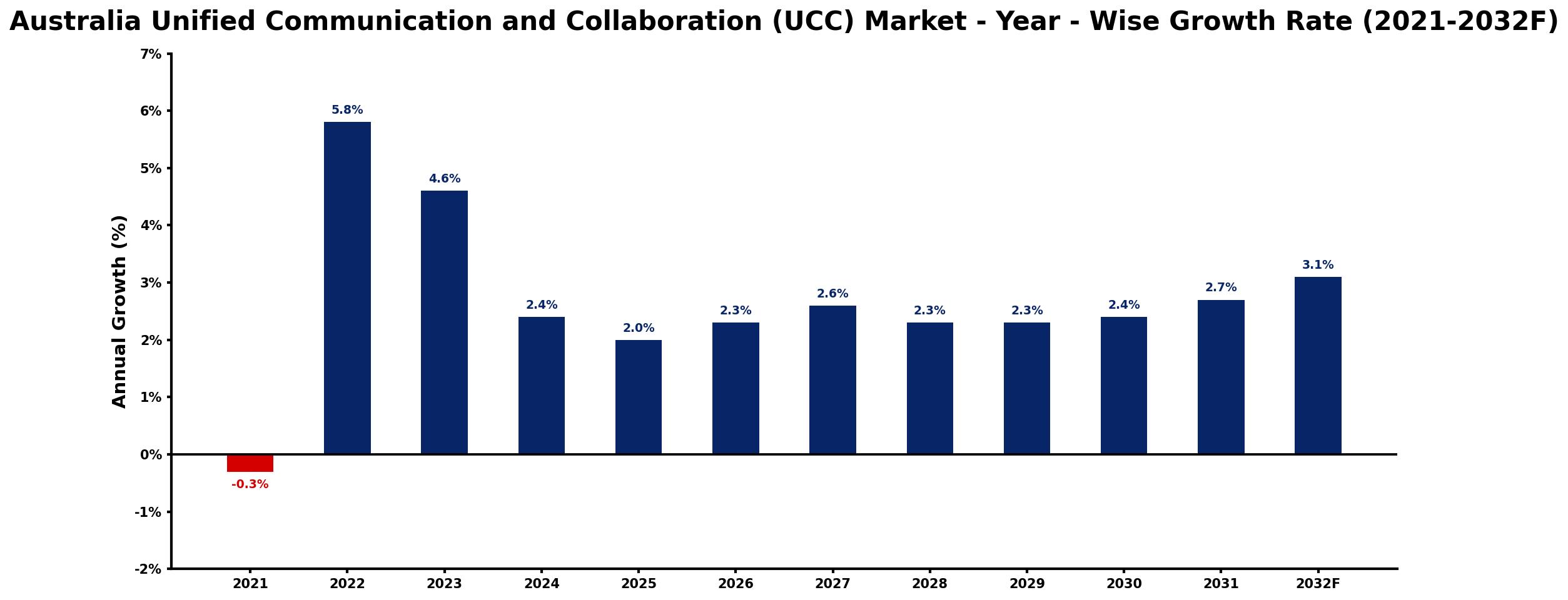
The table below presents the year‑wise growth rates along with the key drivers influencing the market
| Year | Growth Rate | Major Drivers |
| 2021 | -0.3% | decreased enterprise technology investments |
| 2022 | 5.8% | growing remote work adoption rates |
| 2023 | 4.6% | increased demand for digital tools |
| 2024 | 2.4% | expansion of cloud infrastructure services |
| 2025 | 2.0% | growing downstream application demand |
| 2026 | 2.3% | enhanced focus on employee engagement |
| 2027 | 2.6% | investments in cybersecurity solutions |
| 2028 | 2.3% | development of AI-driven applications |
| 2029 | 2.3% | emphasis on mobile workforce solutions |
| 2030 | 2.4% | growth in video conferencing platforms |
| 2031 | 2.7% | increased integration of IoT technologies |
| 2032 | 3.1% | adoption of advanced analytics tools |
Note: Market size estimations and growth projections presented in this report are based on 6Wresearch's proprietary forecasting methodology, utilizing the latest available industry data, government publications, and primary research inputs.
Australia Unified Communication and Collaboration (UCC) Market Synopsis
The Australian UCC market has witnessed significant momentum recently, driven primarily by the urgent need for businesses to adapt to remote work conditions. As organizations shift their focus toward digital integration, the demand for sophisticated communication solutions is poised to increase further. This evolving landscape presents both opportunities and challenges that stakeholders must navigate to ensure sustained growth.
Looking ahead, the market is expected to mature as businesses increasingly recognize the importance of seamless collaboration tools. As technology continues to evolve, the integration of voice, video, and messaging into unified platforms will become standard practice. Organizations will need to remain agile to capitalize on these advancements while addressing interoperability and security concerns.
Australia Unified Communication and Collaboration (UCC) Market Key Takeaways
- The market is experiencing steady growth as remote work becomes entrenched in Australian business culture.
- Digital transformation and the integration of diverse communication platforms are driving UCC adoption.
- Data security and privacy compliance remain crucial considerations for organizations implementing UCC solutions.
- Government initiatives are encouraging investment in UCC technologies to boost productivity and collaboration.
- Emerging trends, such as AI integration and mobile technology advancements, are shaping the future landscape of UCC.
Evaluation of Restraints in Australia Unified Communication and Collaboration (UCC) Market
While the Australian UCC market is on a growth trajectory, several restraints hinder its full potential. Interoperability challenges between various communication platforms can complicate system integration, leading to inefficiencies. Additionally, ensuring data security and compliance with privacy regulations remains paramount; organizations must navigate these complexities to safeguard sensitive information. Furthermore, user resistance to adopting new collaboration tools often slows down implementation, as employees adapt to changing technological environments.
Australia Unified Communication and Collaboration (UCC) Market Trends
Current trends in the UCC market reflect a strong emphasis on cloud-based solutions that offer scalability and flexibility. The rise of AI-driven features is enhancing user experiences, automating routine tasks, and improving overall efficiency. Additionally, mobile technology advancements enable employees to collaborate seamlessly, regardless of location. This shift toward remote and hybrid work is fundamentally transforming how organizations approach communication and collaboration strategies.
Australia Unified Communication and Collaboration (UCC) Market Opportunities
Growth and investment opportunities abound in the Australian UCC market. Organizations can enhance productivity by adopting solutions tailored for specific industry needs, such as healthcare or education. Furthermore, ongoing innovations in AI and machine learning present avenues to develop smarter collaboration tools. Companies focusing on user training and change management initiatives can also leverage these opportunities to mitigate resistance and facilitate smoother transitions to new platforms.
Government Initiatives in the Australia Unified Communication and Collaboration (UCC) Market
The Australian government has implemented a variety of initiatives aimed at promoting digital transformation within the UCC sector. Policies that enhance communication infrastructure and cybersecurity are crucial in supporting businesses as they adapt to an increasingly digital environment. Incentive programs are in place to stimulate investment in UCC technologies, encouraging enterprises to improve their collaboration capabilities and maintain competitive advantages.
Future Insights of the Australia Unified Communication and Collaboration (UCC) Market
From 2026 to 2032, the Australian UCC market is expected to evolve significantly, driven by continuous technological advancements and the growing importance of flexible work arrangements. Organizations will increasingly seek integrated solutions that streamline communication across various channels, fostering improved collaboration. As businesses recognize the necessity of adopting innovative tools, investments in UCC solutions will likely increase, leading to heightened competition and more sophisticated offerings in the market.
Australia Unified Communication and Collaboration (UCC) Market Latest Developments (2025 - 2026)
Recent developments in the UCC market reflect a concerted effort by organizations to enhance their digital collaboration tools. There is a notable shift towards adopting cloud-based platforms that offer greater flexibility and scalability. Additionally, companies are increasingly focusing on integrating AI features into their collaboration tools to improve user experience and operational efficiency. The emphasis on training and change management is also becoming more pronounced as businesses seek to ensure successful transitions to new UCC systems.
Australia Unified Communication and Collaboration (UCC) Market - Key Attractiveness of the Report
- 10 Years of Market Numbers
- Historical Data Starting from 2022 to 2025
- Base Year: 2025
- Forecast Data until 2032
- Key Performance Indicators Impacting the Market
- Major Upcoming Developments and Projects
Key Highlights of the Report:
- Australia Unified Communication and Collaboration (UCC) Market Outlook
- Market Size of Australia Unified Communication and Collaboration (UCC) Market, 2025
- Forecast of Australia Unified Communication and Collaboration (UCC) Market, 2032
- Historical Data and Forecast of Australia Unified Communication and Collaboration (UCC) Revenues & Volume for the Period 2022-2032F
- Australia Unified Communication and Collaboration (UCC) Market Trend Evolution
- Australia Unified Communication and Collaboration (UCC) Market Drivers and Challenges
- Australia Unified Communication and Collaboration (UCC) Price Trends
- Australia Unified Communication and Collaboration (UCC) Porter's Five Forces
- Australia Unified Communication and Collaboration (UCC) Industry Life Cycle
- Historical Data and Forecast of Australia Unified Communication and Collaboration (UCC) Market Revenues & Volume By Components for the Period 2022-2032F
- Historical Data and Forecast of Australia Unified Communication and Collaboration (UCC) Market Revenues & Volume By Types for the Period 2022-2032F
- Historical Data and Forecast of Australia Unified Communication and Collaboration (UCC) Market Revenues & Volume By Services for the Period 2022-2032F
- Historical Data and Forecast of Australia Unified Communication and Collaboration (UCC) Market Revenues & Volume By Types for the Period 2022-2032F
- Historical Data and Forecast of Australia Unified Communication and Collaboration (UCC) Market Revenues & Volume By UCaaS for the Period 2022-2032F
- Historical Data and Forecast of Australia Unified Communication and Collaboration (UCC) Market Revenues & Volume By IP Telephony for the Period 2022-2032F
- Historical Data and Forecast of Australia Unified Communication and Collaboration (UCC) Market Revenues & Volume By Video Conferencing Systems for the Period 2022-2032F
- Historical Data and Forecast of Australia Unified Communication and Collaboration (UCC) Market Revenues & Volume By Services for the Period 2022-2032F
- Historical Data and Forecast of Australia Unified Communication and Collaboration (UCC) Market Revenues & Volume By UC Managed Services for the Period 2022-2032F
- Historical Data and Forecast of Australia Unified Communication and Collaboration (UCC) Market Revenues & Volume By Professional Services for the Period 2022-2032F
- Historical Data and Forecast of Australia Unified Communication and Collaboration (UCC) Market Revenues & Volume By Deployment Mode for the Period 2022-2032F
- Historical Data and Forecast of Australia Unified Communication and Collaboration (UCC) Market Revenues & Volume By On-premises for the Period 2022-2032F
- Historical Data and Forecast of Australia Unified Communication and Collaboration (UCC) Market Revenues & Volume By Public Cloud for the Period 2022-2032F
- Historical Data and Forecast of Australia Unified Communication and Collaboration (UCC) Market Revenues & Volume By Hybrid Cloud for the Period 2022-2032F
- Historical Data and Forecast of Australia Unified Communication and Collaboration (UCC) Market Revenues & Volume By Organization Size for the Period 2022-2032F
- Historical Data and Forecast of Australia Unified Communication and Collaboration (UCC) Market Revenues & Volume By Large Enterprises for the Period 2022-2032F
- Historical Data and Forecast of Australia Unified Communication and Collaboration (UCC) Market Revenues & Volume By Small and Medium- Sized Enterprises (SMEs) for the Period 2022-2032F
- Historical Data and Forecast of Australia Unified Communication and Collaboration (UCC) Market Revenues & Volume By Vertical for the Period 2022-2032F
- Historical Data and Forecast of Australia Unified Communication and Collaboration (UCC) Market Revenues & Volume By BFSI for the Period 2022-2032F
- Historical Data and Forecast of Australia Unified Communication and Collaboration (UCC) Market Revenues & Volume By IT and Telecom for the Period 2022-2032F
- Historical Data and Forecast of Australia Unified Communication and Collaboration (UCC) Market Revenues & Volume By Retail and Consumer Goods for the Period 2022-2032F
- Historical Data and Forecast of Australia Unified Communication and Collaboration (UCC) Market Revenues & Volume By Healthcare for the Period 2022-2032F
- Historical Data and Forecast of Australia Unified Communication and Collaboration (UCC) Market Revenues & Volume By Public Sector and Utilities for the Period 2022-2032F
- Historical Data and Forecast of Australia Unified Communication and Collaboration (UCC) Market Revenues & Volume By Logistics and Transportation for the Period 2022-2032F
- Historical Data and Forecast of Australia Unified Communication and Collaboration (UCC) Market Revenues & Volume By Travel and Hospitality for the Period 2022-2032F
- Historical Data and Forecast of Australia Unified Communication and Collaboration (UCC) Market Revenues & Volume By Other Verticals (Education, Manufacturing and Media and Entertainment) for the Period 2022-2032F
- Australia Unified Communication and Collaboration (UCC) Import Export Trade Statistics
- Market Opportunity Assessment By Components
- Market Opportunity Assessment By Types
- Market Opportunity Assessment By Services
- Market Opportunity Assessment By Deployment Mode
- Market Opportunity Assessment By Organization Size
- Market Opportunity Assessment By Vertical
- Australia Unified Communication and Collaboration (UCC) Top Companies Market Share
- Australia Unified Communication and Collaboration (UCC) Competitive Benchmarking By Technical and Operational Parameters
- Australia Unified Communication and Collaboration (UCC) Company Profiles
- Australia Unified Communication and Collaboration (UCC) Key Strategic Recommendations






































