Australia Unified Threat Management Market Size & Growth Rate (2026-2032)
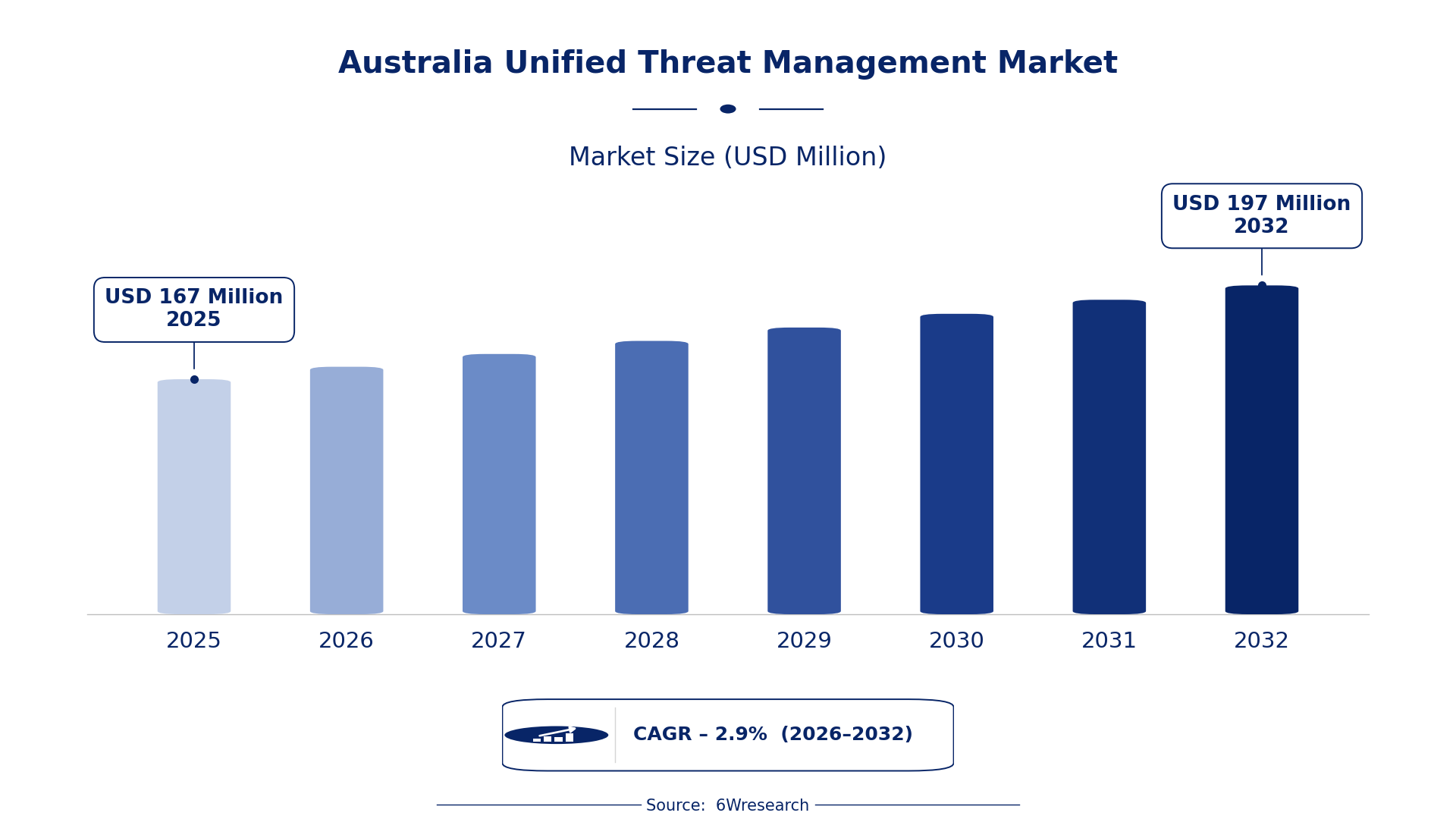
The Australia Unified Threat Management Market was estimated at USD 167 Million in 2025 and is projected to reach USD 197 Million by 2032, growing at a CAGR of 2.9% from 2026 to 2032.
Australia Unified Threat Management Market Synopsis
A surge in cyber threats has left organizations in Australia grappling with the need for integrated security solutions. As businesses face increased risks from malware and ransomware, Unified Threat Management systems are increasingly viewed as essential for defending against these evolving dangers.
Organizations are not merely seeking traditional security measures; they demand comprehensive solutions that combine multiple functionalities into one platform. This shift has led to heightened interest in UTM systems across sectors, as companies prioritize enhanced protection and simplified security management.
Australia Unified Threat Management Market Year-wise Growth Rate and Key Drivers
This graph illustrates the annual growth rates of the Australia Unified Threat Management Market from 2021 to 2032, highlighting a steady upward trajectory and projected expansion over the forecast period.
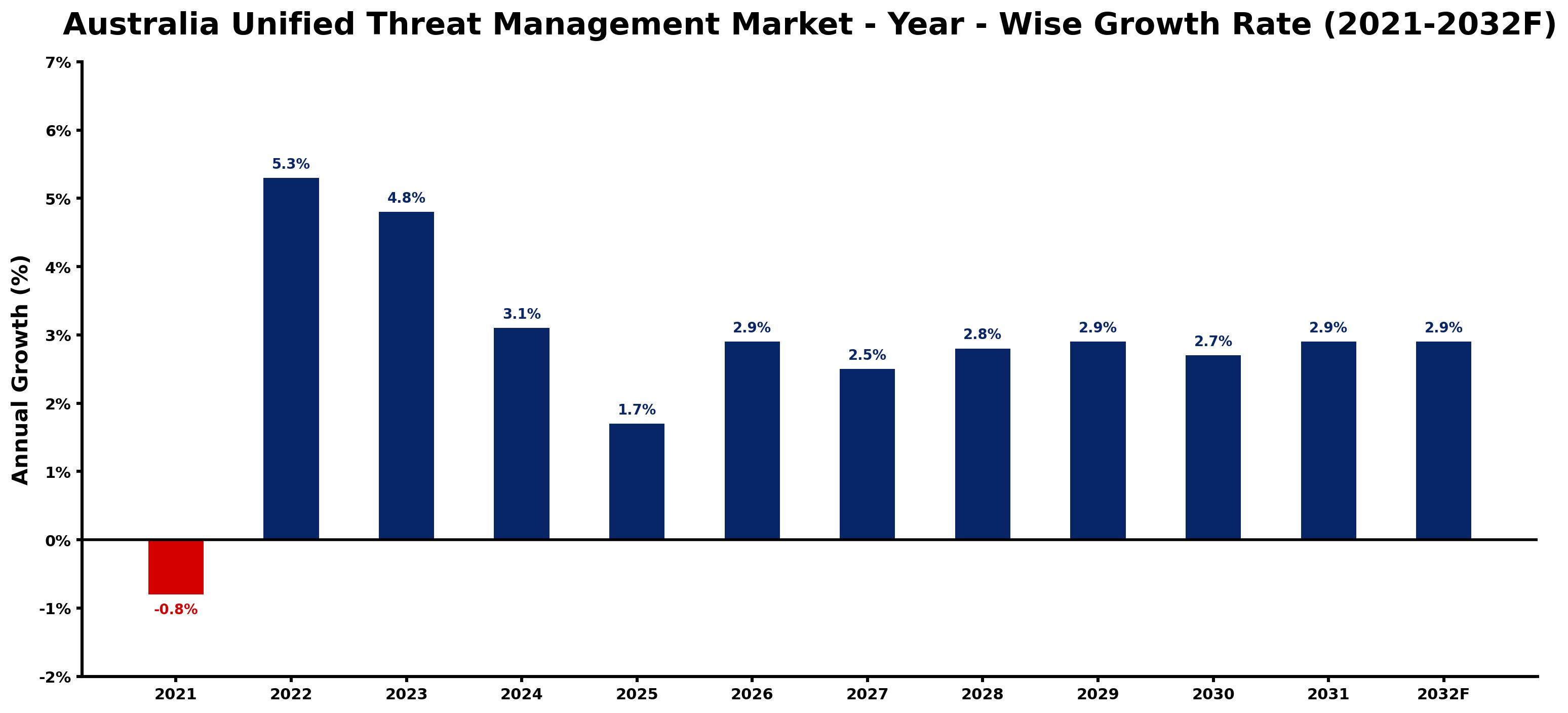
The table below presents the year‑wise growth rates along with the key drivers influencing the market
| Year | Growth Rate | Major Drivers |
| 2021 | -0.8% | Australian Cyber Security Strategy funding delays impacted adoption. |
| 2022 | 5.3% | Increased phishing attacks prompting urgent cybersecurity investments. |
| 2023 | 4.8% | Coordinated cybersecurity frameworks by Australian Cyber Security Centre. |
| 2024 | 3.1% | Rising adoption of IoT devices increasing security needs. |
| 2025 | 1.7% | Data breach incidents accelerating demand for integrated security. |
| 2026 | 2.9% | Heightened regulatory scrutiny on data protection requirements. |
| 2027 | 2.5% | Local enterprises prioritizing threat management systems for resilience. |
| 2028 | 2.8% | Emerging technologies requiring enhanced cybersecurity measures. |
| 2029 | 2.9% | Growing awareness of ransomware threats among businesses. |
| 2030 | 2.7% | Investment in managed security services by local enterprises. |
| 2031 | 2.9% | Increasing awareness of cybersecurity insurance benefits. |
| 2032 | 2.9% | Demand for threat intelligence services following malware attacks. |
Note: Market size estimations and growth projections presented in this report are based on 6Wresearch's proprietary forecasting methodology, utilizing the latest available industry data, government publications, and primary research inputs.
Australia Unified Threat Management Market Key Takeaways
Below are some of the specific key takeaways from the market, including:
- Cybersecurity risks continue to escalate, prompting urgent demand for UTM solutions.
- Integration of diverse security functions in a single platform simplifies management for organizations.
- SMEs are particularly inclined to adopt UTM due to limited resources for standalone security solutions.
- Government policies are actively promoting the adoption of advanced cybersecurity measures.
- Investment in UTM technologies is expected to accelerate as threats evolve and become more sophisticated.
Evaluation of Restraints in Australia Unified Threat Management Market
Despite the growing demand for UTM solutions, several restraints impact the market. Organizations often struggle to keep pace with the rapidly changing threat environment. As cyber threats evolve, ensuring comprehensive protection becomes increasingly complex. Balancing the fine line between usability and security without compromising effectiveness adds additional challenges for providers and users alike.
Australia Unified Threat Management Market Trends
The integration of Artificial Intelligence (AI) and Machine Learning (ML) into UTM solutions is transforming threat detection and response capabilities. Organizations are increasingly adopting AI-driven analytics to predict potential threats before they materialize. Additionally, the emphasis on regulatory compliance is leading firms to seek UTM systems that can not only protect but also ensure compliance with evolving legislation.
Australia Unified Threat Management Market Opportunities
The growing sophistication of cyber threats presents substantial growth opportunities for UTM providers. Organizations are looking for solutions that offer advanced functionalities, such as automated incident response and real-time monitoring. on top of that, the ongoing digital transformation in various industries increases the potential for UTM adoption, especially among those transitioning to cloud-based services.
Government Initiatives in the Australia Unified Threat Management Market
Australia’s government is actively addressing cybersecurity challenges through various initiatives aimed at strengthening national defenses. The introduction of regulatory frameworks and public-private partnerships emphasizes the urgency of enhancing cybersecurity measures, making it crucial for organizations to comply with new standards.
- A recently completed initiative, the Cybersecurity Strategy 2020, outlines comprehensive policies to bolster the nation's cyber defenses.
- Currently ongoing is the Cyber Security Skills Partnership Innovation Fund, which focuses on enhancing skills and collaboration in the cybersecurity sector.
- A planned initiative aims to introduce more stringent regulations for data protection and incident reporting, expected to be rolled out in early 2026.
- The government is also investing in a public-private threat intelligence sharing program to improve real-time responses to cyber incidents.
- Upcoming initiatives may involve expanded funding for cybersecurity research, supporting advancements in UTM technologies.
Future Insights of the Australia Unified Threat Management Market
Looking ahead to 2026-2032, the Australia Unified Threat Management Market is likely to evolve considerably. The emphasis on integrated solutions will lead to more sophisticated UTM systems capable of addressing complex cyber threats. As businesses increasingly recognize the importance of comprehensive cybersecurity, the market is set to grow, driven by technological advancements and heightened regulatory pressures.
Australia Unified Threat Management Market Latest Developments
In the past year, the Australia Unified Threat Management Market has witnessed a flurry of activity as businesses invest in improved security infrastructures. The focus remains on integrating cutting-edge technologies to tackle mounting cyber threats, and players are scrambling to innovate their offerings.
- A major technology vendor announced the launch of a new UTM solution that integrates AI-driven capabilities for enhanced threat intelligence, unveiled in Q2 2025.
- In early 2025, a leading regional operator completed the upgrade of its UTM systems to include more comprehensive endpoint protection measures.
- A current partnership between cybersecurity firms is focusing on developing collaborative threat detection technologies, an initiative that began in late 2025 and continues to gain momentum.
- By mid-2026, a rollout of a new UTM product line aimed at small to medium enterprises is expected to commence, addressing the unique security challenges faced by this segment.
- A pilot program for a cloud-based UTM solution is currently underway, aiming to assess its effectiveness in dynamic enterprise environments.
Australia Unified Threat Management Market - Key Attractiveness of the Report
- 10 Years of Market Numbers
- Historical Data Starting from 2022 to 2025
- Base Year: 2025
- Forecast Data until 2032
- Key Performance Indicators Impacting the Market
- Major Upcoming Developments and Projects
Key Highlights of the Report:
- Australia Unified Threat Management Market Outlook
- Market Size of Australia Unified Threat Management Market, 2025
- Forecast of Australia Unified Threat Management Market, 2032
- Historical Data and Forecast of Australia Unified Threat Management Revenues & Volume for the Period 2022-2032F
- Australia Unified Threat Management Market Trend Evolution
- Australia Unified Threat Management Market Drivers and Challenges
- Australia Unified Threat Management Price Trends
- Australia Unified Threat Management Porter's Five Forces
- Australia Unified Threat Management Industry Life Cycle
- Historical Data and Forecast of Australia Unified Threat Management Market Revenues & Volume By Appliance for the Period 2022-2032F
- Historical Data and Forecast of Australia Unified Threat Management Market Revenues & Volume By Hardware for the Period 2022-2032F
- Historical Data and Forecast of Australia Unified Threat Management Market Revenues & Volume By Software for the Period 2022-2032F
- Historical Data and Forecast of Australia Unified Threat Management Market Revenues & Volume By Virtual for the Period 2022-2032F
- Historical Data and Forecast of Australia Unified Threat Management Market Revenues & Volume By Distribution Channel for the Period 2022-2032F
- Historical Data and Forecast of Australia Unified Threat Management Market Revenues & Volume By Direct for the Period 2022-2032F
- Historical Data and Forecast of Australia Unified Threat Management Market Revenues & Volume By VAR??s for the Period 2022-2032F
- Historical Data and Forecast of Australia Unified Threat Management Market Revenues & Volume By Distributors for the Period 2022-2032F
- Historical Data and Forecast of Australia Unified Threat Management Market Revenues & Volume By Organization Size for the Period 2022-2032F
- Historical Data and Forecast of Australia Unified Threat Management Market Revenues & Volume By SOHO for the Period 2022-2032F
- Historical Data and Forecast of Australia Unified Threat Management Market Revenues & Volume By SMB for the Period 2022-2032F
- Historical Data and Forecast of Australia Unified Threat Management Market Revenues & Volume By Enterprises for the Period 2022-2032F
- Historical Data and Forecast of Australia Unified Threat Management Market Revenues & Volume By Services for the Period 2022-2032F
- Historical Data and Forecast of Australia Unified Threat Management Market Revenues & Volume By Support and Maintenance for the Period 2022-2032F
- Historical Data and Forecast of Australia Unified Threat Management Market Revenues & Volume By Managed UTM for the Period 2022-2032F
- Australia Unified Threat Management Import Export Trade Statistics
- Market Opportunity Assessment By Appliance
- Market Opportunity Assessment By Distribution Channel
- Market Opportunity Assessment By Organization Size
- Market Opportunity Assessment By Services
- Australia Unified Threat Management Top Companies Market Share
- Australia Unified Threat Management Competitive Benchmarking By Technical and Operational Parameters
- Australia Unified Threat Management Company Profiles
- Australia Unified Threat Management Key Strategic Recommendations






































