Topics Covered in Australia Used Car Market Report
Australia Used Car Market Report thoroughly covers the market by vehicle type, vendor and fuel type. Australia Used Car Market Outlook report provides an unbiased and detailed analysis of the ongoing Australia Used Car Market trends, opportunities/high growth areas, and market drivers. This would help stakeholders devise and align their market strategies according to the current and future market dynamics.
Australia Used Car Market Synopsis
The Australia used car market has witnessed steady expansion, supported by rising vehicle parc and strong new car sales reaching at high units in 2025, which has increased the availability of used vehicles. Demand has been further driven by affordability considerations and strong recovery in tourism, with high international visits in 2024, boosting rental and second-hand vehicle demand. Additionally, the growing penetration of electric vehicles, with EV sales rising significantly and used EV supply increasing, has expanded the pool of available vehicles and diversified consumer choices. Further, increasing replacement cycles and higher new car prices have encouraged consumers to shift toward pre-owned vehicles. This trend is particularly evident among urban buyers seeking cost-effective mobility solutions without compromising on features.
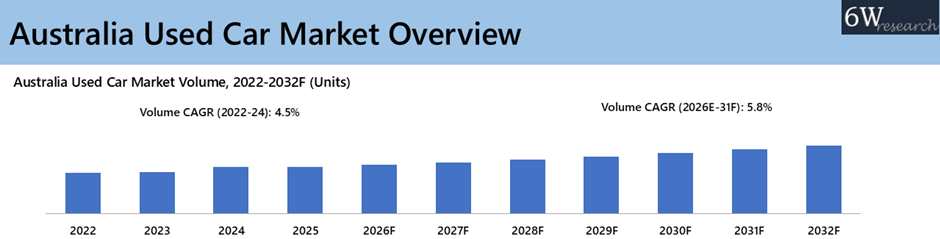
According to 6Wresearch, the Australia Used Car Market is projected to grow at a CAGR of 5.8% in Volume from 2026 to 2032, driven by increasing affordability pressures, rising disposable income, and expanding digital platforms. Australia’s GDP per capita has grown in recent years, enabling consumers to shift towards cost-effective used vehicles. Government initiatives such as legalization of imported used cars and supportive policies have further improved supply, while online platforms are enhancing accessibility, transparency, and transaction efficiency. In addition, favorable financing options and increasing availability of certified pre-owned vehicles are improving buyer confidence. The integration of digital tools such as AI-based pricing and virtual inspections is further streamlining transactions

Market Segmentation By Vehicle Type
SUVs are projected to record the highest growth in Australia’s used car market, driven by rising consumer preference for spacious, versatile, and family-friendly vehicles. Increasing availability of compact and crossover SUVs, along with improving fuel efficiency, is further supporting their demand in the second-hand market.
Market Segmentation By Vendor
Private vendors are projected to record the highest growth in Australia’s used car market, driven by rising adoption of online marketplaces and increasing preference for direct transactions. Lower costs, flexible pricing, and faster deal closures further support their growth.
Market Segmentation By Fuel Type
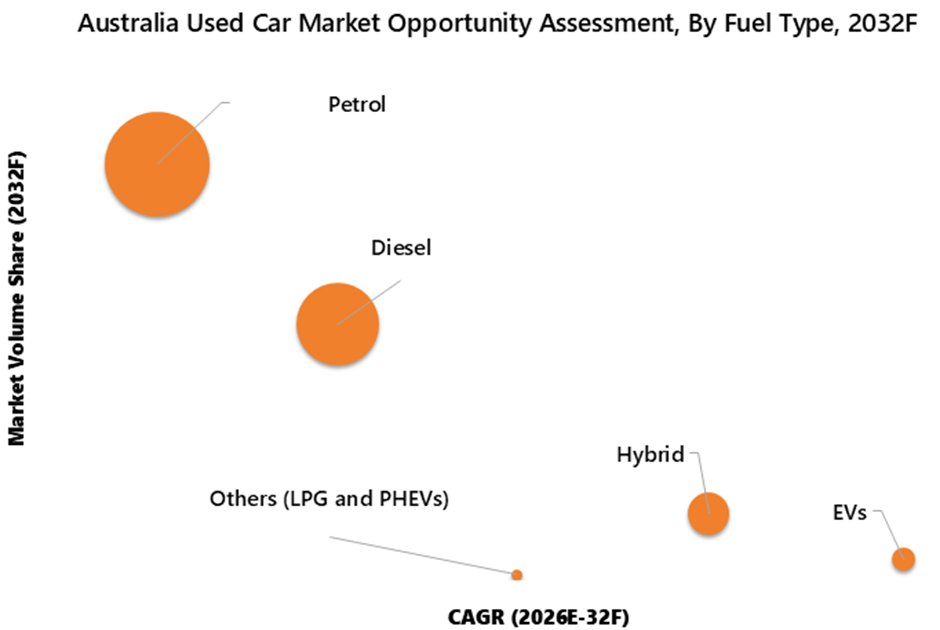
EVs are projected to record the highest growth in Australia’s used car market, driven by rising environmental awareness, government incentives, and expanding charging infrastructure. Improving affordability and battery advancements are further accelerating their adoption in the second-hand market.
Key Attractiveness of the Report
- 10 Years Market Numbers.
- Historical Data Starting from 2022 to 2025
- Base Year: 2025
- Forecast Data until 2032
- Key Performance Indicators Impacting the Market.
- Major Upcoming Developments and Projects.
Key Highlights of the Report:
- Australia Used Car Market Overview
- Australia Used Car Market Outlook
- Australia Used Car Market Forecast
- Historical Data and Forecast of Australia Used Car Market Volume Share and Volume for the Period 2022-2032F
- Historical Data and Forecast of Market Volume Share and Volume, By Vehicle Type, for the Period 2022-2032F
- Historical Data and Forecast of Market Volume Share and Volume, By Vendor, for the Period 2022-2032F
- Historical Data and Forecast of Market Volume Share and Volume, By Fuel Type, for the Period 2022-2032F
- Australia Used Car Market Drivers and Restraints
- Industry Life Cycle
- Porter’s Five Force Analysis
- Australia Used Car Evolution & Trends
- Market Opportunity Assessment
- Australia Used Car Market Volume Ranking, By Companies
- Competitive Benchmarking
- Company Profiles
- Key Strategic Recommendations
Market Scope and Segmentation
The report provides a detailed analysis of the following market segments:
By Vehicle Type
- Passenger
- SUV
- LCV - Utes
- LCV - Vans & Buses
By Vendor
- Private
- Dealer
By Fuel Type
- Petrol
- Diesel
- Hybrid
- EVs
- Others (LPG and PHEVs)






































