Australia Vending machines Market Summary
The australia vending machines market was estimated at USD 153 Million in 2025 and is projected to reach USD 180 Million by 2032, growing at a CAGR of 2.8% from 2026 to 2032.
Australia Vending machines Market Year-wise Growth Rate and Key Drivers
This graph highlights how the Australia Vending machines Market has steadily grown over the past five years, supported by major growth factors.
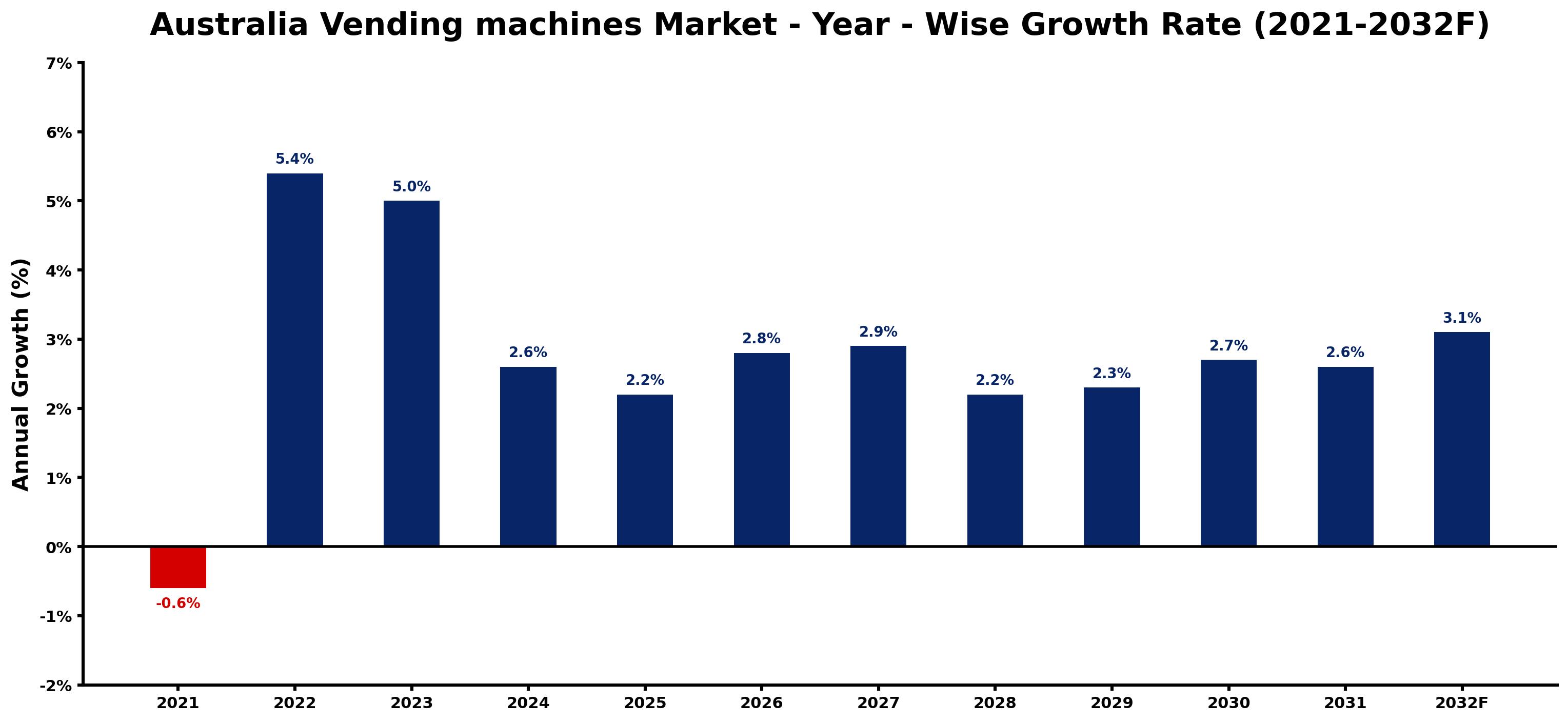
The table below presents the year wise growth rates along with the key drivers influencing the market
| Year | Growth Rate | Major Drivers |
| 2021 | -0.6% | Increased competition from online delivery services significantly diminished foot traffic to vending machine locations. |
| 2022 | 5.4% | Consumer behavior shifts have encouraged healthier snack options in vending machines. |
| 2023 | 5.0% | Technological upgrades in vending machines enhance cashless transaction capabilities significantly. |
| 2024 | 2.6% | Urbanization trends lead to more strategic placements of vending machines in cities. |
| 2025 | 2.2% | Sustainability concerns drive demand for eco-friendly packaging in vending products. |
| 2026 | 2.8% | Partnerships with local businesses create unique vending offerings catering to communities. |
| 2027 | 2.9% | Increased public health awareness promotes vending machines with nutritious beverages and snacks. |
| 2028 | 2.2% | Diverse product offerings evolve to include on-the-go meals and healthier options. |
| 2029 | 2.3% | Emerging tech innovations enhance user experience through personalized vending interfaces. |
| 2030 | 2.7% | Economic recovery post-pandemic encourages investment in automated retail solutions. |
| 2031 | 2.6% | Integration of AI-driven analytics improves inventory management efficiency for operators. |
| 2032 | 3.1% | Digital marketing strategies boost awareness and foot traffic to vending locations. |
Note - Market size estimations and growth projections presented in this report are based on 6Wresearch's advanced forecasting approach, validated with industry datasets as of June 2026.
Australia Vending machines Market Synopsis
The Australia Vending machines Market is projected to reach 2.8% and witness significant growth during the forecast period (2026-2032). The market has seen a steady rise due to the increasing demand for convenient retail solutions in various sectors, including transportation hubs, educational institutions, and workplaces. As consumer behavior evolves towards a preference for accessible snack and beverage options, vending machines are adapting to meet these needs through technological advancements and product diversification.
Australia Vending machines Market Growth Drivers
Several factors are contributing to the growth of the Australia Vending machines Market. These include:
- Shifting Consumer Preferences: There is a noticeable trend towards healthier options, leading to an increase in the availability of nutritious snacks and beverages in vending machines.
- Technological Advancements: The integration of cashless payment systems and mobile payment options enhances consumer convenience and interaction with vending machines, driving their adoption.
- Expansion of Automated Retailing: The growing popularity of automated retail solutions in various locations such as airports and shopping malls is significantly boosting market demand.
- Busy Lifestyles: As consumers lead more hectic lives, the need for quick access to food and beverages is fuelling the vending machine sector.
- Increased Accessibility: Vending machines are increasingly located in high foot-traffic areas, enhancing their visibility and usage among consumers.
Australia Vending machines Market Challenges and Restraints
While the Australia Vending machines Market presents numerous opportunities, there are also challenges that operators must navigate:
- Demand for Healthier Options: The growing consumer preference for health-conscious choices is compelling operators to revise their offerings, which may incur additional costs.
- Operational Reliability: Ensuring the continuous operation of vending machines and addressing technical malfunctions remains a critical concern for operators.
- Vandalism and Theft: The risk of vandalism and theft poses potential financial losses for vending machine operators, necessitating improved security measures.
- Regulatory Compliance: Adherence to government regulations concerning product safety and licensing can be cumbersome and may require additional resources.
- Market Competition: The presence of numerous competitors in the vending sector leads to price wars and challenges in differentiating product offerings.
Australia Vending machines Market Government Investment and Initiatives
The Australian government actively engages in regulating the vending machines sector through various policies and directives. Key initiatives include:
- Infrastructure Investment: Government funding aimed at enhancing public infrastructure indirectly benefits the vending machines market by increasing footfall in supported areas.
- Food Safety Regulations: Stringent food and beverage safety standards are enforced to ensure quality and safety in vending machine products, thus protecting consumers.
- Sustainability Incentives: The government is promoting sustainable practices, encouraging vending operators to offer eco-friendly products and packaging.
- Support for Technological Innovation: Australian policies often support technological advancements, which include incentives for companies adopting cashless payment solutions and smart vending technologies.
- Consumer Protection Laws: Regulations aimed at protecting consumer interests play a vital role in shaping vending operations, focusing on transparency and quality of offerings.
Australia Vending machines Market Latest Developments (May 2025 - June 2026)
In the period from May 2025 to June 2026, the Australia Vending machines Market experienced a notable shift towards innovation and adaptation to consumer needs. Operators began to implement more robust cashless payment systems, reflecting a broader trend in retail. The introduction of healthier product lines has also gained momentum, responding to the public's increasing interest in nutrition. Additionally, the integration of smart technologies, such as touchless interfaces and inventory management systems, has streamlined operations and improved user experience. These developments are indicative of a market that is increasingly aligning with contemporary consumer expectations.
Australia Vending machines Market - Key Attractiveness of the Report
- 10 Years of Market Numbers
- Historical Data Starting from 2022 to 2025
- Base Year: 2025
- Forecast Data until 2032
- Key Performance Indicators Impacting the Market
- Major Upcoming Developments and Projects
Key Highlights of the Report:
- Australia Vending machines Market Outlook
- Market Size of Australia Vending machines Market, 2025
- Forecast of Australia Vending machines Market, 2032
- Historical Data and Forecast of Australia Vending machines Revenues & Volume for the Period 2022-2032F
- Australia Vending machines Market Trend Evolution
- Australia Vending machines Market Drivers and Challenges
- Australia Vending machines Price Trends
- Australia Vending machines Porter's Five Forces
- Australia Vending machines Industry Life Cycle
- Historical Data and Forecast of Australia Vending machines Market Revenues & Volume By Applications for the Period 2022-2032F
- Historical Data and Forecast of Australia Vending machines Market Revenues & Volume By Commercial Places for the Period 2022-2032F
- Historical Data and Forecast of Australia Vending machines Market Revenues & Volume By Offices for the Period 2022-2032F
- Historical Data and Forecast of Australia Vending machines Market Revenues & Volume By Public Places for the Period 2022-2032F
- Historical Data and Forecast of Australia Vending machines Market Revenues & Volume By Others for the Period 2022-2032F
- Historical Data and Forecast of Australia Vending machines Market Revenues & Volume By Payment Mode for the Period 2022-2032F
- Historical Data and Forecast of Australia Vending machines Market Revenues & Volume By Cash for the Period 2022-2032F
- Historical Data and Forecast of Australia Vending machines Market Revenues & Volume By Cashless for the Period 2022-2032F
- Australia Vending machines Import Export Trade Statistics
- Market Opportunity Assessment By Applications
- Market Opportunity Assessment By Payment Mode
- Australia Vending machines Top Companies Market Share
- Australia Vending machines Competitive Benchmarking By Technical and Operational Parameters
- Australia Vending machines Company Profiles
- Australia Vending machines Key Strategic Recommendations






































