Australia Vision Screeners Market Size, Share & Growth Rate
The Australia Vision Screeners Market was estimated at USD 116 Million in 2025 and is projected to reach USD 135 Million by 2032, growing at a CAGR of 2.2% from 2026 to 2032. This growth is primarily fueled by rising awareness surrounding the importance of eye health and increasing incidences of vision disorders. Additionally, advancements in technology are enabling more accurate and user-friendly screening devices, further propelling demand across various sectors, including healthcare facilities and educational institutions.
Australia Vision Screeners Market Year-wise Growth Rate and Key Drivers
This graph highlights how the Australia Vision Screeners Market has steadily grown over the years, supported by major growth factors.
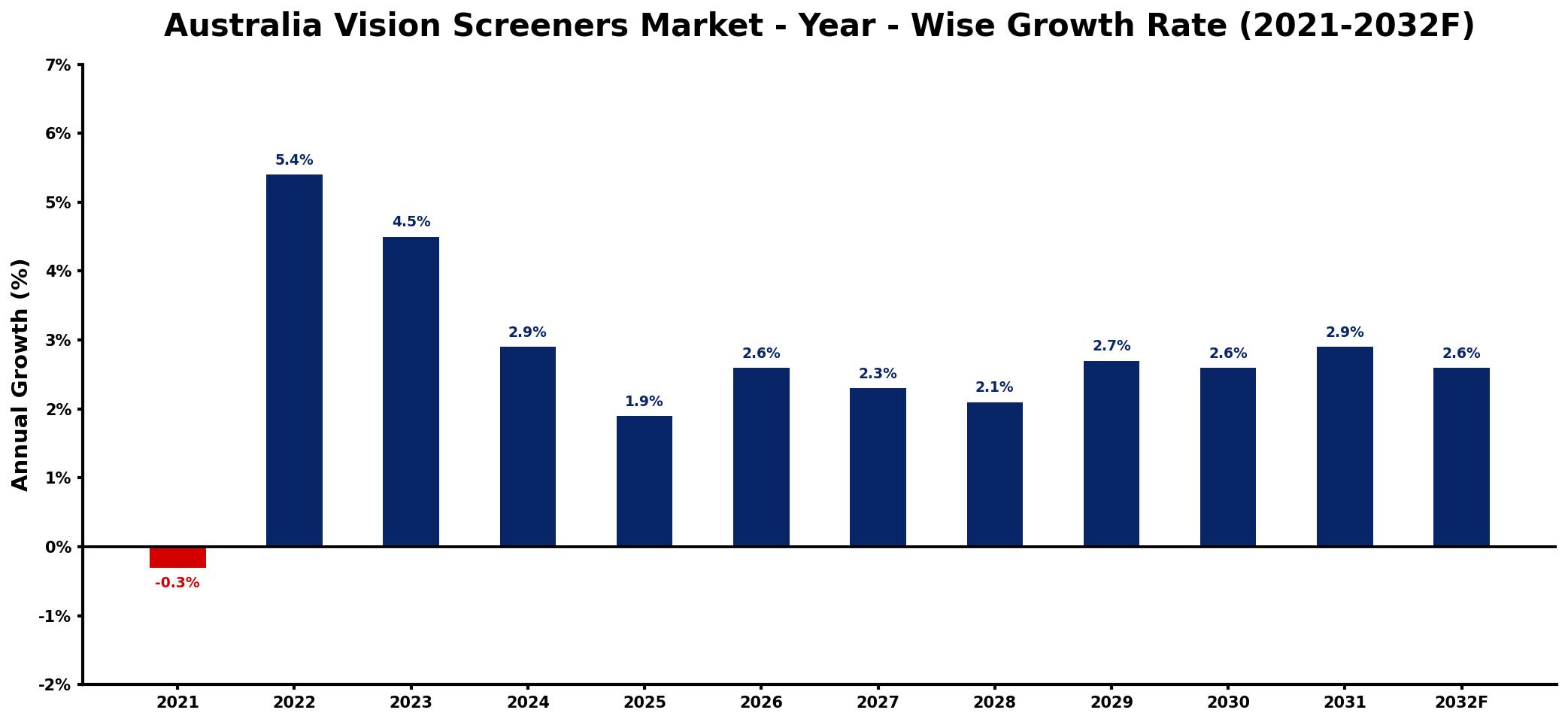
The table below presents the year‑wise growth rates along with the key drivers influencing the market
| Year | Growth Rate | Major Drivers |
| 2021 | -0.3% | decreased healthcare funding allocations |
| 2022 | 5.4% | increased demand for early detection |
| 2023 | 4.5% | growing awareness of eye health |
| 2024 | 2.9% | expansion of telehealth services |
| 2025 | 1.9% | rising investments in healthcare technology |
| 2026 | 2.6% | enhanced regulatory support initiatives |
| 2027 | 2.3% | development of advanced diagnostic tools |
| 2028 | 2.1% | surge in preventive healthcare initiatives |
| 2029 | 2.7% | increased production capacity utilization |
| 2030 | 2.6% | integration of AI in diagnostics |
| 2031 | 2.9% | collaboration between healthcare sectors |
| 2032 | 2.6% | emphasis on patient-centered care |
Note: Market size estimations and growth projections presented in this report are based on 6Wresearch's proprietary forecasting methodology, utilizing the latest available industry data, government publications, and primary research inputs.
Australia Vision Screeners Market Synopsis
A significant driving force in the Australia Vision Screeners Market is the increasing emphasis on early detection of vision impairments. As more Australians recognize the detrimental impact of untreated vision disorders, the demand for accessible vision screening solutions has surged, particularly in schools and community health centers.
Moreover, public health campaigns and educational initiatives spearheaded by government agencies have heightened awareness and encouraged regular screenings, fostering a more proactive approach to eye health across the nation. This shift is crucial in addressing the rising prevalence of refractive errors and other vision-related issues among various age groups.
Australia Vision Screeners Market Key Takeaways
- The market is driven by increasing awareness of vision health and rising prevalence of vision disorders.
- Technological advancements in screening devices enhance diagnostic capabilities and ease of use.
- Government initiatives aim to improve access to vision screening services across Australia.
- Community health centers and schools are key markets for vision screening devices.
- Challenges remain in accessibility and the need for accurate and reliable devices.
Evaluation of Restraints in Australia Vision Screeners Market
Despite the promising growth trajectory, the Australia Vision Screeners Market faces significant challenges. Accessibility remains a critical concern, particularly in rural and underserved areas where healthcare infrastructure is limited. This disparity makes it difficult to provide regular vision screenings to all Australians. Furthermore, maintaining the accuracy of vision screening devices is paramount. Manufacturers must ensure that their products undergo rigorous calibration and validation to deliver reliable results. The constant evolution of technology also poses a challenge, as companies strive to integrate cutting-edge features, including artificial intelligence and telemedicine capabilities, to stay competitive.
Australia Vision Screeners Market Trends
Several current and emerging trends are shaping the Australia Vision Screeners Market. Notably, the integration of telehealth services allows for remote vision assessments, making screenings more accessible to individuals in remote regions. Additionally, portable and user-friendly devices are increasingly being adopted in educational settings, allowing for swift assessments of students' vision health. The incorporation of artificial intelligence in screening technology is enhancing accuracy and facilitating more personalized care.
Australia Vision Screeners Market Opportunities
There are substantial growth and investment opportunities within the Australia Vision Screeners Market, particularly as the government continues to promote eye health initiatives. Partnerships between public health agencies and private sector manufacturers can facilitate the development of innovative screening devices tailored to meet the needs of diverse populations. Additionally, the growing demand for telehealth solutions presents a unique opportunity to create hybrid models that combine in-person and remote screenings, thereby expanding service reach and enhancing patient outcomes.
Government Initiatives in the Australia Vision Screeners Market
Government policies play a pivotal role in shaping the Australia Vision Screeners Market. Initiatives focused on promoting access to vision screenings in schools and community health centers are central to public health efforts. Funding programs support the acquisition of advanced screening technologies, while regulatory frameworks established by the Therapeutic Goods Administration (TGA) ensure that vision screening devices meet safety and efficacy standards. These concerted efforts aim to enhance public awareness and ensure that vision care is accessible to all Australians.
Future Insights of the Australia Vision Screeners Market
Looking ahead to 2026-2032, the Australia Vision Screeners Market is poised for continued growth, driven by sustained public interest in eye health and the ongoing development of innovative screening technologies. As awareness of vision disorders rises, the demand for regular screenings will likely increase, prompting further investments in healthcare infrastructure. Additionally, the integration of advanced technologies and telehealth capabilities is expected to revolutionize the market, offering new avenues for enhancing patient care and accessibility.
Australia Vision Screeners Market Latest Developments (2025 - 2026)
In recent months, the Australia Vision Screeners Market has seen a number of noteworthy developments. Manufacturers are increasingly focusing on enhancing the user experience of screening devices, incorporating intuitive interfaces and telemedicine features. Additionally, partnerships between government agencies and private companies have been initiated to broaden the reach of eye health awareness campaigns. Efforts to update regulatory standards for new technologies are also underway, ensuring that emerging devices align with contemporary healthcare needs.
Australia Vision Screeners Market - Key Attractiveness of the Report
- 10 Years of Market Numbers
- Historical Data Starting from 2022 to 2025
- Base Year: 2025
- Forecast Data until 2032
- Key Performance Indicators Impacting the Market
- Major Upcoming Developments and Projects
Key Highlights of the Report:
- Australia Vision Screeners Market Outlook
- Market Size of Australia Vision Screeners Market, 2025
- Forecast of Australia Vision Screeners Market, 2032
- Historical Data and Forecast of Australia Vision Screeners Revenues & Volume for the Period 2022-2032F
- Australia Vision Screeners Market Trend Evolution
- Australia Vision Screeners Market Drivers and Challenges
- Australia Vision Screeners Price Trends
- Australia Vision Screeners Porter's Five Forces
- Australia Vision Screeners Industry Life Cycle
- Historical Data and Forecast of Australia Vision Screeners Market Revenues & Volume By Product for the Period 2022-2032F
- Historical Data and Forecast of Australia Vision Screeners Market Revenues & Volume By Table-Top Vision Screeners for the Period 2022-2032F
- Historical Data and Forecast of Australia Vision Screeners Market Revenues & Volume By Portable/Handheld Vision Screeners for the Period 2022-2032F
- Historical Data and Forecast of Australia Vision Screeners Market Revenues & Volume By Vision Screening Software for the Period 2022-2032F
- Historical Data and Forecast of Australia Vision Screeners Market Revenues & Volume By Technology for the Period 2022-2032F
- Historical Data and Forecast of Australia Vision Screeners Market Revenues & Volume By Digital Vision Screeners for the Period 2022-2032F
- Historical Data and Forecast of Australia Vision Screeners Market Revenues & Volume By Computer-Based Vision Screeners for the Period 2022-2032F
- Historical Data and Forecast of Australia Vision Screeners Market Revenues & Volume By Application for the Period 2022-2032F
- Historical Data and Forecast of Australia Vision Screeners Market Revenues & Volume By Vision Screening Tests for the Period 2022-2032F
- Historical Data and Forecast of Australia Vision Screeners Market Revenues & Volume By Color Vision Test for the Period 2022-2032F
- Historical Data and Forecast of Australia Vision Screeners Market Revenues & Volume By Binocular Testing for the Period 2022-2032F
- Historical Data and Forecast of Australia Vision Screeners Market Revenues & Volume By Others for the Period 2022-2032F
- Historical Data and Forecast of Australia Vision Screeners Market Revenues & Volume By End Users for the Period 2022-2032F
- Historical Data and Forecast of Australia Vision Screeners Market Revenues & Volume By Hospitals for the Period 2022-2032F
- Historical Data and Forecast of Australia Vision Screeners Market Revenues & Volume By Homecare Settings for the Period 2022-2032F
- Historical Data and Forecast of Australia Vision Screeners Market Revenues & Volume By Specialized Clinics for the Period 2022-2032F
- Historical Data and Forecast of Australia Vision Screeners Market Revenues & Volume By Rehabilitation Centers for the Period 2022-2032F
- Historical Data and Forecast of Australia Vision Screeners Market Revenues & Volume By Ambulatory Surgical Centers for the Period 2022-2032F
- Australia Vision Screeners Import Export Trade Statistics
- Market Opportunity Assessment By Product
- Market Opportunity Assessment By Technology
- Market Opportunity Assessment By Application
- Market Opportunity Assessment By End Users
- Australia Vision Screeners Top Companies Market Share
- Australia Vision Screeners Competitive Benchmarking By Technical and Operational Parameters
- Australia Vision Screeners Company Profiles
- Australia Vision Screeners Key Strategic Recommendations






































