Topics Covered in Australia Washing Machine Market Report
Australia Washing Machine Market Report thoroughly covers the market by Product Type, by Technology, by Capacity, by End User. Australia Washing Machine Market Outlook report provides an unbiased and detailed analysis of the ongoing Australia Washing Machine Market trends, opportunities/high growth areas, and market drivers. This would help stakeholders devise and align their market strategies according to the current and future market dynamics.
Australia Washing Machine Market Synopsis
Australia Washing Machine Market continues to grow steadily, supported by rising urbanisation, population expansion in major cities, and increasing consumer preference for smart and energy-efficient models. Government incentives are also accelerating uptake-Queensland’s Climate Smart Energy Savers rebate program, expanded as of September 2023, offers rebates for 4-star-and-above appliances, reducing upfront costs and boosting demand for high-efficiency washers.
On the supply side, Australia’s accommodation sector recorded high numbers of hotel and resort room-nights in 2024–2025, reflecting high operational activity that sustains commercial laundry needs. Meanwhile, the Build-to-Rent pipeline has surpassed several apartments, and private-sector housing activity remained strong in June 2025, with new houses and multi-unit dwellings rising -further supporting installation demand for new washing machines across residential developments.
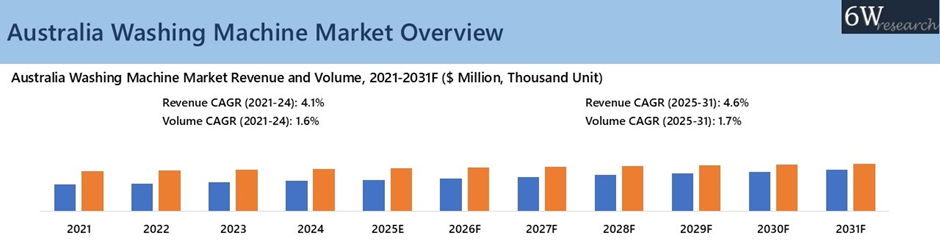
According to 6Wresearch, Australia Washing Machine Market is projected to grow at a revenue CAGR of 4.6% and volume CAGR 1.7% respectively during 2025-2031. Australia Washing Machine Market is expected to maintain positive momentum, supported by strong policy measures and ongoing urban expansion. The NSW Government’s Pre-Sale Finance Guarantee program, announced in the 2025/26 Budget, aims to ease financing constraints and facilitate the delivery of new homes annually through 2030-directly increasing installation demand for washers in newly built dwellings. Rapid urbanisation in major cities such as Sydney and Melbourne is also reshaping consumer needs, with compact living spaces driving preference for space-efficient, low-water, and energy-saving models.
In Greater Sydney, household numbers are projected to grow from 2021 to 2046, while Greater Melbourne is expected to expand from over the same period. This rising household base across high-density urban settings would continue to generate strong demand for modern washing machines. Collectively, these structural drivers position the Australian washing machine market for sustained growth through 2030, with both residential expansion and evolving consumer preferences reinforcing long-term demand.
Market Segmentation By Product Type
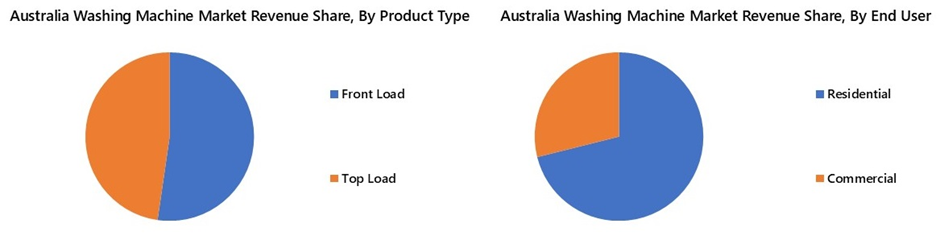
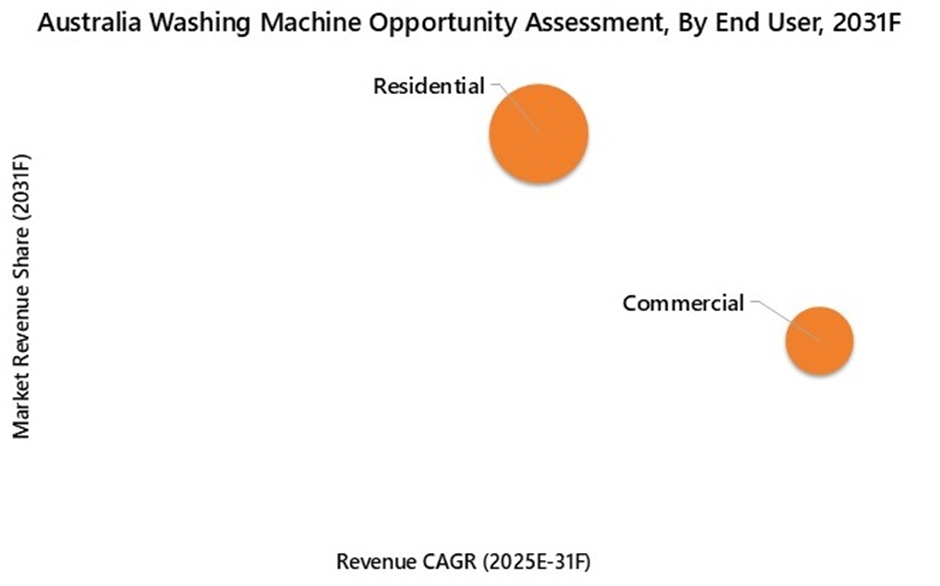
The commercial segment in Australia's washing machine market is expected to see the highest growth due to increasing demand from hotels, laundromats, and other service industries. Rising commercial laundry services, driven by the growth of the tourism and hospitality sectors, along with a focus on energy-efficient appliances, would propel this demand from 2025 to 2031.
Market Segmentation By Technology
Fully automatic washing machines are expected to see the highest growth from 2025–2031 due to increasing demand for convenience, energy efficiency, and smart features. As consumers prioritize ease of use and time-saving appliances, the adoption of fully automatic machines would rise, driven by technological advancements and growing awareness of energy-efficient options.
Market Segmentation By Capacity
The 8 kg and above washing machines are expected to see the highest growth rate from 2025-2031, driven by the rising trend of larger households and the need for more capacity to handle greater laundry loads. Additionally, urbanization, evolving consumer lifestyles, and growing preference for premium, durable appliances will further boost demand.
Market Segmentation By End User
The commercial segment in Australia's washing machine market is expected to see the highest growth due to increasing demand from hotels, laundromats, and other service industries. Rising commercial laundry services, driven by the growth of the tourism and hospitality sectors, along with a focus on energy-efficient appliances, would propel this demand from 2025 to 2031.
Key Attractiveness of the Report
- 10 Years Market Numbers.
- Historical Data Starting from 2021 to 2024
- Base Year: 2024
- Forecast Data until 2031
- Key Performance Indicators Impacting the Market.
- Major Upcoming Developments and Projects.
Key Highlights of the Report:
- Australia Washing Machine Market Overview
- Australia Washing Machine Market Outlook
- Australia Washing Machine Market Forecast
- Historical Data and Forecast of Australia Washing Machine Market Revenues for the Period 2021-2031F
- Historical Data and Forecast of Australia Washing Machine Market Volume, By Product Type, for the Period 2021-2031F
- Historical Data and Forecast of Australia Washing Machine Market Volume, By Technology, for the Period 2021-2031F
- Historical Data and Forecast of Australia Washing Machine Market Volume, By Capacity, for the Period 2021-2031F
- Historical Data and Forecast of Australia Washing Machine Market Volume, By End User, for the Period 2021-2031F
- Industry Life Cycle
- Porter’s Five Force Analysis
- Australia Washing Machine Market Drivers and Restraints
- Market Trends & Evolution
- Market Opportunity Assessment
- Australia Washing Machine Market Revenue Ranking, By Top 3 Companies
- Competitive Benchmarking
- Company Profiles
- Key Strategic Recommendations
Market Scope and Segmentation
The report provides a detailed analysis of the following market segments:
By Product Type
- Front Load
- Top Load
By Technology
- Fully Automatic
- Semi-Automatic
By Capacity
- Below 8kgs
- 8 kgs and Above
By End User
- Commercial
- Residential






































