Australia Waste Management Market Summary
The australia waste management market was estimated at USD 150 Million in 2025 and is projected to reach USD 176 Million by 2032, growing at a CAGR of 2.4% from 2026 to 2032.
Australia Waste Management Market Year-wise Growth Rate and Key Drivers
This graph highlights how the Australia Waste Management Market has steadily grown over the past five years, supported by major growth factors.
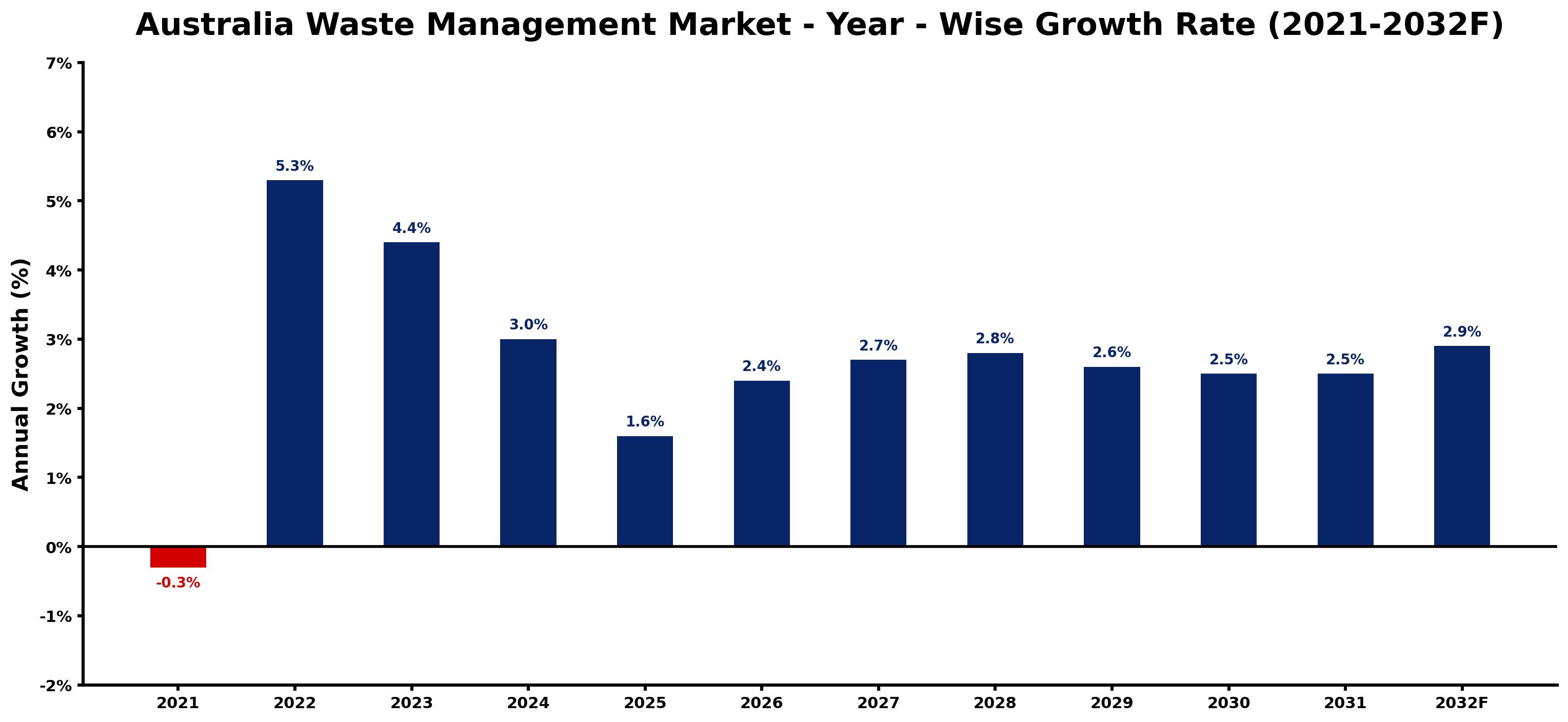
The table below presents the year wise growth rates along with the key drivers influencing the market
| Year | Growth Rate | Major Drivers |
| 2021 | -0.3% | Increased competition from informal waste disposal practices undermined established recycling service providers' market share. |
| 2022 | 5.3% | Public awareness campaigns highlighted the importance of recycling and waste reduction. |
| 2023 | 4.4% | Investment in waste-to-energy technologies gained traction among private sector stakeholders. |
| 2024 | 3.0% | Circular economy principles gained momentum, encouraging innovative waste processing methods. |
| 2025 | 1.6% | Corporate responsibility agendas increasingly prioritized sustainable waste management solutions. |
| 2026 | 2.4% | Urbanization rates led to greater demand for efficient waste collection services. |
| 2027 | 2.7% | Technological innovations streamlined recycling processes, improving operational efficiencies. |
| 2028 | 2.8% | Partnerships between government and private sectors fostered more comprehensive waste strategies. |
| 2029 | 2.6% | Public-private collaboration initiatives emerged, targeting landfill reduction and recycling rates. |
| 2030 | 2.5% | Investment in smart waste management systems increased, enhancing data-driven decision-making. |
| 2031 | 2.5% | Consumer demand for eco-friendly products influenced waste management practices significantly. |
| 2032 | 2.9% | Industry consolidation trends reshaped competitive landscapes, leading to enhanced service offerings. |
Note - Market size estimations and growth projections presented in this report are based on 6Wresearch's advanced forecasting approach, validated with industry datasets as of June 2026.
Australia Waste Management Market Synopsis
The Australia Waste Management Market is projected to reach 2.4% and witness significant growth during the forecast period (2026-2032). This growth is driven by increasing awareness regarding environmental protection, government initiatives aimed at enhancing recycling and waste reuse practices, and a surge in research and development investments targeted at innovative waste management technologies. Additionally, stringent environmental regulations surrounding hazardous waste disposal and treatment further bolster the expansion of this sector.
Australia Waste Management Market Growth Drivers
The Australia Waste Management Market is experiencing several key growth drivers that are shaping its landscape. Among these drivers are:
- Heightened public awareness: The growing consciousness regarding environmental issues, such as pollution and resource depletion, has led to increased demand for sustainable waste management solutions. Citizens are increasingly advocating for policies oriented towards better waste practices.
- Government regulations: Regulatory frameworks like the Waste Avoidance and Resource Recovery Act 2001 (WARR) are instrumental in guiding efficient waste management. These guidelines mandate responsible waste disposal, subsequently elevating the standard of waste management practices across the country.
- Investment in advanced technologies: The rise in research and development efforts has resulted in the emergence of advanced waste management technologies, such as smart landfills and automated recycling facilities, enhancing efficiency and effectiveness in waste handling.
- Urbanization trends: Australia's rapid urban development contributes to increased residential construction activities, leading to higher generation of solid waste. The need for effective waste management systems to tackle this issue becomes more pronounced as urban areas expand.
- Circular economy initiatives: The push towards a circular economy is creating significant opportunities for sustainable practices, promoting waste minimization and encouraging businesses to adopt recycling-focused models.
Australia Waste Management Market Government Investment and Initiatives
Government investment and initiatives play a critical role in shaping the growth trajectory of the Australia Waste Management Market. Key initiatives include:
- Expansion of recycling programs: The Australian government has allocated funding to enhance recycling capabilities across various sectors, aiming to reduce landfill dependency through improved collection and processing facilities.
- Public awareness campaigns: Various public campaigns, including "Clean Up Australia Day," encourage community engagement in waste reduction efforts and promote sustainable waste disposal practices.
- Investment in infrastructure: Ongoing investments in waste management infrastructure aim to upgrade existing facilities and develop new waste processing plants, thus improving overall waste handling efficiency.
- Research funding: The Australian government is backing research initiatives focused on innovative waste management technologies, such as composting solutions and waste-to-energy projects, supporting the transition towards more sustainable systems.
- Support for businesses: Programs like the Waste Levy Program incentivize businesses to adopt sustainable waste management practices, thereby fostering an environment conducive to innovation and efficiency.
Australia Waste Management Market Latest Developments (May 2025 - June 2026)
In the period from May 2025 to June 2026, the Australia Waste Management Market has witnessed several notable developments, reflecting the ongoing transformation of the sector. These developments include:
- Increased collaboration between government and private sectors to enhance waste management efficiency and sustainability measures, aligning with national waste reduction goals.
- The introduction of advanced waste sorting technologies stands out, significantly improving recycling rates and reducing contamination in recyclable materials.
- Emerging trends in smart waste management solutions leveraging IoT platforms for better data management, enabling real-time monitoring and optimized waste collection processes.
- Expansion of public and private partnerships investing in infrastructure development projects, including state-of-the-art recycling facilities capable of handling diverse waste streams.
- A noticeable uptick in community engagement initiatives aimed at fostering sustainable waste management practices, reflecting a shared commitment between residents and local governments.
Australia Waste Management Market - Key Attractiveness of the Report
- 10 Years of Market Numbers
- Historical Data Starting from 2022 to 2025
- Base Year: 2025
- Forecast Data until 2032
- Key Performance Indicators Impacting the Market
- Major Upcoming Developments and Projects
Key Highlights of the Report:
- Australia Waste Management Market Outlook
- Market Size of Australia Waste Management Market, 2025
- Forecast of Australia Waste Management Market, 2032F
- Historical Data and Forecast of Australia Waste Management Revenues & Volume for the Period 2022-2032F
- Australia Waste Management Market Trend Evolution
- Australia Waste Management Market Drivers and Challenges
- Australia Waste Management Price Trends
- Australia Waste Management Porter's Five Forces
- Australia Waste Management Industry Life Cycle
- Historical Data and Forecast of Australia Waste Management Market Revenues & Volume By Types for the Period 2022-2032F
- Historical Data and Forecast of Australia Waste Management Market Revenues & Volume By Municipal Waste for the Period 2022-2032F
- Historical Data and Forecast of Australia Waste Management Market Revenues & Volume By Industrial Waste for the Period 2022-2032F
- Historical Data and Forecast of Australia Waste Management Market Revenues & Volume By Hazardous Waste for the Period 2022-2032F
- Historical Data and Forecast of Australia Waste Management Market Revenues & Volume By Services? for the Period 2022-2032F
- Historical Data and Forecast of Australia Waste Management Market Revenues & Volume By Collection Service for the Period 2022-2032F
- Historical Data and Forecast of Australia Waste Management Market Revenues & Volume By Collection & transportation for the Period 2022-2032F
- Historical Data and Forecast of Australia Waste Management Market Revenues & Volume By Storage & handling for the Period 2022-2032F
- Historical Data and Forecast of Australia Waste Management Market Revenues & Volume By Sorting for the Period 2022-2032F
- Historical Data and Forecast of Australia Waste Management Market Revenues & Volume By Disposable Service for the Period 2022-2032F
- Historical Data and Forecast of Australia Waste Management Market Revenues & Volume By Landfills for the Period 2022-2032F
- Historical Data and Forecast of Australia Waste Management Market Revenues & Volume By Recycling for the Period 2022-2032F
- Historical Data and Forecast of Australia Waste Management Market Revenues & Volume By Compositing & anaerobic digestion for the Period 2022-2032F
- Australia Waste Management Import Export Trade Statistics
- Market Opportunity Assessment By Types
- Market Opportunity Assessment By Services?
- Australia Waste Management Top Companies Market Share
- Australia Waste Management Competitive Benchmarking By Technical and Operational Parameters
- Australia Waste Management Company Profiles
- Australia Waste Management Key Strategic Recommendations






































