Australia Welding Equipment, Accessories & Consumables Market Size, Share & Growth Rate
The Australia Welding Equipment, Accessories & Consumables Market was estimated at USD 173 Million in 2025 and is projected to reach USD 203 Million by 2032, growing at a CAGR of 2.3% from 2026 to 2032. This growth trajectory is largely attributed to the rising demand for high-quality accessories that enhance operational efficiency and safety in various industries, including manufacturing and construction. Furthermore, the ongoing shift towards advanced welding technologies and the necessity for regular maintenance and replacement of consumables are significantly propelling market expansion.
Australia Welding Equipment, Accessories & Consumables Market Year-wise Growth Rate and Key Drivers
This graph highlights how the Australia Welding Equipment, Accessories & Consumables Market has steadily grown over the years, supported by major growth factors.
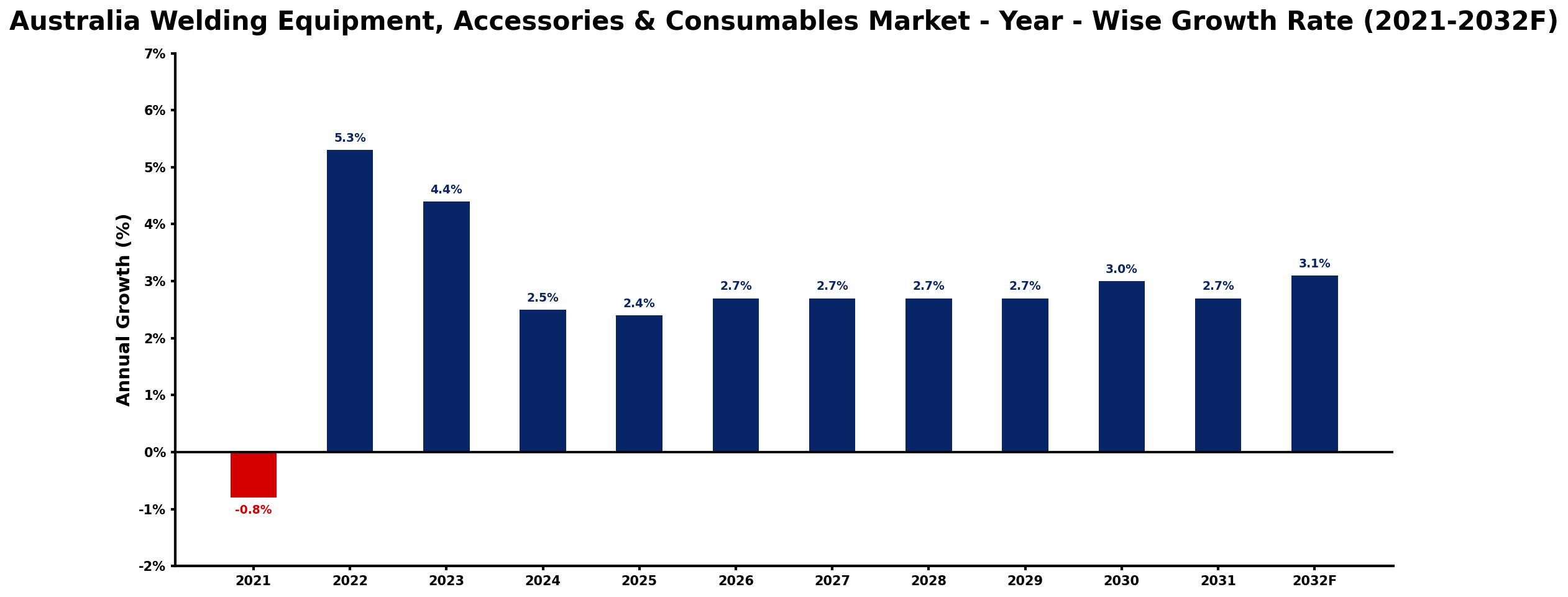
The table below presents the year‑wise growth rates along with the key drivers influencing the market
| Year | Growth Rate | Major Drivers |
| 2021 | -0.8% | Decreased industrial construction activity |
| 2022 | 5.3% | Rising demand from manufacturing sector |
| 2023 | 4.4% | Increased investments in infrastructure |
| 2024 | 2.5% | Growth in renewable energy projects |
| 2025 | 2.4% | Expansion of automotive production capacity |
| 2026 | 2.7% | Surge in residential construction projects |
| 2027 | 2.7% | expanding industrial usage applications |
| 2028 | 2.7% | expanding healthcare application demand |
| 2029 | 2.7% | Increased exports of manufactured goods |
| 2030 | 3.0% | stronger distribution network expansion |
| 2031 | 2.7% | rising infrastructure development spending |
| 2032 | 3.1% | Increased focus on automation technologies |
Note: Market size estimations and growth projections presented in this report are based on 6Wresearch's proprietary forecasting methodology, utilizing the latest available industry data, government publications, and primary research inputs.
Australia Welding Equipment, Accessories & Consumables Market Synopsis
In Australia, the welding equipment accessories and consumables market is experiencing an evolution driven by technological advancements and increased safety regulations. A growing emphasis on ergonomic designs and durability in welding products is reshaping consumer expectations and industry standards.
This market is also witnessing a surge in automation and precision welding processes, which require compatible accessories and consumables. As industries prioritize equipment reliability and operational efficiency, the demand for high-quality welding tools and supplies continues to expand, signaling strong growth potential in the upcoming years.
- The market is projected to grow from USD 173 Million in 2025 to USD 203 Million by 2032.
- Technological advancements and increased focus on safety are reshaping product offerings in this sector.
- Regular maintenance and demand for high-quality consumables are critical growth drivers.
- Product compatibility and integration challenges remain significant hurdles for suppliers.
- Government policies are actively promoting innovation and sustainability within the industry.
Despite the favorable growth environment, several restraints limit market potential. Rapid technological advancements necessitate ongoing research and development, which can be a costly venture for manufacturers. Moreover, the need for product compatibility across diverse welding equipment brands creates additional pressure on companies striving for seamless integration. Supply chain disruptions, often exacerbated by fluctuating raw material prices, present another layer of complexity, demanding agile strategies to navigate this dynamic landscape.
A notable trend shaping the Australia Welding Equipment, Accessories & Consumables Market is the shift towards automation and robotics in welding processes. This trend is encouraging the development of highly specialized accessories that enhance precision and reduce downtime. Additionally, there is an increasing focus on environmental sustainability, prompting manufacturers to develop eco-friendly consumables and recyclable materials.
Moreover, the demand for ergonomic designs is rising, driven by a workforce increasingly concerned about safety and comfort in the workplace. As industries evolve, the integration of smart technologies into welding equipment is also gaining traction, providing real-time feedback to operators and streamlining the workflow.
The market presents genuine growth opportunities in several areas. The burgeoning infrastructure projects and manufacturing sectors in Australia are creating a heightened demand for advanced welding technologies and high-quality consumables. Moreover, the shift towards sustainable and eco-friendly products opens avenues for manufacturers to differentiate their offerings and cater to a more environmentally conscious consumer base. Collaboration and partnerships with local industries can also enhance market penetration and foster innovation.
The Australian government has implemented several initiatives to bolster the welding equipment accessories and consumables market. Policies aimed at promoting innovation are key, as they provide funding and support for research and development projects. Additionally, regulatory frameworks ensure product safety and quality, benefiting both manufacturers and consumers. Programs encouraging the adoption of advanced welding technologies and export incentives further enhance market competitiveness and encourage industry growth.
Looking ahead to 2026-2032, the Australia Welding Equipment, Accessories & Consumables Market is poised for sustained growth. As industries continue to embrace automation and advanced manufacturing techniques, the demand for innovative welding products will rise. The emphasis on safety and efficiency will further drive the need for high-quality accessories and consumables. This combination of trends positions the market for positive momentum, with significant opportunities for manufacturers who can adapt to evolving consumer needs and technological advancements.
Recent industry developments indicate a growing focus on integrating smart technologies within welding equipment, allowing for enhanced precision and efficiency. Manufacturers are also responding to increasing regulatory demands for sustainability by exploring eco-friendly materials for consumables. Moreover, partnerships between technology providers and manufacturers are expected to foster innovation, ultimately shaping the market's future trajectory.
- 10 Years of Market Numbers
- Historical Data Starting from 2022 to 2025
- Base Year: 2025
- Forecast Data until 2032
- Key Performance Indicators Impacting the Market
- Major Upcoming Developments and Projects
Key Highlights of the Report:
- Australia Welding Equipment, Accessories & Consumables Market Outlook
- Market Size of Australia Welding Equipment, Accessories & Consumables Market, 2025
- Forecast of Australia Welding Equipment, Accessories & Consumables Market, 2032
- Historical Data and Forecast of Australia Welding Equipment, Accessories & Consumables Revenues & Volume for the Period 2022-2032F
- Australia Welding Equipment, Accessories & Consumables Market Trend Evolution
- Australia Welding Equipment, Accessories & Consumables Market Drivers and Challenges
- Australia Welding Equipment, Accessories & Consumables Price Trends
- Australia Welding Equipment, Accessories & Consumables Porter's Five Forces
- Australia Welding Equipment, Accessories & Consumables Industry Life Cycle
- Historical Data and Forecast of Australia Welding Equipment, Accessories & Consumables Market Revenues & Volume By Equipment for the Period 2022-2032F
- Historical Data and Forecast of Australia Welding Equipment, Accessories & Consumables Market Revenues & Volume By Electrodes & Filler Metal Equipment for the Period 2022-2032F
- Historical Data and Forecast of Australia Welding Equipment, Accessories & Consumables Market Revenues & Volume By Oxy-fuel Gas Equipment for the Period 2022-2032F
- Historical Data and Forecast of Australia Welding Equipment, Accessories & Consumables Market Revenues & Volume By Other Equipment for the Period 2022-2032F
- Historical Data and Forecast of Australia Welding Equipment, Accessories & Consumables Market Revenues & Volume By Based on the Accessory for the Period 2022-2032F
- Historical Data and Forecast of Australia Welding Equipment, Accessories & Consumables Market Revenues & Volume By Protective Gear for the Period 2022-2032F
- Historical Data and Forecast of Australia Welding Equipment, Accessories & Consumables Market Revenues & Volume By Gas Manifolds for the Period 2022-2032F
- Historical Data and Forecast of Australia Welding Equipment, Accessories & Consumables Market Revenues & Volume By Flow Controllers for the Period 2022-2032F
- Historical Data and Forecast of Australia Electrodes & Filler Metal Equipment Welding Equipment, Accessories & Consumables Market Revenues & Volume By Gas Panels for the Period 2022-2032F
- Historical Data and Forecast of Australia Welding Equipment, Accessories & Consumables Market Revenues & Volume By Consumable for the Period 2022-2032F
- Historical Data and Forecast of Australia Welding Equipment, Accessories & Consumables Market Revenues & Volume By Electrodes & Filler Materials for the Period 2022-2032F
- Historical Data and Forecast of Australia Welding Equipment, Accessories & Consumables Market Revenues & Volume By Gases for the Period 2022-2032F
- Historical Data and Forecast of Australia Welding Equipment, Accessories & Consumables Market Revenues & Volume By Fluxes & Wires for the Period 2022-2032F
- Historical Data and Forecast of Australia Welding Equipment, Accessories & Consumables Market Revenues & Volume By Technology for the Period 2022-2032F
- Historical Data and Forecast of Australia Welding Equipment, Accessories & Consumables Market Revenues & Volume By Arc Welding for the Period 2022-2032F
- Historical Data and Forecast of Australia Welding Equipment, Accessories & Consumables Market Revenues & Volume By Oxy-fuel Welding for the Period 2022-2032F
- Historical Data and Forecast of Australia Welding Equipment, Accessories & Consumables Market Revenues & Volume By Others for the Period 2022-2032F
- Historical Data and Forecast of Australia Welding Equipment, Accessories & Consumables Market Revenues & Volume By End-Use Industry for the Period 2022-2032F
- Historical Data and Forecast of Australia Welding Equipment, Accessories & Consumables Market Revenues & Volume By General Fabrication for the Period 2022-2032F
- Historical Data and Forecast of Australia Welding Equipment, Accessories & Consumables Market Revenues & Volume By Power Generation for the Period 2022-2032F
- Historical Data and Forecast of Australia Welding Equipment, Accessories & Consumables Market Revenues & Volume By Automotive for the Period 2022-2032F
- Historical Data and Forecast of Australia Welding Equipment, Accessories & Consumables Market Revenues & Volume By Construction & Infrastructure for the Period 2022-2032F
- Historical Data and Forecast of Australia Welding Equipment, Accessories & Consumables Market Revenues & Volume By Heavy Fabrication for the Period 2022-2032F
- Historical Data and Forecast of Australia Welding Equipment, Accessories & Consumables Market Revenues & Volume By Shipbuilding for the Period 2022-2032F
- Historical Data and Forecast of Australia Welding Equipment, Accessories & Consumables Market Revenues & Volume By Maintenance & Repair for the Period 2022-2032F
- Historical Data and Forecast of Australia Welding Equipment, Accessories & Consumables Market Revenues & Volume By Offshore for the Period 2022-2032F
- Australia Welding Equipment, Accessories & Consumables Import Export Trade Statistics
- Market Opportunity Assessment By Equipment
- Market Opportunity Assessment By Consumable
- Market Opportunity Assessment By Technology
- Market Opportunity Assessment By End-Use Industry
- Australia Welding Equipment, Accessories & Consumables Top Companies Market Share
- Australia Welding Equipment, Accessories & Consumables Competitive Benchmarking By Technical and Operational Parameters
- Australia Welding Equipment, Accessories & Consumables Company Profiles
- Australia Welding Equipment, Accessories & Consumables Key Strategic Recommendations






































