Australia Wood Processing Market Size, Share & Growth Rate
The Australia Wood Processing Market was estimated at USD 96 Million in 2025 and is projected to reach USD 113 Million by 2032, growing at a CAGR of 2.4% from 2026 to 2032. This growth trajectory is largely fueled by the robust demand from the furniture and construction sectors, which continue to seek sustainable and innovative wood products. Additionally, the increasing shift towards value-added products, like engineered wood, underscores the industry's adaptability and resilience in a competitive landscape.
Australia Wood Processing Market Year-wise Growth Rate and Key Drivers
This graph highlights how the Australia Wood Processing Market has steadily grown over the years, supported by major growth factors.
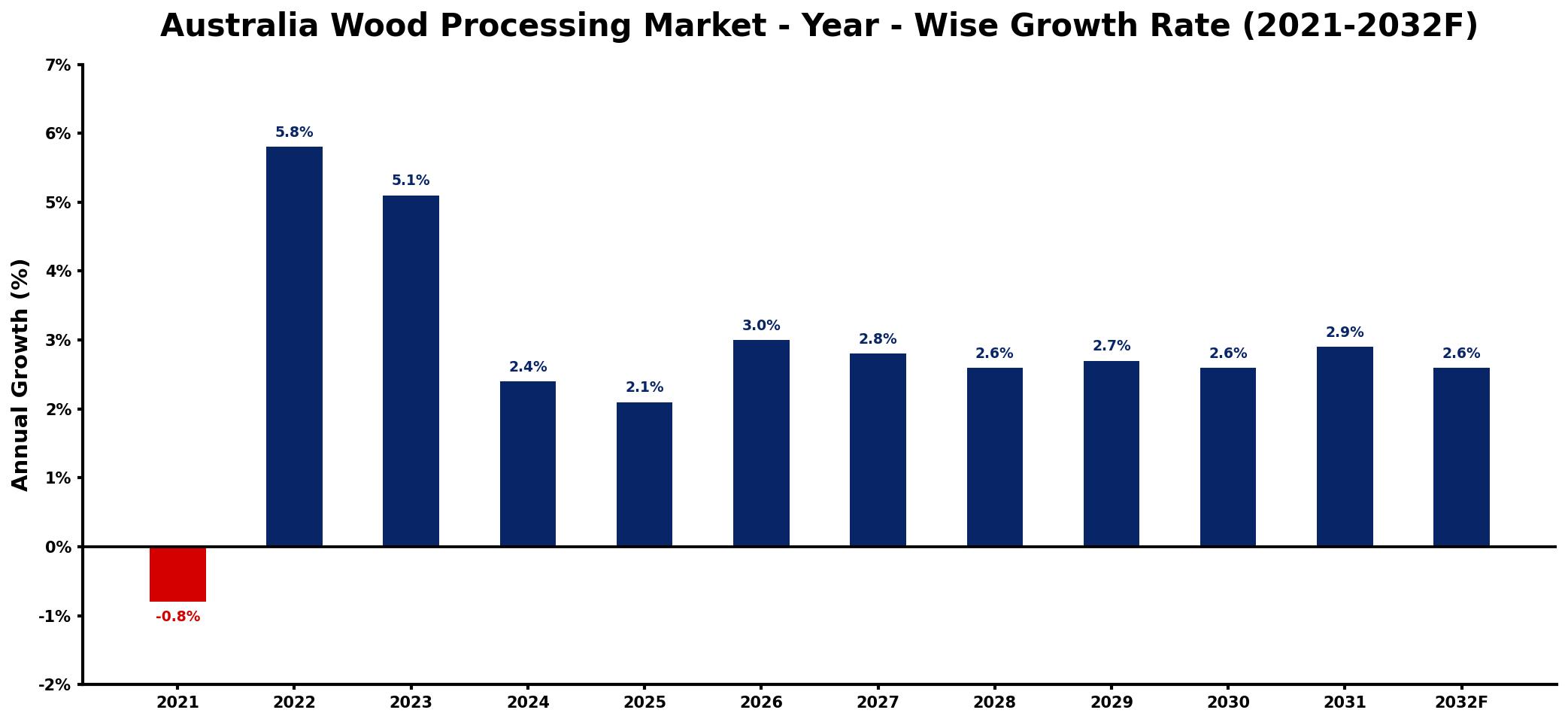
The table below presents the year‑wise growth rates along with the key drivers influencing the market
| Year | Growth Rate | Major Drivers |
| 2021 | -0.8% | decreased construction activity levels |
| 2022 | 5.8% | surge in residential building projects |
| 2023 | 5.1% | expansion of export markets |
| 2024 | 2.4% | growth in green building materials |
| 2025 | 2.1% | increased investment in technology |
| 2026 | 3.0% | rising demand for furniture exports |
| 2027 | 2.8% | enhanced sustainable sourcing practices |
| 2028 | 2.6% | growing popularity of DIY projects |
| 2029 | 2.7% | increased urbanization trends observed |
| 2030 | 2.6% | strengthening underlying market demand |
| 2031 | 2.9% | greater focus on eco-friendly designs |
| 2032 | 2.6% | rising consumer interest in craftsmanship |
Note: Market size estimations and growth projections presented in this report are based on 6Wresearch's proprietary forecasting methodology, utilizing the latest available industry data, government publications, and primary research inputs.
Australia Wood Processing Market Synopsis
Australia's wood processing market is uniquely positioned due to its vast forest resources, which serve as a sustainable foundation for various wood products. This abundant supply caters to the growing needs of diverse industries, including furniture, construction, and packaging, thereby bolstering the sector's economic contribution.
Furthermore, the market is characterized by innovative processing technologies, which enhance efficiency and output quality. The integration of automation and robotics in wood processing facilities highlights a commitment to meeting the evolving demands of environmentally conscious consumers and businesses alike.
Australia Wood Processing Market Key Takeaways
- The market showcases consistent growth, driven by increasing demand from the furniture and construction sectors.
- Technological innovations are enhancing production efficiency and product quality across the industry.
- Sustainable practices are becoming integral, influencing both production methods and consumer preferences.
- The rise of value-added products, such as engineered wood, signals a shift toward modernization in processing techniques.
- Government policies actively support innovation and sustainability within the wood processing market.
Evaluation of Restraints in Australia Wood Processing Market
Despite the positive outlook, several restraints hinder market performance. Rising energy costs pose a significant challenge for wood processing facilities, impacting operational expenses and profitability. Labor shortages also plague the sector, making it difficult for companies to find skilled workers capable of operating advanced machinery. Additionally, increased competition from imported processed wood products can pressure local producers to maintain competitiveness in pricing and quality. Fluctuations in timber supply, exacerbated by environmental factors such as wildfires and climate change, create unpredictability in production capabilities.
Australia Wood Processing Market Trends
Emerging trends in the Australia wood processing market point toward a clear shift towards sustainability and eco-friendly practices. Companies are increasingly investing in sustainable forestry methods to align with consumer demand for greener products. Furthermore, the adoption of digital technologies, including advanced software for supply chain management, is becoming commonplace, streamlining operations and improving overall efficiency. These trends suggest that the industry is not only adapting to current demands but is also proactively shaping its future.
Australia Wood Processing Market Opportunities
The Australia wood processing market presents numerous growth opportunities, particularly in the area of value-added products. As consumer preferences evolve, there is a notable uptick in the demand for engineered wood and prefabricated components, which are not only sustainable but also align with contemporary construction practices. Additionally, investments in modern processing facilities offer a pathway to increase production capacity and improve product offerings, thereby enhancing competitiveness. Market players can capitalize on these opportunities by diversifying their product lines and embracing innovative technologies.
Government Initiatives in the Australia Wood Processing Market
The Australian government plays a pivotal role in supporting the wood processing sector through various initiatives aimed at promoting sustainability and innovation. This includes research grants focused on developing new technologies and processes that enhance productivity while ensuring the ecological integrity of forest ecosystems. Additionally, government partnerships with industry stakeholders aim to facilitate knowledge sharing and best practices, further strengthening the market's foundations and boosting its growth potential.
Future Insights of the Australia Wood Processing Market
Looking ahead to 2026-2032, the Australia wood processing market is poised for strategic growth driven by technological advancements and a commitment to sustainability. The trend toward value-added products will likely accelerate, with increased investments in automation and digital solutions shaping the operational landscape. Moreover, the sector's adaptability to environmental challenges will become increasingly critical, as stakeholders work to mitigate risks associated with timber supply fluctuations while responding to consumer preferences for sustainable options.
Australia Wood Processing Market Latest Developments (2025 - 2026)
In recent months, the Australia wood processing market has seen a notable emphasis on sustainable practices, with several industry players announcing initiatives aimed at reducing their carbon footprints. Companies are increasingly adopting advanced technologies to improve production efficiency while reducing waste. Additionally, collaborative projects between government and industry to promote innovation in wood processing are gaining traction, setting the stage for transformative changes in the sector.
Australia Wood Processing Market - Key Attractiveness of the Report
- 10 Years of Market Numbers
- Historical Data Starting from 2022 to 2025
- Base Year: 2025
- Forecast Data until 2032
- Key Performance Indicators Impacting the Market
- Major Upcoming Developments and Projects
Key Highlights of the Report:
- Australia Wood Processing Market Outlook
- Market Size of Australia Wood Processing Market, 2025
- Forecast of Australia Wood Processing Market, 2032
- Historical Data and Forecast of Australia Wood Processing Revenues & Volume for the Period 2022-2032F
- Australia Wood Processing Market Trend Evolution
- Australia Wood Processing Market Drivers and Challenges
- Australia Wood Processing Price Trends
- Australia Wood Processing Porter's Five Forces
- Australia Wood Processing Industry Life Cycle
- Historical Data and Forecast of Australia Wood Processing Market Revenues & Volume By Type for the Period 2022-2032F
- Historical Data and Forecast of Australia Wood Processing Market Revenues & Volume By Wood Chips for the Period 2022-2032F
- Historical Data and Forecast of Australia Wood Processing Market Revenues & Volume By Sawn Wood Lumber for the Period 2022-2032F
- Historical Data and Forecast of Australia Wood Processing Market Revenues & Volume By Others for the Period 2022-2032F
- Australia Wood Processing Import Export Trade Statistics
- Market Opportunity Assessment By Type
- Australia Wood Processing Top Companies Market Share
- Australia Wood Processing Competitive Benchmarking By Technical and Operational Parameters
- Australia Wood Processing Company Profiles
- Australia Wood Processing Key Strategic Recommendations






































