Australia Wooden Packaging Market Size, Share & Growth Rate
The Australia Wooden Packaging Market was estimated at USD 83 Million in 2025 and is projected to reach USD 97 Million by 2032, growing at a CAGR of 2.3% from 2026 to 2032. This growth trajectory is largely fueled by an increasing demand for sustainable packaging solutions, as businesses across sectors like food and beverage and cosmetics prioritize eco-friendly alternatives. The strength and durability of wooden packaging also enhance its appeal, allowing companies to align their branding with a commitment to sustainability.
Australia Wooden Packaging Market Year-wise Growth Rate and Key Drivers
This graph highlights how the Australia Wooden Packaging Market has steadily grown over the years, supported by major growth factors.
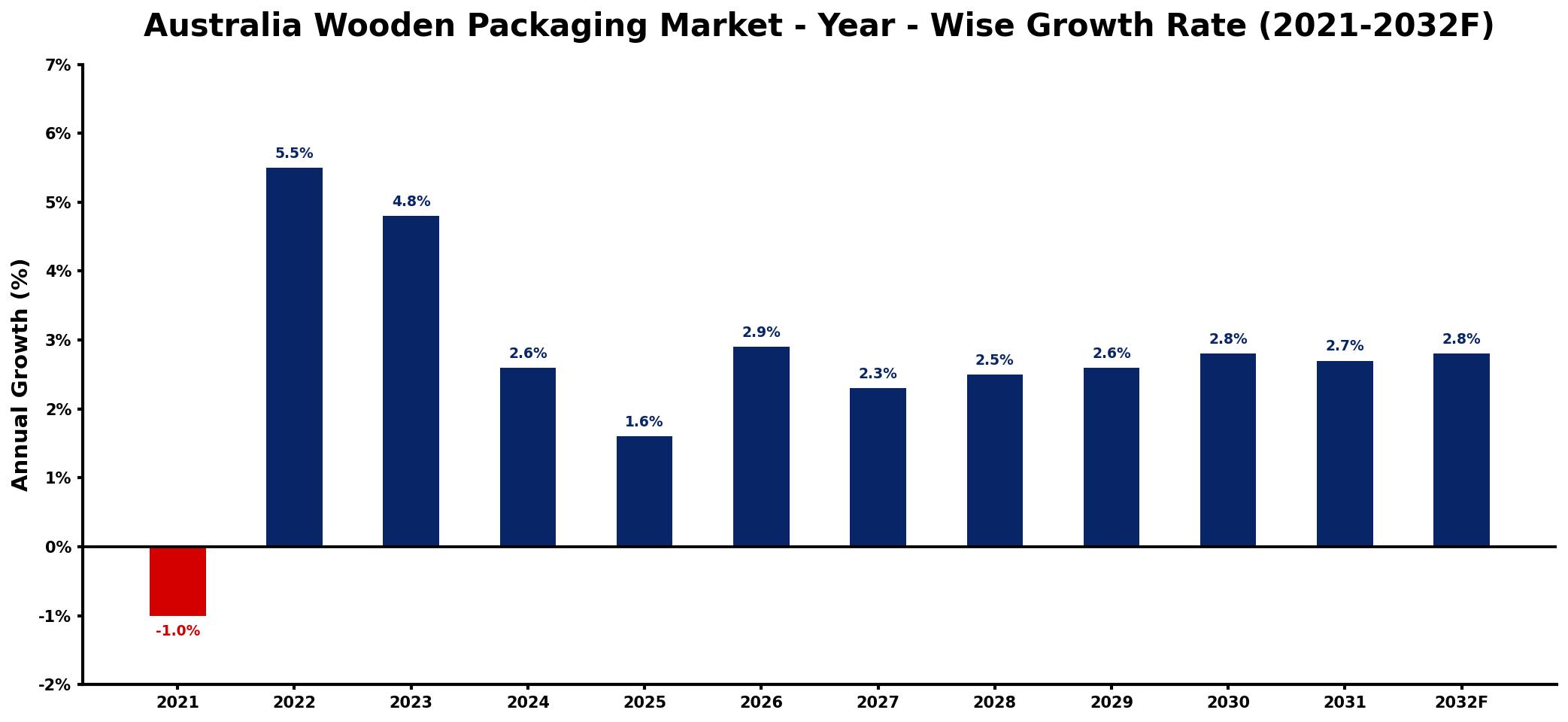
The table below presents the year‑wise growth rates along with the key drivers influencing the market
| Year | Growth Rate | Major Drivers |
| 2021 | -1.0% | decrease in consumer spending habits |
| 2022 | 5.5% | rise in sustainable material adoption |
| 2023 | 4.8% | growth in e-commerce shipping demands |
| 2024 | 2.6% | increased investment in logistics innovation |
| 2025 | 1.6% | expansion of export markets opportunities |
| 2026 | 2.9% | surge in demand from agriculture |
| 2027 | 2.3% | enhanced regulations for environmental standards |
| 2028 | 2.5% | growing popularity of artisanal goods |
| 2029 | 2.6% | strengthening of local manufacturing initiatives |
| 2030 | 2.8% | development of smart supply chains |
| 2031 | 2.7% | increased focus on product safety |
| 2032 | 2.8% | rising trends in home deliveries |
Note: Market size estimations and growth projections presented in this report are based on 6Wresearch's proprietary forecasting methodology, utilizing the latest available industry data, government publications, and primary research inputs.
Australia Wooden Packaging Market Synopsis
The Australian wooden packaging market is characterized by a rising preference for biodegradable and recyclable materials, reflecting a significant shift in consumer behavior. This trend is particularly pronounced in the food and beverage sector, where aesthetically pleasing and sturdy wooden crates are increasingly utilized for product presentation.
Furthermore, the market thrives on the versatility of wooden packaging solutions, ranging from functional pallets to decorative boxes. The adaptability of wooden materials not only enhances their usability across various industries but also elevates brand perception, thus driving demand further.
Australia Wooden Packaging Market Key Takeaways
- Growing consumer preference for sustainable and biodegradable packaging is reshaping industry dynamics.
- The aesthetic appeal of wooden packaging bolsters brand image, particularly in luxury and cosmetic sectors.
- Strict regulatory frameworks are in place to ensure responsible sourcing and treatment of timber.
- Investment in innovative recycling technologies is expected to enhance the market's sustainability footprint.
- Opportunities abound for companies leveraging eco-friendly practices and materials.
Evaluation of Restraints in Australia Wooden Packaging Market
Despite its numerous advantages, the Australia wooden packaging market faces constraints primarily related to regulatory compliance and environmental concerns. Stringent regulations regarding the treatment of timber are essential to mitigate the risk of pest and disease spread, which can complicate production and distribution processes. Additionally, the industry's image could be jeopardized by perceptions related to deforestation, urging companies to substantiate their sustainability claims with transparent practices and a commitment to responsible sourcing.
Australia Wooden Packaging Market Trends
A significant trend emerging in the Australia wooden packaging market is the incorporation of digital branding elements in packaging designs. As consumers increasingly engage with brands through online platforms, wooden packaging featuring unique designs and branding is gaining traction. Furthermore, advancements in wood treatment technologies are enhancing durability while reducing environmental impact, pushing the boundaries of traditional wooden packaging applications.
Additionally, the shift towards minimalist design aesthetics in various industries is prompting manufacturers to innovate their packaging solutions. This trend not only emphasizes the natural beauty of wood but also aligns with broader movements toward sustainable and simple living.
Australia Wooden Packaging Market Opportunities
Investment opportunities in the Australia wooden packaging market are ripe for those willing to innovate. Companies focusing on the development of advanced recycling processes and sustainable sourcing methods are poised for success. Furthermore, niche markets such as customized wooden packaging for artisanal products represent a growing segment, as consumers seek unique offerings that align with their values of sustainability and quality.
Government Initiatives in the Australia Wooden Packaging Market
The Australian government is actively involved in shaping policies to ensure the sustainability of the wooden packaging industry. Key initiatives include regulations on timber treatment processes aimed at preventing pest and disease transmission. Additionally, there are incentives encouraging the use of recycled or sustainably sourced wood, enhancing the attractiveness of wooden packaging as a viable alternative within various industries. These initiatives are crucial in promoting a circular economy while also addressing environmental concerns.
Future Insights of the Australia Wooden Packaging Market
Looking ahead to 2026-2032, the Australia wooden packaging market is expected to continue its growth trajectory, driven by increasing consumer awareness of sustainability and ecological responsibility. The shift towards more sustainable packaging solutions is anticipated to bolster demand across sectors, particularly as businesses enhance their branding strategies around eco-friendly practices. Moreover, innovations in product design and material use are likely to play a critical role in shaping future market dynamics.
Australia Wooden Packaging Market Latest Developments (2025 - 2026)
Recent developments in the Australia wooden packaging market have highlighted a growing focus on sustainable practices and innovative materials. Companies are increasingly adopting advanced treatment technologies that enhance wood durability while minimizing environmental impacts. Additionally, the trend towards customizable designs has gained momentum, particularly among small businesses seeking to differentiate their products in competitive markets. This shift towards personalization is expected to drive further growth in the sector.
Australia Wooden Packaging Market - Key Attractiveness of the Report
- 10 Years of Market Numbers
- Historical Data Starting from 2022 to 2025
- Base Year: 2025
- Forecast Data until 2032
- Key Performance Indicators Impacting the Market
- Major Upcoming Developments and Projects
Key Highlights of the Report:
- Australia Wooden Packaging Market Outlook
- Market Size of Australia Wooden Packaging Market, 2025
- Forecast of Australia Wooden Packaging Market, 2032
- Historical Data and Forecast of Australia Wooden Packaging Revenues & Volume for the Period 2022-2032F
- Australia Wooden Packaging Market Trend Evolution
- Australia Wooden Packaging Market Drivers and Challenges
- Australia Wooden Packaging Price Trends
- Australia Wooden Packaging Porter's Five Forces
- Australia Wooden Packaging Industry Life Cycle
- Historical Data and Forecast of Australia Wooden Packaging Market Revenues & Volume By Type for the Period 2022-2032F
- Historical Data and Forecast of Australia Wooden Packaging Market Revenues & Volume By Pallets for the Period 2022-2032F
- Historical Data and Forecast of Australia Wooden Packaging Market Revenues & Volume By Boxes and Bins for the Period 2022-2032F
- Historical Data and Forecast of Australia Wooden Packaging Market Revenues & Volume By Crates and Cases for the Period 2022-2032F
- Historical Data and Forecast of Australia Wooden Packaging Market Revenues & Volume By Spools for the Period 2022-2032F
- Historical Data and Forecast of Australia Wooden Packaging Market Revenues & Volume By Dunnage for the Period 2022-2032F
- Historical Data and Forecast of Australia Wooden Packaging Market Revenues & Volume By Others for the Period 2022-2032F
- Historical Data and Forecast of Australia Wooden Packaging Market Revenues & Volume By Application for the Period 2022-2032F
- Historical Data and Forecast of Australia Wooden Packaging Market Revenues & Volume By Food & Beverages Storage for the Period 2022-2032F
- Historical Data and Forecast of Australia Wooden Packaging Market Revenues & Volume By Transportation for the Period 2022-2032F
- Historical Data and Forecast of Australia Wooden Packaging Market Revenues & Volume By Industrial for the Period 2022-2032F
- Historical Data and Forecast of Australia Wooden Packaging Market Revenues & Volume By Shipping for the Period 2022-2032F
- Historical Data and Forecast of Australia Wooden Packaging Market Revenues & Volume By Others for the Period 2022-2032F
- Australia Wooden Packaging Import Export Trade Statistics
- Market Opportunity Assessment By Type
- Market Opportunity Assessment By Application
- Australia Wooden Packaging Top Companies Market Share
- Australia Wooden Packaging Competitive Benchmarking By Technical and Operational Parameters
- Australia Wooden Packaging Company Profiles
- Australia Wooden Packaging Key Strategic Recommendations






































