Australia Wooden Toys Market Size, Share & Growth Rate
The Australia Wooden Toys Market was estimated at USD 102 Million in 2025 and is projected to reach USD 119 Million by 2032, growing at a CAGR of 2.2% from 2026 to 2032. This growth trajectory is underpinned by a notable increase in parental demand for sustainable and safe toys. As more families prioritize eco-friendly products, the appeal of wooden toys as durable, non-toxic alternatives to plastic continues to gain momentum across the nation.
Australia Wooden Toys Market Year-wise Growth Rate and Key Drivers
This graph highlights how the Australia Wooden Toys Market has steadily grown over the years, supported by major growth factors.
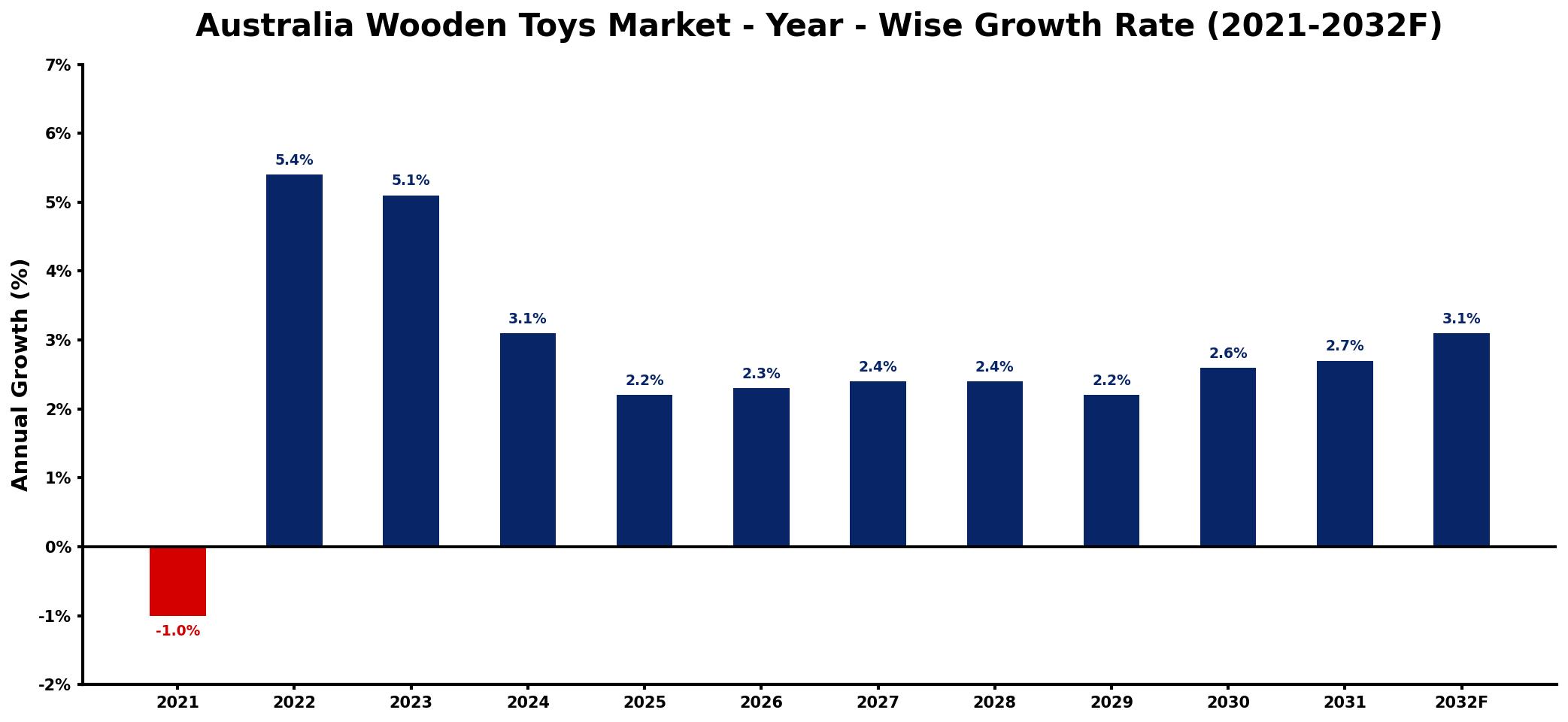
The table below presents the year‑wise growth rates along with the key drivers influencing the market
| Year | Growth Rate | Major Drivers |
| 2021 | -1.0% | decrease in consumer spending habits |
| 2022 | 5.4% | rise in eco-conscious consumerism |
| 2023 | 5.1% | increased interest in sustainable products |
| 2024 | 3.1% | growth in online retail platforms |
| 2025 | 2.2% | expansion of educational initiatives |
| 2026 | 2.3% | surge in family-oriented activities |
| 2027 | 2.4% | uptick in local manufacturing investments |
| 2028 | 2.4% | increase in parental purchasing power |
| 2029 | 2.2% | growing regional consumption patterns |
| 2030 | 2.6% | enhanced product safety regulations |
| 2031 | 2.7% | development of innovative designs |
| 2032 | 3.1% | increased capital investment inflows |
Note: Market size estimations and growth projections presented in this report are based on 6Wresearch's proprietary forecasting methodology, utilizing the latest available industry data, government publications, and primary research inputs.
Australia Wooden Toys Market Synopsis
A distinctive characteristic of the Australia Wooden Toys Market is its blend of artisanal craftsmanship and larger-scale production. This dynamic creates a unique variety of offerings, from handcrafted pieces to those manufactured by established companies. Parents are increasingly drawn to these products, valuing the educational benefits they provide alongside their intrinsic play value.
The market's resilience is evident in its ability to adapt to shifting consumer preferences, particularly as nostalgia plays a significant role in purchasing decisions. Wooden toys are often seen as heirloom-quality items, fostering both emotional connections and a sense of longevity that parents appreciate.
Australia Wooden Toys Market Key Takeaways
- The market is characterized by a strong emphasis on safety and non-toxic materials, appealing to health-conscious parents.
- Growing environmental awareness among consumers contributes significantly to the market's growth, with wooden toys viewed as more sustainable than plastic alternatives.
- Educational benefits of wooden toys, including enhanced creativity and sensory development, are pivotal in influencing purchasing decisions.
- Artisanal manufacturers and local artisans play a crucial role in defining the unique aesthetic and quality of products in this market.
- The emotional appeal of wooden toys as heirloom products provides an additional layer of motivation for consumer investment.
Evaluation of Restraints in Australia Wooden Toys Market
Despite the market's robust growth prospects, it faces significant restraints, primarily stemming from stringent safety regulations. Manufacturers must navigate complex compliance requirements regarding the use of non-toxic materials and the design of products to eliminate choking hazards. This balancing act of adhering to safety standards while maintaining aesthetic and educational qualities can be challenging, particularly for smaller artisanal producers who may lack the resources of larger manufacturers.
Australia Wooden Toys Market Trends
Current trends in the Australia Wooden Toys Market reflect a growing inclination towards eco-friendly materials and production methods. Increasingly, consumers are seeking products that align with sustainable practices, propelling manufacturers to innovate their processes. Additionally, the rise of online retail channels has transformed how consumers purchase wooden toys, allowing for greater access to niche artisanal products and broadening market reach.
Australia Wooden Toys Market Opportunities
Significant growth opportunities exist for companies that emphasize educational value alongside sustainability. Product lines that incorporate STEM principles or focus on developmental milestones for children are likely to resonate well with parents. Moreover, expanding e-commerce platforms can facilitate the reach of unique offerings to broader audiences, driving market penetration.
Government Initiatives in the Australia Wooden Toys Market
The Australian government has implemented various policies aimed at enhancing consumer protection and safety standards in the wooden toys market. Regulations are in place to ensure that materials used in toy production meet health and safety standards, reinforcing the focus on non-toxic, child-safe products. Additionally, there are initiatives designed to support local manufacturers and promote craftsmanship, fostering a competitive environment for artisanal producers.
Future Insights of the Australia Wooden Toys Market
Looking ahead to 2026-2032, the Australia Wooden Toys Market is poised for steady growth, driven by consumer preference for environmentally friendly and safe toys. As the importance of early childhood development continues to gain traction, wooden toys that promote creativity and imagination will be particularly sought after. Furthermore, as regulations continue to tighten around safety standards, companies that invest in compliant, innovative product development will likely lead the market.
Australia Wooden Toys Market Latest Developments (2025 - 2026)
The industry has recently seen a wave of innovations, with manufacturers introducing new designs that cater to both aesthetic and educational requirements. Several artisanal brands have gained recognition for their unique, handcrafted products, reinforcing consumer interest in sustainable options. In response to online demand, businesses are enhancing their digital presence to reach parents looking for safe, eco-friendly toys.
Australia Wooden Toys Market - Key Attractiveness of the Report
- 10 Years of Market Numbers
- Historical Data Starting from 2022 to 2025
- Base Year: 2025
- Forecast Data until 2032
- Key Performance Indicators Impacting the Market
- Major Upcoming Developments and Projects
Key Highlights of the Report:
- Australia Wooden Toys Market Outlook
- Market Size of Australia Wooden Toys Market, 2025
- Forecast of Australia Wooden Toys Market, 2032
- Historical Data and Forecast of Australia Wooden Toys Revenues & Volume for the Period 2022-2032F
- Australia Wooden Toys Market Trend Evolution
- Australia Wooden Toys Market Drivers and Challenges
- Australia Wooden Toys Price Trends
- Australia Wooden Toys Porter's Five Forces
- Australia Wooden Toys Industry Life Cycle
- Historical Data and Forecast of Australia Wooden Toys Market Revenues & Volume By Product Type for the Period 2022-2032F
- Historical Data and Forecast of Australia Wooden Toys Market Revenues & Volume By Educational Toys for the Period 2022-2032F
- Historical Data and Forecast of Australia Wooden Toys Market Revenues & Volume By Construction Toys for the Period 2022-2032F
- Historical Data and Forecast of Australia Wooden Toys Market Revenues & Volume By Musical Toys for the Period 2022-2032F
- Historical Data and Forecast of Australia Wooden Toys Market Revenues & Volume By Game Toys for the Period 2022-2032F
- Historical Data and Forecast of Australia Wooden Toys Market Revenues & Volume By Dolls & Miniatures for the Period 2022-2032F
- Historical Data and Forecast of Australia Wooden Toys Market Revenues & Volume By Automotive Toys for the Period 2022-2032F
- Historical Data and Forecast of Australia Wooden Toys Market Revenues & Volume By Pretend Play Toys for the Period 2022-2032F
- Historical Data and Forecast of Australia Wooden Toys Market Revenues & Volume By Wood Type for the Period 2022-2032F
- Historical Data and Forecast of Australia Wooden Toys Market Revenues & Volume By Softwood for the Period 2022-2032F
- Historical Data and Forecast of Australia Wooden Toys Market Revenues & Volume By Hardwood for the Period 2022-2032F
- Historical Data and Forecast of Australia Wooden Toys Market Revenues & Volume By Age Group for the Period 2022-2032F
- Historical Data and Forecast of Australia Wooden Toys Market Revenues & Volume By Below 1 Year for the Period 2022-2032F
- Historical Data and Forecast of Australia Wooden Toys Market Revenues & Volume By Age 1-3 for the Period 2022-2032F
- Historical Data and Forecast of Australia Wooden Toys Market Revenues & Volume By Age 3-5 for the Period 2022-2032F
- Historical Data and Forecast of Australia Wooden Toys Market Revenues & Volume By Age 5-12 for the Period 2022-2032F
- Historical Data and Forecast of Australia Wooden Toys Market Revenues & Volume By Age 12+ for the Period 2022-2032F
- Historical Data and Forecast of Australia Wooden Toys Market Revenues & Volume By Distribution Channel for the Period 2022-2032F
- Historical Data and Forecast of Australia Wooden Toys Market Revenues & Volume By Online for the Period 2022-2032F
- Historical Data and Forecast of Australia Wooden Toys Market Revenues & Volume By Offline for the Period 2022-2032F
- Australia Wooden Toys Import Export Trade Statistics
- Market Opportunity Assessment By Product Type
- Market Opportunity Assessment By Wood Type
- Market Opportunity Assessment By Age Group
- Market Opportunity Assessment By Distribution Channel
- Australia Wooden Toys Top Companies Market Share
- Australia Wooden Toys Competitive Benchmarking By Technical and Operational Parameters
- Australia Wooden Toys Company Profiles
- Australia Wooden Toys Key Strategic Recommendations






































