Austria Acetone Market Size (2020-2030)

Austria's Acetone Market has shown a steady growth trajectory over the past decade. The peak market size of €13.87 million is projected for 2030, with a notable increase from €8.31 million in 2020. From 2020 to 2024, the market size fluctuated, experiencing a slight decline in 2024 due to a negative growth rate of -1.71%. However, the market rebounded swiftly, showcasing positive growth rates in the subsequent years. The CAGR for the period 2022-2024 stands at 1.83%, while the forecasted CAGR for 2025-2030 is 3.83%. The industry drivers behind this growth include increasing demand from end-user industries such as pharmaceuticals and chemicals. Looking ahead, Austria's Acetone Market is expected to witness further expansion with upcoming investments in sustainable production technologies and enhanced distribution networks to cater to the rising demand.
Austria Acetone Market: Production & Trade Performance (2019-2025)
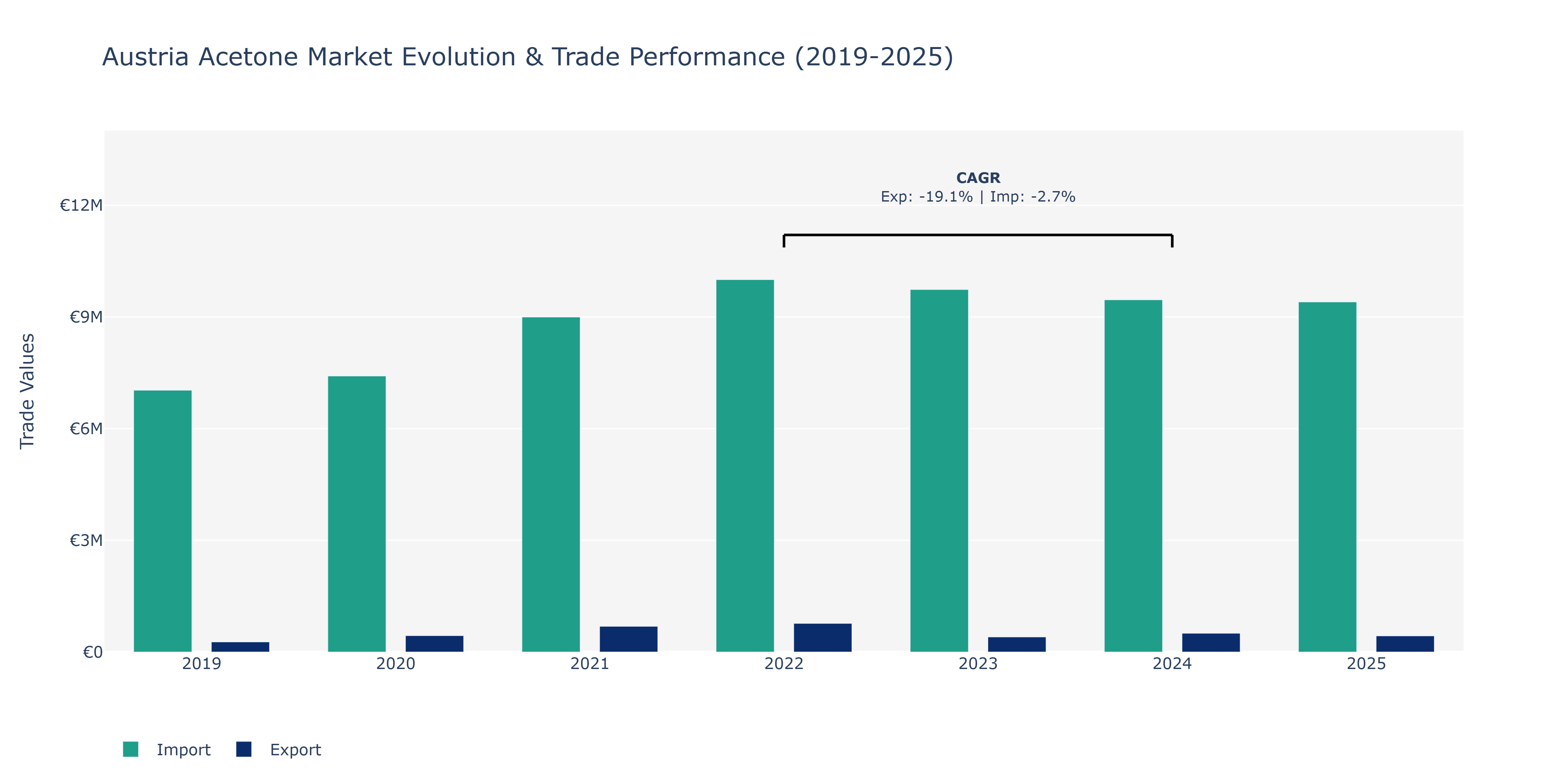
The Austria Acetone Market experienced fluctuations in both exports and imports over the analyzed period. Between 2019 and 2020, exports increased from €271.45 thousand to €441.28 thousand, marking a significant rise. This upward trend continued in 2021, reaching €691.88 thousand, the peak point during the period. However, a notable decline occurred in 2023, dropping to €405.93 thousand before slightly recovering in 2024 to €504.01 thousand. On the imports side, a similar pattern emerged with a steady increase from €7.03 million in 2019 to €7.42 million in 2020. The peak point was observed in 2022 at €10.0 million, followed by a decrease in the subsequent years. The market's dynamics can be attributed to various factors such as changes in global demand for chemical products, price fluctuations, and regulatory developments impacting trade relations with key partners like Germany and Italy, supporting these movements.
Key Highlights of the Report:
- Austria Acetone Market Outlook
- Market Size of Austria Acetone Market, 2025
- Forecast of Austria Acetone Market, 2032
- Historical Data and Forecast of Austria Acetone Revenues & Volume for the Period 2022-2032F
- Austria Acetone Market Trend Evolution
- Austria Acetone Market Drivers and Challenges
- Austria Acetone Price Trends
- Austria Acetone Porter`s Five Forces
- Austria Acetone Industry Life Cycle
- Historical Data and Forecast of Austria Acetone Market Revenues & Volume By Application for the Period 2022-2032F
- Historical Data and Forecast of Austria Acetone Market Revenues & Volume By Methyl Methacrylate (MMA) for the Period 2022-2032F
- Historical Data and Forecast of Austria Acetone Market Revenues & Volume By Bisphenol A (BPA) for the Period 2022-2032F
- Historical Data and Forecast of Austria Acetone Market Revenues & Volume By Solvents for the Period 2022-2032F
- Historical Data and Forecast of Austria Acetone Market Revenues & Volume By Others for the Period 2022-2032F
- Historical Data and Forecast of Austria Acetone Market Revenues & Volume By Distribution Channel for the Period 2022-2032F
- Historical Data and Forecast of Austria Acetone Market Revenues & Volume By Manufacturer to Distributor for the Period 2022-2032F
- Historical Data and Forecast of Austria Acetone Market Revenues & Volume By Manufacturer to End-User for the Period 2022-2032F
- Historical Data and Forecast of Austria Acetone Market Revenues & Volume By Grade for the Period 2022-2032F
- Historical Data and Forecast of Austria Acetone Market Revenues & Volume By Specialty Grade for the Period 2022-2032F
- Historical Data and Forecast of Austria Acetone Market Revenues & Volume By Technical Grade for the Period 2022-2032F
- Austria Acetone Import Export Trade Statistics
- Market Opportunity Assessment By Application
- Market Opportunity Assessment By Distribution Channel
- Market Opportunity Assessment By Grade
- Austria Acetone Top Companies Market Share
- Austria Acetone Competitive Benchmarking By Technical and Operational Parameters
- Austria Acetone Company Profiles
- Austria Acetone Key Strategic Recommendations






































