Austria Commercial Aircraft Market: Import Trend Analysis
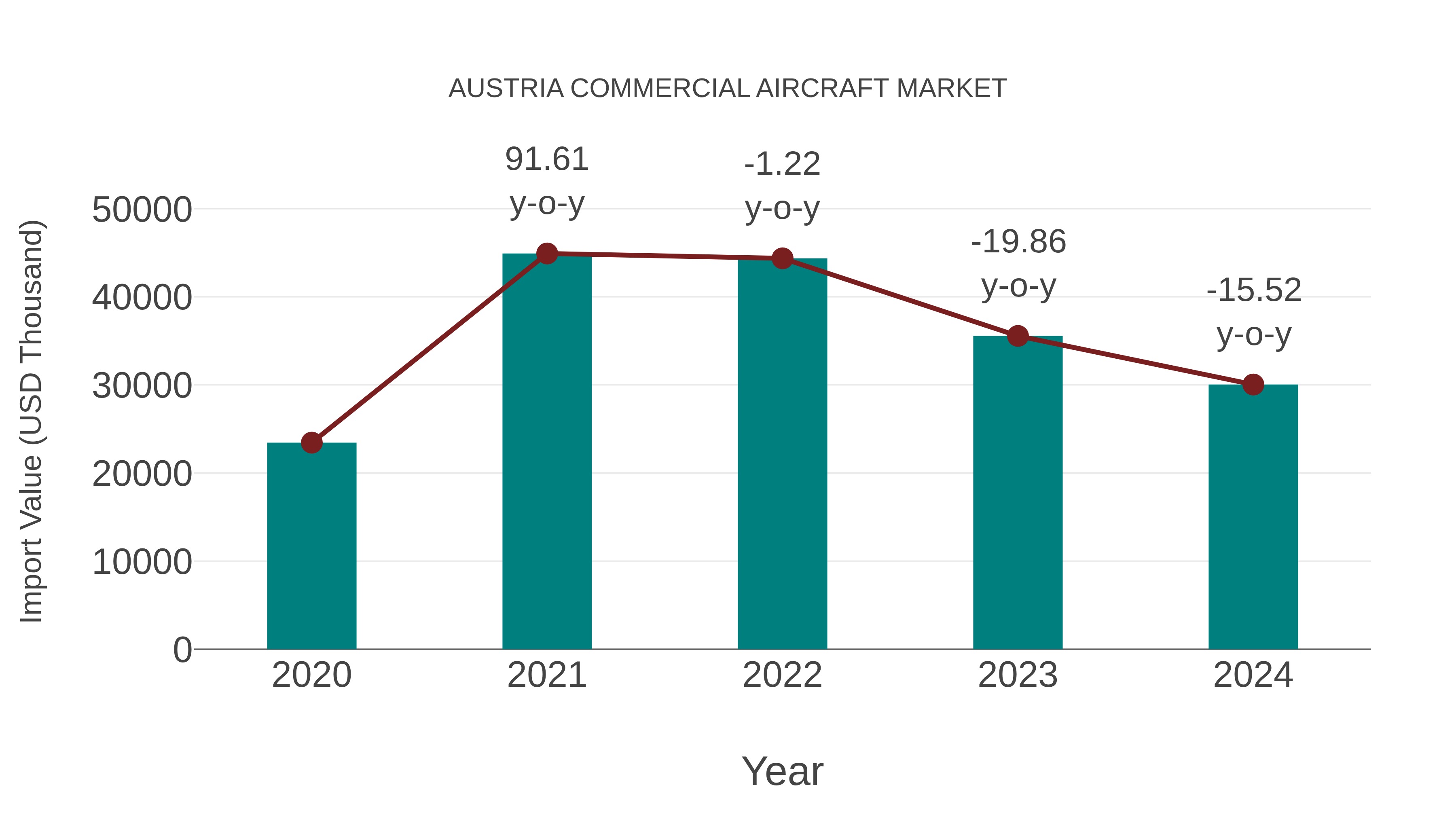
In the Austria commercial aircraft market, the import trend experienced a decline of -15.52% from 2023 to 2024, while the compound annual growth rate (CAGR) for 2020-2024 stood at 6.39%. This negative growth can be attributed to a possible shift in demand dynamics or changes in trade policies impacting import momentum.
Austria Commercial Aircraft Market Overview
The commercial aircraft market in Austria involves the procurement, leasing, and operation of passenger aircraft, regional jets, and cargo planes for airline fleets, charter services, and air cargo logistics. Commercial aircraft support air transportation, tourism industry, and global trade, providing air travel connectivity, passenger comfort, and freight logistics solutions for airlines, aircraft manufacturers, and aviation stakeholders in the aerospace industry.
Drivers of the market
The commercial aircraft market in Austria is influenced by the demand for air travel and the growth of the aviation industry. Commercial aircraft are used for passenger and cargo transportation. The market benefits from the increasing number of air passengers and the expansion of airline fleets. Innovations in aircraft technology, such as fuel-efficient engines and advanced avionics, further support market growth. The trend towards sustainable aviation, including the development of electric and hybrid aircraft, enhances the market`s potential.
Challenges of the market
The commercial aircraft market in Austria faces challenges associated with airline profitability, fleet modernization, and regulatory compliance. With demand for fuel-efficient aircraft, passenger comfort amenities, and route network expansions, airlines must navigate operational costs, aircraft leasing agreements, and customer loyalty strategies. Market players need to address aircraft safety standards, air traffic management systems, and aviation sustainability initiatives. Competition from global aircraft manufacturers, fluctuating fuel prices, and geopolitical uncertainties further influence market dynamics, driving investments in new aircraft acquisitions, fleet maintenance programs, and aviation technology innovations to enhance airline competitiveness and passenger experience.
Government Policy of the market
The commercial aircraft market in Austria benefits from policies supporting air transport infrastructure and aviation safety standards. Financial incentives encourage airlines and aircraft manufacturers to invest in fuel-efficient and technologically advanced aircraft models. Research initiatives focus on sustainable aviation biofuels and carbon-neutral flight operations, fostering innovation and supporting Austria`s aviation industry with environmentally responsible air transportation solutions.
Key Highlights of the Report:
- Austria Commercial Aircraft Market Outlook
- Market Size of Austria Commercial Aircraft Market, 2025
- Forecast of Austria Commercial Aircraft Market, 2032
- Historical Data and Forecast of Austria Commercial Aircraft Revenues & Volume for the Period 2022-2032F
- Austria Commercial Aircraft Market Trend Evolution
- Austria Commercial Aircraft Market Drivers and Challenges
- Austria Commercial Aircraft Price Trends
- Austria Commercial Aircraft Porter`s Five Forces
- Austria Commercial Aircraft Industry Life Cycle
- Historical Data and Forecast of Austria Commercial Aircraft Market Revenues & Volume By Aircraft Type for the Period 2022-2032F
- Historical Data and Forecast of Austria Commercial Aircraft Market Revenues & Volume By Narrow Body Aircrafts for the Period 2022-2032F
- Historical Data and Forecast of Austria Commercial Aircraft Market Revenues & Volume By Wide Body Aircrafts for the Period 2022-2032F
- Historical Data and Forecast of Austria Commercial Aircraft Market Revenues & Volume By Regional Jets for the Period 2022-2032F
- Historical Data and Forecast of Austria Commercial Aircraft Market Revenues & Volume By Turboprop Aircrafts for the Period 2022-2032F
- Austria Commercial Aircraft Import Export Trade Statistics
- Market Opportunity Assessment By Aircraft Type
- Austria Commercial Aircraft Top Companies Market Share
- Austria Commercial Aircraft Competitive Benchmarking By Technical and Operational Parameters
- Austria Commercial Aircraft Company Profiles
- Austria Commercial Aircraft Key Strategic Recommendations






































