Austria Electric Mobility Market: Import Trend Analysis
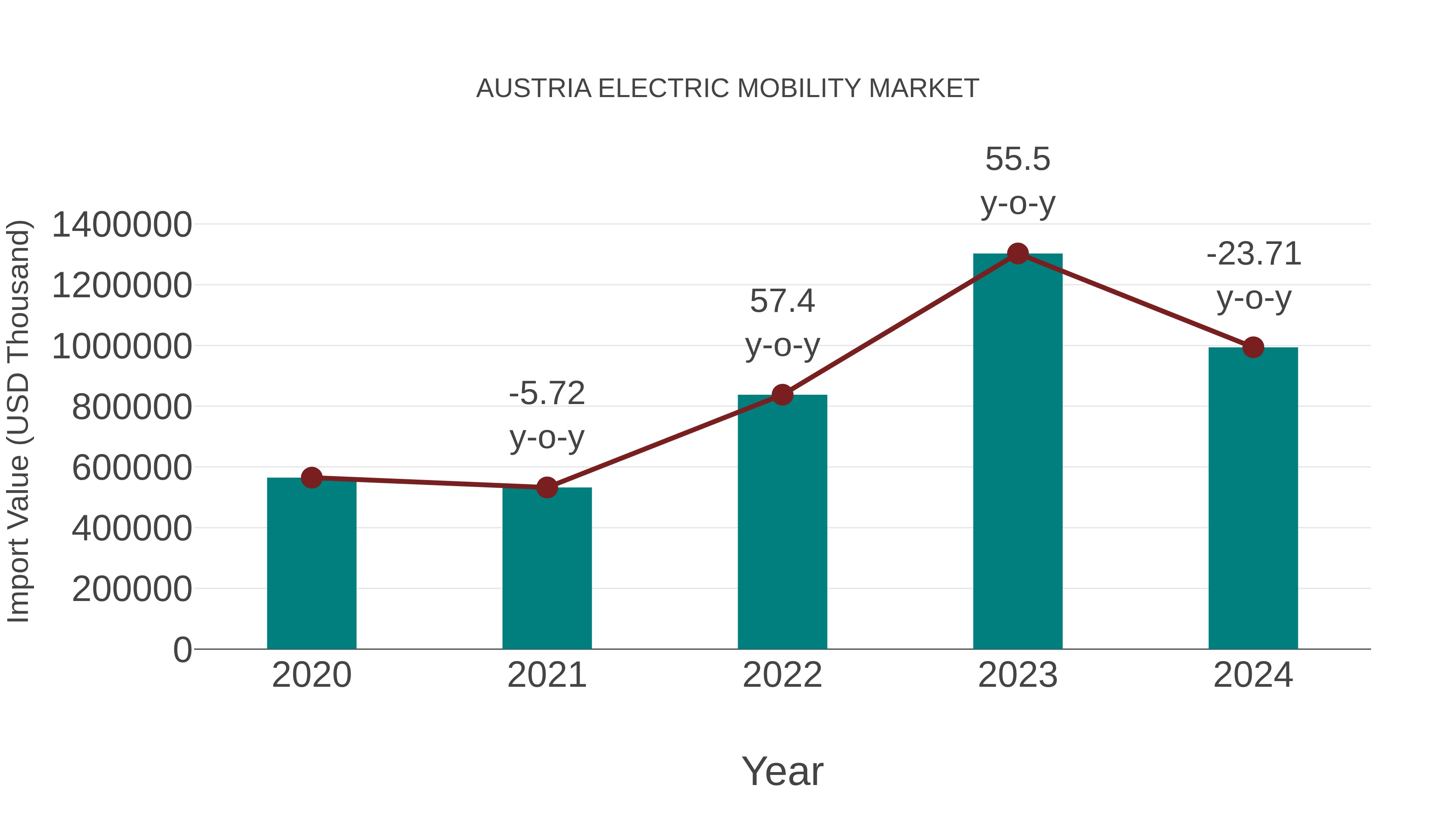
The import trend of electric mobility products in the Austria market from 2020 to 2024 exhibited a Compound Annual Growth Rate (CAGR) of 15.19%. Notably, in 2023-2024, there was a year-on-year growth rate of -23.71%. Despite the decline in 2023-2024, the overall trend showed a significant increase in imports during the period.
Austria Electric Mobility Market Overview
The Austria Electric Mobility Market is experiencing steady growth driven by increasing environmental awareness and government incentives. The country aims to have 1 million electric vehicles on the road by 2030, leading to a surge in the adoption of electric cars, bikes, and scooters. Key players in the market include BMW, Tesla, and Renault, offering a range of electric vehicle options to consumers. Austria`s well-developed charging infrastructure, with over 6,000 public charging stations, supports the growing demand for electric vehicles. Additionally, the government provides various incentives such as tax breaks, subsidies, and free parking to promote electric mobility. With a strong commitment to sustainability and reducing emissions, the Austria Electric Mobility Market is poised for further expansion in the coming years.
Austria Electric Mobility Market Trends and Opportunities
The Austria Electric Mobility Market is experiencing rapid growth driven by increasing government support, rising environmental awareness, and technological advancements. Key trends include a growing demand for electric vehicles (EVs) due to incentives such as tax benefits and subsidies, expansion of charging infrastructure to address range anxiety, and the emergence of innovative mobility solutions such as e-scooters and e-bikes. Opportunities in the market lie in the development of sustainable transportation options, collaboration between automakers and energy companies to create integrated solutions, and leveraging data analytics for efficient fleet management. Additionally, the shift towards electric mobility presents opportunities for industries like renewable energy and battery manufacturing to expand their presence in Austria`s market. Overall, the electric mobility sector in Austria is poised for continued growth and investment.
Austria Electric Mobility Market Challenges
In the Austria Electric Mobility Market, several challenges are faced, including infrastructure development for charging stations, range anxiety among consumers, high upfront costs of electric vehicles (EVs), and the need for government support and incentives to promote adoption. The limited availability of charging stations and the time needed for recharging also pose challenges for EV users. Additionally, concerns about battery technology, such as limited battery life and environmental impact, hinder widespread acceptance of electric vehicles. Overcoming these challenges will require collaborative efforts from the government, private sector, and consumers to invest in infrastructure, develop more affordable EV options, and provide incentives to make electric mobility a more viable and sustainable choice in Austria.
Austria Electric Mobility Market Drivers
The Austria Electric Mobility Market is being driven by several key factors. Government initiatives and policies promoting electric vehicles, such as incentives and subsidies for buyers, tax benefits, and investment in charging infrastructure, are playing a significant role in increasing adoption. Rising environmental concerns and the need to reduce greenhouse gas emissions are also driving the shift towards electric mobility. Technological advancements in electric vehicle technology, leading to improved performance, longer battery life, and lower costs, are making electric vehicles more attractive to consumers. Additionally, increasing awareness about the benefits of electric vehicles, such as lower operating costs and reduced dependence on fossil fuels, is further propelling the growth of the electric mobility market in Austria.
Austria Electric Mobility Market Government Policy
The Austrian government has implemented various policies to promote the growth of the electric mobility market. These include financial incentives such as subsidies for the purchase of electric vehicles, reduced taxes for electric cars, and funding for the development of charging infrastructure. Additionally, there are regulations in place to encourage the installation of charging stations in public spaces and commercial buildings. The government has set ambitious targets to increase the number of electric vehicles on the road, aiming for a significant share of electric cars in the total vehicle fleet by 2030. These policies demonstrate Austria`s commitment to sustainability and reducing greenhouse gas emissions through the promotion of electric mobility.
Austria Electric Mobility Market Future Outlook
The future outlook for the Austria Electric Mobility Market appears promising as the country aims to reduce greenhouse gas emissions and promote sustainable transportation solutions. The government has set ambitious targets to increase the number of electric vehicles on the road, supported by incentives such as subsidies and tax breaks. Additionally, a growing awareness of environmental issues and advancements in electric vehicle technology are driving consumer interest in electric vehicles. As infrastructure for charging stations continues to improve and battery technology advances, the Austria Electric Mobility Market is expected to experience significant growth in the coming years. Overall, the market is poised for expansion with opportunities for electric vehicle manufacturers, charging infrastructure providers, and related industries.
Key Highlights of the Report:
- Austria Electric Mobility Market Outlook
- Market Size of Austria Electric Mobility Market, 2025
- Forecast of Austria Electric Mobility Market, 2032
- Historical Data and Forecast of Austria Electric Mobility Revenues & Volume for the Period 2022 - 2032F
- Austria Electric Mobility Market Trend Evolution
- Austria Electric Mobility Market Drivers and Challenges
- Austria Electric Mobility Price Trends
- Austria Electric Mobility Porter's Five Forces
- Austria Electric Mobility Industry Life Cycle
- Historical Data and Forecast of Austria Electric Mobility Market Revenues & Volume By Product for the Period 2022 - 2032F
- Historical Data and Forecast of Austria Electric Mobility Market Revenues & Volume By Electric Bikes for the Period 2022 - 2032F
- Historical Data and Forecast of Austria Electric Mobility Market Revenues & Volume By Electric Scooters for the Period 2022 - 2032F
- Historical Data and Forecast of Austria Electric Mobility Market Revenues & Volume By Electric Motorized Scooters for the Period 2022 - 2032F
- Historical Data and Forecast of Austria Electric Mobility Market Revenues & Volume By Electric Motorcycles for the Period 2022 - 2032F
- Historical Data and Forecast of Austria Electric Mobility Market Revenues & Volume By Drive for the Period 2022 - 2032F
- Historical Data and Forecast of Austria Electric Mobility Market Revenues & Volume By Belt Drive for the Period 2022 - 2032F
- Historical Data and Forecast of Austria Electric Mobility Market Revenues & Volume By Chain Drive for the Period 2022 - 2032F
- Historical Data and Forecast of Austria Electric Mobility Market Revenues & Volume By Hub Drive for the Period 2022 - 2032F
- Historical Data and Forecast of Austria Electric Mobility Market Revenues & Volume By Battery for the Period 2022 - 2032F
- Historical Data and Forecast of Austria Electric Mobility Market Revenues & Volume By Lead Acid Battery for the Period 2022 - 2032F
- Historical Data and Forecast of Austria Electric Mobility Market Revenues & Volume By Li-Ion Battery for the Period 2022 - 2032F
- Historical Data and Forecast of Austria Electric Mobility Market Revenues & Volume By End-use for the Period 2022 - 2032F
- Historical Data and Forecast of Austria Electric Mobility Market Revenues & Volume By Personal for the Period 2022 - 2032F
- Historical Data and Forecast of Austria Electric Mobility Market Revenues & Volume By Commercial for the Period 2022 - 2032F
- Austria Electric Mobility Import Export Trade Statistics
- Market Opportunity Assessment By Product
- Market Opportunity Assessment By Drive
- Market Opportunity Assessment By Battery
- Market Opportunity Assessment By End-use
- Austria Electric Mobility Top Companies Market Share
- Austria Electric Mobility Competitive Benchmarking By Technical and Operational Parameters
- Austria Electric Mobility Company Profiles
- Austria Electric Mobility Key Strategic Recommendations






































